
Introduction
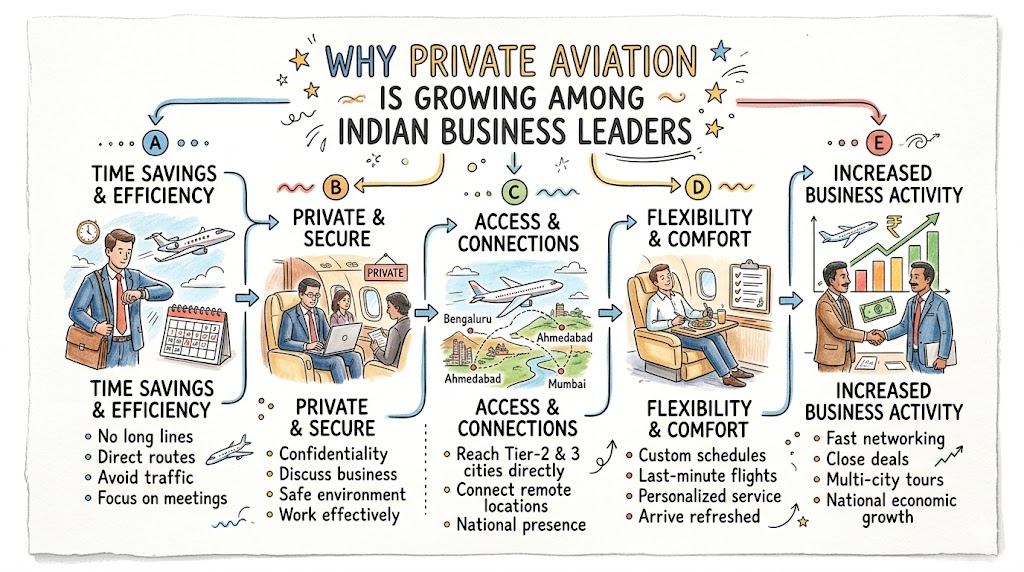
In recent years, private aviation has emerged as a preferred mode of travel for Indian business leaders, entrepreneurs, and corporate executives. As India’s economy grows and businesses expand into multiple cities and international markets, the need for efficient, flexible, and secure travel has increased dramatically. Unlike commercial flights, private aviation offers exclusive cabins, flexible schedules, access to regional airports, and enhanced productivity, making it an ideal solution for high-level executives with demanding travel requirements.
Business leaders in India face unique challenges, including congested commercial airports, limited direct flight options to secondary cities, and time-sensitive meetings. Private aviation addresses these challenges by providing tailored solutions that save time, maintain privacy, and allow executives to work or conduct confidential meetings while in transit. This combination of efficiency, convenience, and comfort is driving a steady growth in the adoption of private aviation across corporate India.
Real-World Use Cases
The increasing popularity of private aviation is driven by practical business needs:
- CEOs traveling between multiple cities for meetings in a single day without relying on commercial flight schedules.
- Entrepreneurs managing urgent client visits, allowing flexibility for last-minute itinerary changes.
- Corporate teams traveling together to attend conferences, board meetings, or site inspections efficiently.
- VIP travelers seeking discretion during sensitive negotiations or high-profile trips.
- International business travelers who want direct access to smaller or regional airports near business hubs.
- Leaders aiming to minimize downtime, ensuring that travel time is used productively.
- Business families or high-net-worth individuals who prioritize comfort, luxury, and privacy during travel.
Evaluation Criteria for Business Leaders
Before choosing private aviation, Indian business leaders should consider key evaluation factors:
- Fleet availability and aircraft type suitable for solo or group travel
- Private terminal access and airport flexibility
- Cabin comfort, seating configuration, and onboard amenities
- Experienced crew and safety certifications
- Flight scheduling flexibility and multi-city routing
- Operational reliability and maintenance standards
- Cost versus value, including time savings and productivity gains
- Baggage handling and special cargo accommodation
- Onboard connectivity for calls and work
- Discretion, privacy, and security measures
- Group travel arrangements for corporate teams
Best for
This guide is best for Indian business leaders, corporate executives, entrepreneurs, VIPs, and corporate travel planners who want to optimize efficiency, comfort, and productivity while traveling for business.
Not Ideal for
Private aviation may not be ideal for budget-conscious travelers, leisure passengers, or individuals who prioritize cost over time and privacy. It is designed for executives and teams seeking efficiency, flexibility, and a premium travel experience.
Key Drivers for Private Aviation Growth in India
1- Time Savings and Efficiency
Private jets allow executives to bypass long security checks, commercial boarding procedures, and layovers, providing direct and faster access to destinations. This is especially valuable for multi-city itineraries or urgent meetings.
2- Flexible Scheduling
Unlike commercial airlines, private aviation provides complete control over departure and arrival times, enabling leaders to adapt to last-minute schedule changes or meet tight business deadlines.
3- Privacy and Confidentiality
Private aircraft offer exclusive cabins, allowing business leaders to conduct sensitive discussions, confidential meetings, and strategic planning without exposure to other passengers or airport crowds.
4- Safety and Maintenance Standards
Operators adhere to strict safety regulations and maintenance protocols, ensuring that aircraft, crew, and operations meet or exceed industry standards.
5- Comfort and Luxury
Cabins feature custom seating, catering options, entertainment, and advanced amenities, creating a comfortable environment that supports both work and relaxation.
6- Regional Connectivity
Private jets can access secondary airports and regional destinations that are not served by commercial airlines, enabling executives to reach emerging business hubs and remote locations efficiently.
7- Business Productivity
With quiet cabins, Wi-Fi connectivity, and flexible seating arrangements, executives can use travel time to hold meetings, work on documents, or make calls, maximizing productivity.
8- Cost-Benefit Considerations
Although private aviation has higher upfront costs, the value in time savings, efficiency, and productivity often outweighs ticket prices, especially for frequent or high-stakes business travel.
9- Group Travel Advantages
Corporate teams or project groups can travel together in one aircraft, simplifying logistics, coordinating meetings, and reducing the administrative burden of multiple bookings.
10- Trend of Corporate Aviation in India
Rising adoption is fueled by economic growth, increasing international business, a growing number of high-net-worth individuals, and awareness of efficiency gains, making private aviation a strategic choice for business leaders.
Comparison Table: Private Aviation vs Commercial Business Travel
| Feature | Private Aviation | Commercial Business Travel | Key Advantage |
|---|---|---|---|
| Departure Flexibility | Full control over schedule | Airline timetable dependent | Saves time, fits business needs |
| Airport Access | Regional/private airports | Major commercial hubs only | Reduces ground travel time |
| Cabin Privacy | Exclusive cabin | Shared with other passengers | Allows confidential discussions |
| Productivity | Onboard workspaces and meetings | Limited workspace | Enhances in-flight efficiency |
| Group Travel | Teams travel together | Multiple seat bookings | Streamlines coordination |
| Comfort & Amenities | Customized luxury and service | Airline-provided premium | Tailored comfort |
| Time Savings | Avoids security and layovers | Subject to delays | Maximizes productive time |
| Safety | Rigorous maintenance and certified crews | Airline standards | High operational safety |
Tips for Choosing Private Aviation in India
- Verify operator safety certifications and reputation
- Evaluate aircraft type and cabin configuration
- Confirm private terminal and airport access
- Check onboard connectivity, Wi-Fi, and amenities
- Compare cost versus business value
- Assess scheduling flexibility and reliability
- Consider group or team travel requirements
- Plan for last-minute or urgent travel
Common Mistakes Business Leaders Should Avoid
- Choosing operators based only on cost
- Ignoring crew or aircraft credentials
- Overlooking privacy and security needs
- Failing to plan multi-city itineraries efficiently
- Skipping group travel arrangements
- Booking too late during peak travel periods
- Underestimating airport accessibility
- Not confirming amenities and connectivity
- Ignoring maintenance and safety records
- Neglecting total journey time and productivity value
Frequently Asked Questions
1. Why is private aviation growing among Indian business leaders?
Business leaders increasingly value time efficiency, privacy, flexibility, and productivity, which commercial flights cannot always provide.
2. What are the main advantages over commercial flights?
Private jets offer exclusive cabins, flexible schedules, regional airport access, and tailored services, enhancing comfort and efficiency.
3. Can executives save time with private jets in India?
Yes, by avoiding long security lines, layovers, and boarding procedures, private aviation significantly reduces total travel time.
4. Are private jets safe for corporate travel?
Private operators follow strict safety and maintenance standards, ensuring safe and reliable operations for high-level executives.
5. How does private aviation support confidentiality?
Exclusive cabins allow private discussions, board meetings, and strategic conversations without exposure to other passengers or airport staff.
6. Is it cost-effective for frequent corporate travelers?
While upfront costs are higher, the time saved, operational efficiency, and business productivity often justify private aviation for frequent travelers.
7. Can business teams travel together on one aircraft?
Yes, private jets can accommodate groups or corporate teams, streamlining logistics and coordination.
8. How flexible are flight schedules?
Private jets allow travelers to choose departure and arrival times, including same-day adjustments for urgent business needs.
9. Do private jets offer connectivity and onboard productivity?
Yes, most aircraft are equipped with Wi-Fi, workspaces, and communication tools, enabling executives to remain productive in-flight.
10. What factors should Indian leaders consider when selecting private aviation?
Leaders should assess operator credentials, aircraft type, safety records, private terminal access, amenities, cost versus value, and schedule flexibility.
Conclusion
Private aviation in India is growing rapidly because it provides executives and business leaders with unmatched efficiency, privacy, comfort, and productivity. By enabling flexible scheduling, access to regional airports, and in-flight productivity, private jets allow leaders to maximize time, reduce travel stress, and maintain discretion. For corporate teams, entrepreneurs, and VIPs, private aviation is not just a luxury—it is a strategic business tool that supports operational excellence and ensures every journey is both efficient and effective.
