
Introduction
Private jet travel has transformed the way corporate executives approach business trips, offering unmatched efficiency, flexibility, and comfort. For top-level decision-makers, time is money, and every delay can impact strategic outcomes. Private jets provide a solution that goes beyond commercial airlines, allowing executives to maximize productivity, maintain privacy, and travel on their own schedule. Choosing private air travel is no longer a luxury but a strategic business advantage for executives who value efficiency, safety, and seamless travel experiences.
Real-world Use Cases
Corporate executives often need to attend meetings across multiple cities in a single day, visit clients in remote locations, or make last-minute business trips that commercial airlines cannot accommodate. For example, a CEO managing international mergers can schedule meetings in Toronto, New York, and Chicago within 24 hours using a private jet, something nearly impossible with commercial flights. Similarly, executives attending confidential board meetings benefit from the privacy and security of private travel, avoiding crowded terminals and potential leaks of sensitive discussions.
Evaluation Criteria for Executives
When considering private jet travel, executives evaluate factors such as flight availability, flexibility, on-board amenities, safety standards, cost-efficiency relative to time saved, and the ability to conduct business during transit. Companies may weigh the return on investment for repeated trips, considering how private travel reduces downtime, missed connections, and travel fatigue, enabling leaders to remain productive and focused.
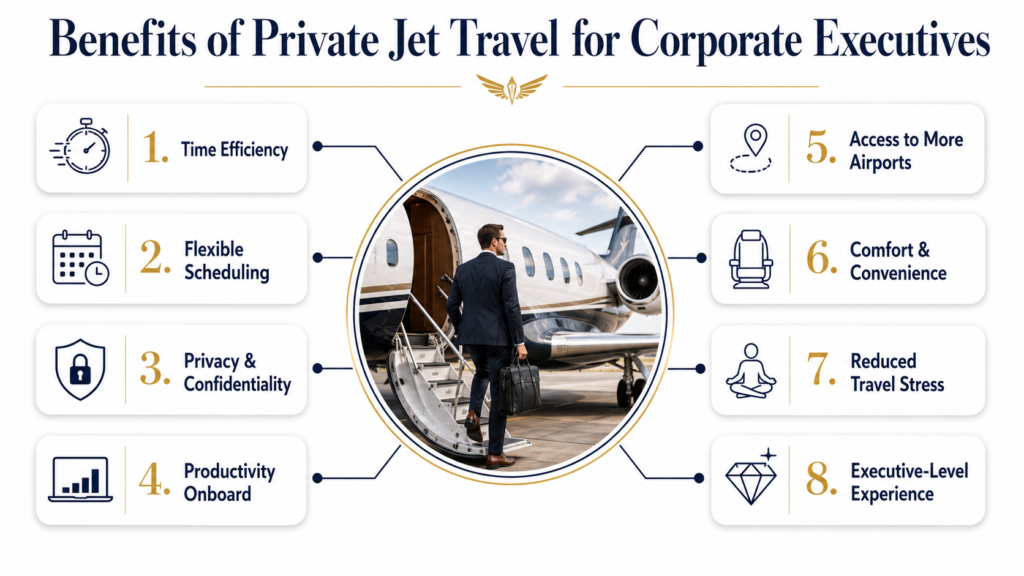
Key Benefits of Private Jet Travel
1- Time Efficiency
Private jets allow executives to depart on-demand without waiting in long airport queues or adhering to commercial flight schedules. Boarding takes minutes, and direct flights eliminate layovers, significantly reducing travel time and ensuring executives reach destinations promptly.
2- Flexibility and Custom Schedules
Executives can adjust departure times at short notice, reroute flights if meetings change, and schedule multi-city trips without logistical constraints. This flexibility ensures that critical business decisions are not compromised by rigid airline timetables.
3- Enhanced Productivity
Private jets are equipped with Wi-Fi, workstations, and private cabins, allowing executives to conduct calls, review documents, and hold confidential discussions mid-flight. This transforms travel time into productive business hours.
4- Privacy and Confidentiality
Corporate travel often involves sensitive discussions. Private jets provide a secure, closed environment, reducing the risk of information leaks and maintaining confidentiality in high-stakes negotiations or strategic meetings.
5- Comfort and Health
Spacious seating, controlled cabin environment, and personalized services reduce travel fatigue, allowing executives to arrive refreshed and focused. This is particularly valuable for long-haul international travel where rest and comfort impact decision-making.
6- Networking Opportunities
Private jet travel often brings executives together in a controlled environment, fostering networking, collaboration, and relationship-building with other business leaders during flights.
7- Remote and International Access
Executives can reach airports closer to clients or project sites, avoiding secondary transportation delays. This is ideal for remote locations or international hubs that are underserved by commercial airlines.
8- Operational Efficiency and Reliability
Private jets minimize the impact of flight cancellations, delays, or airport congestion. With dedicated crews and flexible schedules, executives maintain operational continuity and avoid missed opportunities.
Comparison with Commercial Travel
While commercial airlines are cost-effective for routine travel, they rarely accommodate the unique time constraints, privacy needs, or schedule flexibility required by high-level executives. Private jet travel converts hours of waiting into productive work time, ensures confidentiality, and allows direct travel to destinations that commercial airlines may not serve efficiently.
Practical Tips for Corporate Executives
- Booking Strategy: Partner with reputable private jet operators who provide on-demand scheduling and reliable service.
- Cost Consideration: Evaluate trips based on time saved versus operating costs; short-term charters often deliver the best ROI.
- Operational Planning: Coordinate ground transportation in advance and leverage executive concierges to maximize seamless travel.
FAQs
1- Is private jet travel only for the ultra-rich?
Not necessarily. Companies of various sizes use private jet services for strategic business trips, and fractional ownership or on-demand charters make it accessible for corporate executives seeking efficiency.
2- How safe is private jet travel compared to commercial flights?
Private jets adhere to strict aviation regulations, often with newer aircraft and dedicated crews, offering safety standards equal to or exceeding commercial aviation.
3- Can executives work effectively during flights?
Yes. Private jets are equipped with Wi-Fi, conference tables, and private spaces, enabling productive work and confidential meetings while in transit.
4- Are last-minute flights possible?
Absolutely. One of the key advantages of private jets is the ability to schedule flights on-demand, accommodating urgent business needs and schedule changes.
5- Does private jet travel save time overall?
Yes. Boarding, security, and check-in are minimal, direct flights are available, and executives avoid layovers, translating into significant time savings.
6- How do costs compare with commercial flights?
While private jets are more expensive upfront, the time saved, increased productivity, and operational flexibility often result in higher ROI for executives on critical trips.
7- Is privacy guaranteed onboard?
Private jets provide secure environments, with limited crew and passengers, ensuring sensitive discussions remain confidential.
8- Can private jets reach smaller or remote airports?
Yes. Many private jets can access airports not served by commercial airlines, bringing executives closer to clients or project sites.
9- Are there health benefits to private travel?
Yes. Reduced exposure to crowded terminals and personalized cabin environments minimize stress, fatigue, and risk of illness during travel.
10- How does private jet travel improve networking?
Executives often travel with colleagues or other leaders in private settings, fostering collaboration, informal meetings, and relationship-building during flights.
Conclusion
Private jet travel is a strategic tool for corporate executives, providing unparalleled efficiency, flexibility, and privacy. By reducing travel time, enhancing productivity, and ensuring comfort, private jets allow executives to focus on what truly matters: making critical business decisions and maintaining a competitive edge. For any corporate leader who values time, confidentiality, and operational reliability, private air travel is not just a luxury—it is an essential component of modern executive strategy. Considering these benefits, executives can plan smarter trips, optimize their schedules, and turn travel time into productive, stress-free experiences.
