
Introduction
On-demand charter travel offers a level of flexibility, privacy, comfort, and convenience that scheduled airline services cannot always provide. Instead of following a fixed timetable, travelers can arrange an aircraft according to their preferred route, departure time, passenger count, baggage requirements, and onboard preferences.
This makes on-demand charter especially valuable for business executives, corporate teams, families, medical travelers, event organizers, luxury travelers, and clients who need to reach destinations that are not easily served by commercial airlines.
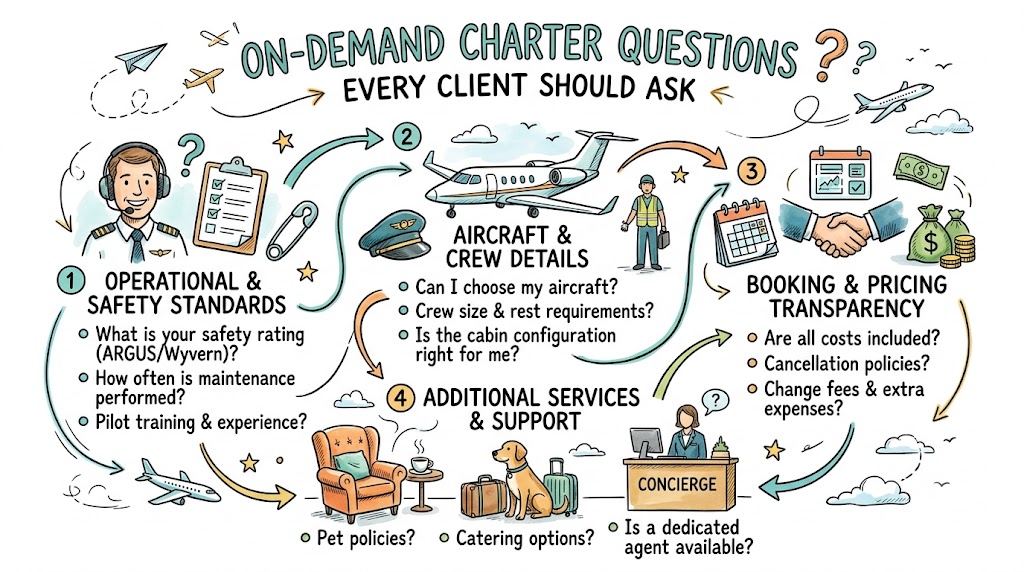
However, booking a charter flight involves more than choosing an aircraft and accepting a quotation. Every charter arrangement includes operational, safety, legal, pricing, scheduling, baggage, and service considerations that clients should understand before making payment.
Asking the right questions helps travelers compare options properly, avoid unexpected charges, understand who is operating the flight, and select an aircraft that is suitable for the journey.
What Is an On-Demand Charter Flight?
An on-demand charter flight is a private flight arranged according to the specific travel requirements of a client.
Unlike scheduled airlines, where passengers select from fixed routes and departure times, an on-demand charter allows the client to request a journey based on:
- Preferred departure location
- Preferred destination
- Desired departure time
- Number of passengers
- Baggage requirements
- Aircraft preference
- Catering needs
- Ground transportation
- Special assistance
The aircraft is arranged for the requested journey, subject to availability, airport suitability, regulatory approval, weather, and operational conditions.
On-demand charter can be used for domestic and international travel. Depending on the route and passenger requirements, clients may choose from turboprops, light jets, midsize jets, heavy jets, helicopters, or other suitable aircraft.
How On-Demand Charter Differs from Commercial Air Travel
Commercial airlines operate according to published schedules and fixed routes. Passengers usually travel through major airports, follow standard check-in procedures, and share the aircraft with other travelers.
On-demand charter provides a more customized experience.
Clients may benefit from:
- Flexible departure times
- Access to smaller airports
- Private cabin space
- Faster boarding procedures
- Direct routes where operationally possible
- Customized catering
- Dedicated ground support
- Greater control over the itinerary
The actual experience depends on the aircraft, operator, airport, route, and services included in the agreement.
How On-Demand Charter Differs from Jet Cards and Fractional Ownership
On-demand charter is generally arranged flight by flight. The client pays for the specific trip without making a long-term aircraft ownership commitment.
Jet cards usually involve purchasing a set number of flight hours or access under predefined conditions.
Fractional ownership allows a client to purchase a share in an aircraft program and receive flight access under the terms of that arrangement.
On-demand charter may be suitable for clients who fly occasionally, require different aircraft types for different journeys, or prefer to avoid long-term commitments.
Why Asking the Right Questions Matters
Private charter can simplify travel, but clients should never assume that every provider, quotation, aircraft, or service arrangement is the same.
Asking detailed questions helps clients understand:
- Who will actually operate the flight
- Whether the operator is properly authorized
- Which aircraft will be used
- Whether the aircraft is suitable for the route
- What the quotation includes
- Which charges may change
- What happens during delays or cancellations
- How baggage and special requests will be handled
- What backup arrangements are available
- What documents are required
A clear discussion before booking reduces confusion and helps clients make informed decisions.
1. Who Will Operate the Aircraft?
This is one of the most important questions to ask.
The company arranging the flight may not always be the company operating the aircraft. A booking may involve:
- A charter broker
- A travel platform
- An aircraft owner
- An aircraft management company
- A licensed charter operator
The actual operator is responsible for conducting the flight.
Before booking, ask for:
- The legal name of the operator
- The aircraft registration details when available
- The operator’s contact information
- Confirmation of who holds operational responsibility
- The name of the company listed in the charter agreement
Understanding the difference between the broker and the operator helps clients know who is responsible for the aircraft, crew, maintenance, and flight operations.
2. Is the Operator Properly Licensed?
Clients should confirm that the operator is authorized to conduct commercial charter flights under the applicable aviation regulations.
Do not rely only on promotional claims. Ask the provider to explain:
- Which authority regulates the operation
- What approval allows the aircraft to conduct charter flights
- Whether the proposed aircraft is approved for the requested service
- Whether the route requires additional permissions
- Whether international operations require specific permits
Licensing requirements differ by country and type of operation. A professional provider should be able to answer these questions clearly.
3. What Is the Operator’s Safety Record?
Safety should always be a priority when selecting a charter provider.
Clients can ask about:
- The operator’s operating history
- Internal safety management practices
- Pilot training procedures
- Aircraft inspection programs
- Maintenance arrangements
- Incident reporting systems
- Operational risk assessment
- Independent safety evaluations when applicable
A client does not need to be an aviation expert to ask reasonable safety questions.
The goal is to understand whether the operator follows organized procedures, maintains proper documentation, and communicates openly about safety.
4. What Aircraft Will Be Used?
Ask for the exact aircraft model proposed for the flight.
Important details include:
- Aircraft manufacturer and model
- Passenger capacity
- Cabin layout
- Aircraft range
- Baggage capacity
- Cabin height
- Washroom availability
- Seating configuration
- Year of refurbishment if relevant
- Cabin amenities
- Aircraft registration when available
Different aircraft in the same category can offer very different cabin sizes, luggage capacity, and onboard facilities.
Clients should review the aircraft details instead of relying only on broad descriptions such as light jet, midsize jet, or luxury aircraft.
5. Is the Aircraft Suitable for My Route?
An aircraft may look attractive but still be unsuitable for a particular journey.
Suitability depends on:
- Flight distance
- Passenger count
- Baggage weight
- Runway length
- Airport elevation
- Weather conditions
- Fuel requirements
- Required fuel stops
- Airport restrictions
- Cabin comfort expectations
For example, an aircraft may technically complete a route but require a fuel stop when fully loaded. Another aircraft may offer a nonstop flight with more baggage capacity.
Ask the provider to explain why the proposed aircraft is appropriate for the requested journey.
6. Are Aircraft Substitutions Allowed?
Charter agreements often allow aircraft substitutions in certain situations.
Substitution may become necessary because of:
- Technical issues
- Maintenance requirements
- Weather disruption
- Crew availability
- Previous flight delays
- Operational restrictions
Ask:
- Can the original aircraft be replaced?
- Will the replacement be in the same category?
- Can a smaller aircraft be substituted?
- Will cabin amenities remain comparable?
- Will the price change?
- Can the client reject the replacement?
- What happens if no suitable aircraft is available?
The substitution policy should be clearly explained before payment.
7. Who Are the Pilots?
Clients can ask reasonable questions about the assigned crew.
Useful questions include:
- Are two pilots assigned?
- Are the pilots licensed for the aircraft type?
- How much experience do they have on the aircraft?
- How recently have they flown the aircraft model?
- What recurrent training do they complete?
- How are duty-time limitations managed?
- Is additional crew required for long flights?
Pilot names may not always be available at the early booking stage, but the operator should be able to explain its crew qualification standards.
8. How Is the Aircraft Maintained?
Aircraft maintenance is essential for safe and reliable operations.
Ask about:
- Scheduled inspection programs
- Preventive maintenance
- Maintenance providers
- Technical documentation
- Defect reporting
- Component replacement
- Airworthiness status
- Maintenance release procedures
Clients should avoid making assumptions based only on aircraft appearance. A well-maintained aircraft is supported by complete records, approved inspections, and qualified maintenance personnel.
9. What Is Included in the Charter Price?
A charter quotation should clearly explain what is included.
Possible inclusions may cover:
- Aircraft flying charges
- Fuel
- Crew
- Airport handling
- Landing fees
- Basic catering
- Taxes
- Passenger service charges
- Standard ground support
- Overnight crew expenses
- Parking
Never assume that every quotation includes the same items.
Ask for a written breakdown so that you can compare offers accurately.
10. Are There Any Additional or Variable Charges?
Some charges may change depending on the final operation.
Ask whether additional costs may apply for:
- Flight delays
- Extended waiting time
- Extra airport parking
- Route changes
- Passenger changes
- Additional baggage
- Special catering
- Ground transportation
- International permits
- De-icing
- Overnight crew accommodation
- Airport opening extensions
- Diversions
- Additional fuel stops
A professional quotation should explain which charges are fixed and which may vary.
11. Is the Price Fixed or Estimated?
Some charter prices are firm, while others are based on estimates.
Ask the provider:
- Is the quoted amount guaranteed?
- Can fuel prices affect the total?
- Can airport charges change?
- Does a schedule change affect the cost?
- Are taxes included?
- What happens if the route changes?
- Are additional flight hours billed separately?
Understanding whether the price is fixed or estimated helps clients plan the total travel budget.
12. What Is the Cancellation and Refund Policy?
Cancellation terms should be reviewed before confirming the booking.
Ask about:
- Cancellation fees
- Refund eligibility
- Rescheduling options
- Credit validity
- Operator cancellation
- Weather cancellation
- Aircraft unavailability
- Passenger no-show
- International permit delays
- Force majeure conditions
Some bookings may become non-refundable after a particular stage.
The policy should be provided in writing.
13. What Happens If the Aircraft Becomes Unavailable?
Aircraft can become unavailable due to technical, operational, maintenance, or scheduling issues.
Ask the provider:
- Will a replacement aircraft be arranged?
- Will the replacement meet similar standards?
- Who pays any additional cost?
- Can the client accept or reject the replacement?
- Is a refund available?
- How quickly will the client be informed?
- Is there a backup aircraft plan?
Clear backup arrangements are especially important for time-sensitive business or medical travel.
14. What Happens During Bad Weather?
Weather can affect any flight, including private charter.
Possible outcomes include:
- Delayed departure
- Route change
- Alternate airport
- Fuel stop
- Diversion
- Overnight stay
- Rescheduling
- Cancellation
Ask who decides whether the flight can operate and how clients will be updated.
Safety-based decisions must always take priority over schedule convenience.
15. How Much Baggage Can Passengers Carry?
Baggage limits depend on the aircraft.
Factors include:
- Number of passengers
- Total weight
- Bag dimensions
- Storage compartment size
- Cabin baggage space
- Fuel requirements
- Route length
A jet may carry several passengers comfortably but have limited room for large suitcases.
Clients should provide accurate baggage information before booking.
16. Can I Carry Oversized or Special Baggage?
Special baggage should always be declared in advance.
Examples include:
- Golf equipment
- Musical instruments
- Medical devices
- Product samples
- Sports equipment
- Fragile items
- Camera equipment
- Large suitcases
- Wheelchairs
Ask whether the aircraft can accommodate the item and whether any additional handling or documentation is required.
17. Are Pets Allowed on the Flight?
Pet travel policies vary by operator, aircraft, route, and destination.
Ask about:
- Whether pets are permitted
- Required health documents
- Vaccination records
- Cabin arrangements
- Carrier requirements
- Cleaning charges
- International entry rules
- Size restrictions
- Number of pets allowed
Pet documentation can take time to arrange, especially for international travel.
18. What Catering Options Are Available?
Catering can range from simple refreshments to customized meals.
Ask about:
- Standard catering
- Premium meals
- Vegetarian options
- Vegan meals
- Religious dietary requirements
- Allergy-sensitive meals
- Children’s meals
- Celebration cakes
- Beverage preferences
- Catering charges
Requests should be submitted early, especially for departures from smaller airports.
19. Can Ground Transportation Be Arranged?
Many clients need transportation before departure and after arrival.
Ask whether the provider can arrange:
- Chauffeur service
- Hotel transfers
- Office transfers
- Security vehicles
- Medical transport
- Event transportation
- Multi-city coordination
- Airport-side vehicle access where permitted
Confirm whether ground transportation is included or charged separately.
20. Which Airports Can the Aircraft Use?
Private aviation can access many airports that scheduled airlines do not serve, but not every aircraft can use every airport.
Airport suitability depends on:
- Runway length
- Runway surface
- Airport operating hours
- Customs facilities
- Immigration facilities
- Night landing approval
- Aircraft weight
- Local restrictions
- Weather
- Parking availability
Ask which departure and arrival airports are operationally suitable and whether another airport may reduce total travel time.
21. What Documents Will Passengers Need?
Passenger documentation depends on the route.
Possible requirements include:
- Government identification
- Passport
- Visa
- Passenger manifest
- Customs declaration
- Medical documents
- Pet documents
- Travel authorization
- Invitation documents
- Health records
International flights may require more advance coordination than domestic flights.
Provide accurate passenger details early to avoid delays.
22. How Early Should Passengers Arrive?
Private charter boarding is often faster than commercial travel, but arrival timing varies.
It may depend on:
- Airport procedures
- Security screening
- Customs
- Immigration
- International documentation
- Special baggage
- Ground handling
- Passenger assistance
Ask for the recommended reporting time instead of assuming that passengers can arrive immediately before departure.
23. Is In-Flight Wi-Fi Available?
Not every aircraft offers Wi-Fi.
Ask:
- Is connectivity installed?
- Is it available on the entire route?
- Is there an additional fee?
- Is the connection suitable for email?
- Can passengers make calls?
- Can it support video meetings?
- Are there data limits?
Connectivity can vary by aircraft, location, altitude, and service provider.
24. What Cabin Amenities Are Included?
Cabin amenities vary significantly between aircraft.
Possible features include:
- Reclining seats
- Worktables
- Charging ports
- Entertainment systems
- Climate control
- Refreshment facilities
- Sleeping arrangements
- Washroom
- Cabin attendant
- Privacy partitions
Ask for recent photographs and a written list of available amenities.
25. Is the Charter Agreement Clear and Complete?
The charter agreement should clearly reflect the booking.
Review:
- Operator identity
- Aircraft details
- Route
- Schedule
- Passenger count
- Total price
- Payment schedule
- Cancellation policy
- Refund terms
- Substitution policy
- Additional charges
- Liability provisions
- Baggage terms
- Special requests
Never sign an agreement that contains unclear or incomplete information.
How to Compare Private Charter Quotations
The lowest quotation is not always the best option.
Compare each offer carefully.
| Comparison Factor | Charter Option A | Charter Option B | What to Verify |
|---|---|---|---|
| Actual operator | Confirmed or unclear | Confirmed or unclear | Name of licensed operator |
| Aircraft type | Exact model stated | General category only | Aircraft model and capacity |
| Passenger capacity | Suitable | May be limited | Seating and baggage |
| Fuel stops | Nonstop | One stop | Total journey time |
| Safety information | Clearly provided | Limited details | Operator and maintenance |
| Included charges | Detailed | Partially explained | Fuel, handling, taxes, parking |
| Cancellation policy | Flexible or strict | Flexible or strict | Refund and rescheduling |
| Aircraft substitution | Clearly explained | Unclear | Replacement standards |
| Catering | Included or extra | Included or extra | Menu and charges |
| Support | Dedicated contact | General support | Availability during disruption |
A proper comparison should consider safety, aircraft suitability, total journey time, service quality, and contract terms.
Red Flags Clients Should Never Ignore
Some warning signs should not be overlooked.
These include:
- Refusal to identify the operator
- Extremely low pricing without explanation
- Incomplete quotation
- Pressure to pay immediately
- Unclear bank details
- Missing aircraft information
- Vague crew answers
- No cancellation terms
- Hidden fees
- Poor communication
- Unwillingness to provide a written agreement
- Promises that ignore weather or operational limits
Clients should pause the booking process when important information is missing.
Common Mistakes When Booking an On-Demand Charter
Choosing Solely by Price
A low quotation may involve a smaller aircraft, an additional fuel stop, limited baggage, or excluded charges.
Providing Incomplete Passenger Information
Incorrect names or missing documents can delay the journey.
Underestimating Baggage
Too much baggage can affect aircraft selection and flight planning.
Booking the Wrong Aircraft Category
A small aircraft may not provide the range or cabin space required.
Ignoring Airport Restrictions
The closest airport may not be suitable for the selected aircraft.
Failing to Read Cancellation Terms
Clients may lose a large portion of the payment if they cancel without understanding the policy.
Assuming All Aircraft Have the Same Amenities
Wi-Fi, washrooms, cabin attendants, and sleeping arrangements vary.
Making Late Changes
Last-minute passenger, schedule, route, or catering changes may affect cost and availability.
Tips for First-Time Charter Clients
First-time clients can simplify the booking process by following a few practical steps.
Share the Complete Itinerary
Provide the departure point, destination, preferred timing, and return details.
Confirm Passenger Count
Include adults, children, infants, and pets.
Declare Baggage Early
Share the number, size, and type of bags.
Ask for a Written Quotation
The quotation should explain inclusions and exclusions.
Confirm the Operator
Know who will actually conduct the flight.
Review the Aircraft
Check the model, cabin layout, range, and baggage capacity.
Read the Contract
Pay attention to cancellation, substitution, and additional charges.
Ask About Weather Alternatives
Understand possible delays, diversions, and alternate airports.
Communicate Special Needs
Share catering, medical, mobility, pet, and ground transport requirements early.
Request a Final Briefing
Before departure, confirm timing, airport location, contact details, and documents.
On-Demand Charter Booking Checklist
Use this checklist before confirming a charter flight.
- Operator confirmed
- Aircraft model confirmed
- Passenger capacity verified
- Baggage capacity verified
- Route suitability checked
- Crew qualification standards explained
- Maintenance questions answered
- Safety information reviewed
- Written quotation received
- Additional charges explained
- Price confirmed as fixed or estimated
- Cancellation policy reviewed
- Refund terms understood
- Aircraft substitution policy reviewed
- Weather alternatives discussed
- Catering requested
- Pet arrangements confirmed
- Ground transportation arranged
- Passenger documents checked
- Payment details verified
- Emergency contact saved
- Final flight briefing requested
Frequently Asked Questions
1. What is an on-demand charter flight?
An on-demand charter flight is a privately arranged journey based on a client’s preferred route, timing, passenger count, and travel requirements. Unlike commercial airlines, the flight is not selected from a fixed public schedule. The aircraft is arranged for the requested trip, subject to availability, airport suitability, regulatory requirements, and weather. Clients may choose from different aircraft categories depending on flight distance, baggage, passenger count, and comfort expectations.
2. How is on-demand charter pricing calculated?
Charter pricing depends on aircraft type, flight duration, fuel, crew, airport fees, handling, taxes, parking, positioning, permits, catering, and ground services. Some quotations include most charges, while others may exclude variable expenses. Clients should request a detailed written quotation and ask whether the amount is fixed or estimated. Comparing the final number alone may be misleading if the included services are different.
3. How far in advance should I book a private charter?
Booking early generally provides more aircraft choices and better scheduling flexibility. However, the ideal booking time depends on the route, season, aircraft category, airport availability, and international permit requirements. Domestic flights may sometimes be arranged at shorter notice, while international journeys may require additional preparation. Clients with fixed schedules, large groups, special baggage, pets, or customized catering should book earlier.
4. Can a charter flight be booked at short notice?
A flight may be arranged at short notice if a suitable aircraft, crew, airport slot, and required permissions are available. The process may take longer for international travel or airports with operating restrictions. Short-notice bookings may also limit aircraft choice. Clients should provide complete passenger details, documents, baggage information, and payment promptly to avoid delays.
5. What happens if bad weather affects the flight?
Bad weather may cause a delay, route change, diversion, alternate airport, rescheduling, or cancellation. The final operational decision should be based on safety. Clients should ask how updates will be communicated and whether extra costs may apply for diversions, overnight stays, or alternate transportation. A clear weather policy helps travelers prepare for disruption.
6. Can the operator change the aircraft after booking?
Some charter agreements allow aircraft substitution because of technical issues, maintenance, crew availability, or operational disruption. Clients should review whether the replacement must be equal or better in size, range, and cabin quality. The agreement should also explain whether the client can reject the replacement and whether the price will change.
7. How do I know whether a charter operator is legitimate?
Ask for the operator’s legal name, regulatory authorization, aircraft details, and written charter agreement. Verify who will actually operate the flight rather than relying only on the broker or platform name. A professional provider should answer questions about licensing, crew, maintenance, safety, and payment terms clearly. Avoid providers who refuse to disclose important operating information.
8. Are catering and ground transportation included?
Catering and ground transportation may be included, offered as optional services, or billed separately. The arrangement depends on the quotation and aircraft. Basic refreshments may be included on some flights, while premium meals may cost extra. Chauffeur services, hotel transfers, and special vehicles should also be confirmed in writing before travel.
9. Can pets travel on private charter flights?
Pets may be accepted depending on the operator, aircraft, airport, and destination. Clients should confirm the policy before booking and provide the required health, vaccination, and travel documents. International pet travel may involve additional entry rules. Cleaning charges, size restrictions, and cabin arrangements should also be discussed.
10. What should I check before signing a charter agreement?
Confirm the operator, aircraft model, route, schedule, passenger details, price, payment terms, cancellation policy, refund rules, baggage allowance, aircraft substitution policy, and additional charges. Ensure all special requests are written into the agreement. Do not sign until unclear terms have been explained.
Conclusion
Booking an on-demand charter should involve more than selecting a private aircraft and accepting a price. Clients should understand who will operate the flight, whether the aircraft is suitable, what safety and maintenance standards apply, and how the total cost is calculated.
Asking detailed questions about crew qualifications, baggage, cancellations, weather, additional charges, catering, airport access, and backup arrangements helps protect the client’s time, money, comfort, and travel plans. A clear quotation and complete charter agreement are essential parts of a responsible booking process.
