
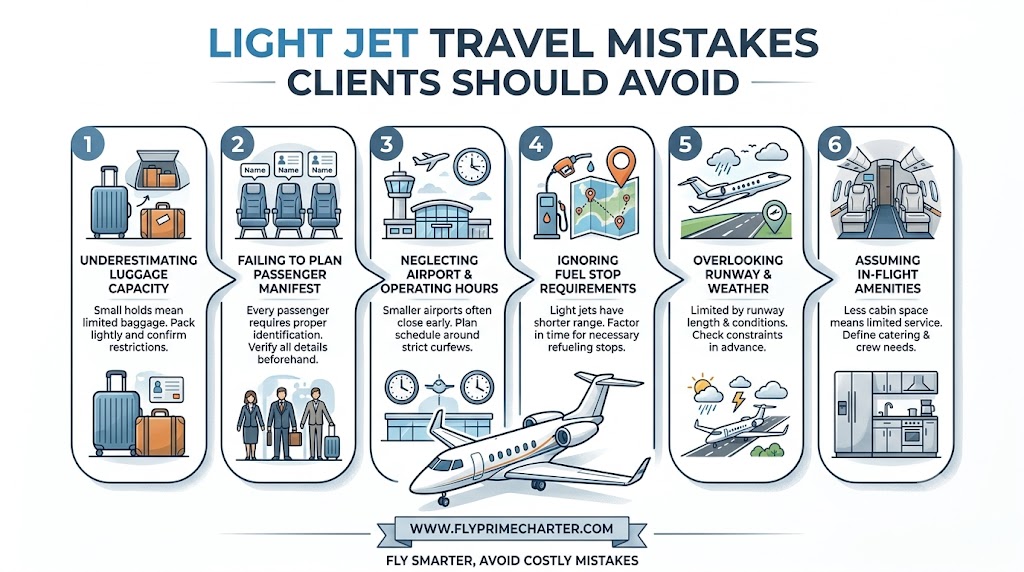
Introduction
Light jet travel can provide a practical balance between private aviation convenience, flexible scheduling, and access to smaller airports. For business trips, short regional journeys, family travel, and time-sensitive itineraries, a light jet can often be an efficient alternative to conventional commercial travel.
However, the quality of a charter experience depends on much more than choosing an aircraft and confirming a departure time. Clients can encounter unexpected costs, unsuitable aircraft, restrictive cancellation terms, airport limitations, weather disruptions, or service gaps when important details are overlooked.
The most common problems usually happen before the aircraft ever leaves the ground. A quotation may look attractive while excluding repositioning, ground transportation, catering, de-icing, overnight expenses, or other operational charges. Likewise, selecting an aircraft based only on passenger capacity can result in an uncomfortable or operationally unsuitable trip.
A better approach is to evaluate the complete journey rather than simply purchasing flight hours. This guide explains the major mistakes clients should avoid when arranging light jet travel and provides a practical framework for evaluating aircraft, operators, pricing, airports, scheduling, and service expectations.
Understanding Light Jet Travel
Light jets are generally designed for shorter regional and business-oriented missions. They can provide private cabins, faster airport processing, access to smaller airports, and greater scheduling flexibility than many commercial alternatives.
However, not every light jet is interchangeable.
Important differences can exist in:
- Passenger capacity
- Cabin dimensions
- Baggage capacity
- Range
- Payload capability
- Runway requirements
- Airport compatibility
- Cabin configuration
- Lavatory availability
- Performance in hot or high conditions
- Weather capability
- Crew requirements
- Operating restrictions
This is why the phrase “light jet” should not be treated as a complete aircraft specification.
A client should evaluate whether the proposed aircraft is appropriate for the actual mission rather than assuming that every aircraft in the same category will provide the same experience.
The Most Common Light Jet Travel Mistakes
1. Choosing an Aircraft Based Only on Passenger Capacity
One of the simplest mistakes is asking, “How many people can the aircraft carry?” and stopping there.
Passenger capacity does not tell the entire story.
An aircraft advertised for a certain number of passengers may not provide the same level of comfort when everyone brings luggage. Cabin configuration, baggage volume, seating arrangement, and flight duration can significantly affect the experience.
For example, a group traveling with business equipment, golf bags, large suitcases, or specialized luggage may have different requirements from a group traveling with small carry-on bags.
What to check
Before accepting an aircraft, confirm:
- Actual passenger configuration
- Usable baggage capacity
- Cabin dimensions
- Seating arrangement
- Lavatory availability
- Expected luggage volume
- Special baggage restrictions
- Cabin amenities
- Whether the aircraft configuration matches the quoted aircraft
Better practice: Evaluate the complete passenger-and-baggage load, not just the number of seats.
2. Assuming the Quoted Price Is the Final Price
A headline charter price may not represent the complete trip cost.
Depending on the itinerary and operator, additional costs may arise from:
- Aircraft repositioning
- Landing fees
- Parking
- Crew expenses
- Overnight crew accommodation
- Ground transportation
- Catering
- Special handling
- De-icing
- International services
- Additional flight time
- Airport-related charges
- Changes to the itinerary
Not every charge applies to every trip, but clients should understand what is included and what is not.
Ask for an all-in cost structure
Instead of asking only:
“What is the aircraft price?”
ask:
“What is included in the quoted amount, and which operational or passenger-related charges could be added?”
A professional quotation should make the major cost components understandable.
3. Focusing on the Lowest Quote
Price matters, but the cheapest quotation may not represent the lowest overall trip cost.
A lower initial quote can become less attractive if it comes with:
- Less convenient airports
- More restrictive cancellation terms
- Limited schedule flexibility
- Additional repositioning charges
- Poor baggage suitability
- Unclear inclusions
- Limited ground transportation
- Less convenient aircraft positioning
The right comparison is not simply:
Quote A vs. Quote B
It is:
Total trip cost + operational suitability + service terms + flexibility + risk
A client should compare quotations on equivalent assumptions.
4. Ignoring the Departure and Arrival Airports
Private aviation offers access to many airports that may be less practical for commercial airline travel, but airport suitability still matters.
A preferred airport may have restrictions involving:
- Operating hours
- Runway length
- Aircraft performance
- Noise procedures
- Weather
- Customs availability
- Parking
- Handling services
- Ground transportation
- Local operating restrictions
A theoretically convenient airport may therefore be unsuitable for a particular aircraft or itinerary.
Better approach
Evaluate the entire ground journey:
Home → departure airport → aircraft → destination airport → final destination
The shortest flight is not automatically the shortest overall journey.
5. Not Checking Airport Operating Hours
Some airports have operating-hour restrictions or limited services outside normal periods.
This can become especially important when a client requests:
- Very early departures
- Late-night arrivals
- Weekend operations
- Holiday travel
- Short-notice schedule changes
An airport may technically exist as an option while still being impractical for the desired departure or arrival time.
Before booking, confirm
- Airport operating hours
- After-hours procedures
- Handling availability
- Fuel availability
- Customs arrangements where applicable
- Any applicable airport restrictions
6. Assuming the Aircraft Can Fly the Requested Route Without Constraints
Range is not simply a straight-line distance calculation.
Actual flight planning can be affected by:
- Passenger and baggage weight
- Weather
- Winds
- Required fuel reserves
- Alternate airport requirements
- Air traffic restrictions
- Runway conditions
- Airport elevation
- Temperature
- Operational requirements
A route that appears comfortably within an aircraft’s published range may require operational adjustments.
This is why clients should rely on the operator’s flight-planning assessment rather than making range assumptions from a basic map.
7. Booking Too Close to the Departure Date Without Understanding the Risks
Private aviation can provide greater flexibility than scheduled airline travel, but aircraft availability is not unlimited.
Short-notice booking can reduce the number of suitable aircraft available and may increase the complexity of:
- Aircraft positioning
- Crew scheduling
- Airport arrangements
- Catering
- Ground transportation
- Special requests
Urgent travel can also limit the ability to compare multiple suitable options.
If the trip is predictable, earlier planning generally provides more opportunity to evaluate alternatives.
8. Providing an Incomplete Passenger Manifest
Passenger information is operationally important.
Clients should provide accurate information regarding:
- Passenger names
- Number of passengers
- Baggage
- Special baggage
- Children where applicable
- Pets where permitted
- Special assistance requirements
- International travel documentation where applicable
Last-minute changes can create operational or administrative complications.
The safest approach is to provide accurate passenger information as early as practical and immediately communicate material changes to the charter provider.
9. Underestimating Baggage Requirements
Light jets can have meaningful baggage limitations, particularly when the aircraft is carrying a full passenger load.
Commonly overlooked items include:
- Golf equipment
- Ski equipment
- Musical instruments
- Large cases
- Sporting equipment
- Business equipment
- Pet carriers
Clients should provide realistic baggage information instead of assuming that everything will fit because the aircraft has an advertised baggage compartment.
Practical rule
If the luggage is unusual, oversized, unusually heavy, or particularly important, tell the operator before finalizing the aircraft.
10. Assuming Every Light Jet Has the Same Cabin Experience
Aircraft specifications can vary considerably.
Two aircraft that both fall within the light jet category may differ in:
- Cabin width
- Cabin height
- Legroom
- Seating arrangement
- Noise levels
- Lavatory availability
- Interior configuration
- Connectivity
- Refreshment facilities
If comfort is important, clients should request the specific aircraft type and, where relevant, the actual configuration.
11. Ignoring the Difference Between Aircraft Type and Actual Aircraft
A quotation may identify an aircraft model without identifying the specific tail number or final aircraft assignment.
That distinction can matter.
The actual aircraft may have a different:
- Interior configuration
- Cabin equipment
- Seating layout
- Baggage arrangement
- Connectivity capability
- Age and refurbishment status
Aircraft substitutions can also occur for legitimate operational reasons.
Clients should understand the provider’s substitution policy before booking if the exact aircraft configuration is important.
12. Not Reading Cancellation and Change Terms
This is one of the most important contractual mistakes.
Charter agreements can contain specific conditions concerning:
- Cancellation deadlines
- Refunds
- Deposits
- Schedule changes
- Passenger changes
- Route changes
- Aircraft substitutions
- Weather disruptions
- Operator cancellation
- Client-requested delays
A client who does not understand these provisions may face unexpected financial consequences.
Before paying a deposit, clarify
- What happens if I cancel?
- What happens if I change the departure time?
- What happens if I change the route?
- What happens if the passenger count changes?
- What happens if weather disrupts the flight?
- What happens if the operator cannot provide the originally proposed aircraft?
Get important answers in writing.
13. Treating Weather as an Afterthought
Private aviation does not eliminate weather-related operational limitations.
Conditions such as:
- Thunderstorms
- Strong winds
- Low visibility
- Icing
- Heavy precipitation
- Runway contamination
can affect flight operations.
Weather can also cause indirect consequences such as aircraft repositioning problems or airport closures.
A responsible operator should manage these risks through flight planning and operational procedures. Clients should nevertheless avoid assuming that a charter schedule is immune to weather disruption.
14. Expecting a Guaranteed Departure Time Under All Conditions
Clients sometimes treat a charter departure time as equivalent to a guaranteed appointment.
Operational reality is more complicated.
A flight can be affected by:
- Weather
- Air traffic restrictions
- Aircraft technical issues
- Airport restrictions
- Crew duty limitations
- Ground handling
- Security procedures
- Unexpected operational events
A precise itinerary is useful, but clients should understand the difference between a requested schedule and an operationally achievable departure.
15. Not Asking About Aircraft Substitution
Aircraft substitution is an important issue to clarify before travel.
An operator may need to provide another aircraft because of:
- Maintenance
- Scheduling
- Operational constraints
- Availability changes
- Unexpected technical issues
The substitute aircraft may have different:
- Seating
- Baggage capacity
- Cabin configuration
- Amenities
- Performance characteristics
Clients should understand whether substitutions are permitted under the agreement and how materially different equipment will be handled.
16. Assuming All Charter Providers Operate the Same Way
The company arranging a charter may not necessarily be the same entity operating the aircraft.
There can be differences between:
- Charter brokers
- Aircraft operators
- Management companies
- Aircraft owners
- Handling providers
- Ground transportation companies
Clients should understand who is responsible for the actual flight operation and what role each party plays.
Useful questions
- Who is the actual aircraft operator?
- Who holds operational responsibility?
- Who is my contractual counterparty?
- Who should I contact during a disruption?
- Who handles schedule changes?
- Who coordinates ground services?
Clear responsibilities reduce confusion when something changes.
17. Choosing a Provider Without Reviewing Its Operational Credentials
Clients should not evaluate a charter provider solely on website design, sales presentation, or testimonials.
The relevant question is whether the proposed operation is appropriate, properly authorized where applicable, and professionally managed.
Depending on jurisdiction and operation type, clients may want to understand:
- Applicable operating authorization
- Safety oversight
- Operator experience
- Aircraft management arrangements
- Crew qualifications
- Maintenance arrangements
- Insurance
- Operational procedures
The exact regulatory requirements depend on where and how the flight is operated.
18. Forgetting About Ground Transportation
The flight is only one part of the journey.
A poorly coordinated transfer can eliminate much of the time saved by private aviation.
Consider:
- Pickup location
- Airport transfer time
- Vehicle availability
- Arrival coordination
- Waiting time
- Multiple passengers
- Luggage capacity
- Return transportation
For business travel, ground transportation should be coordinated around the expected aircraft arrival rather than treated as an unrelated reservation.
19. Treating Catering as an Automatic Service
Catering options vary by aircraft, operator, airport, and flight duration.
Clients with dietary restrictions or specific preferences should communicate them early.
Consider:
- Dietary restrictions
- Allergies
- Meal timing
- Beverages
- Children’s requirements
- Special occasions
- Availability at the departure airport
Avoid assuming that a specific menu is automatically available simply because catering is offered.
20. Forgetting About Pets and Special Items
Pets and unusual baggage can require advance planning.
Similarly, certain items may have aviation-specific restrictions or handling requirements.
If traveling with:
- Pets
- Medical equipment
- Sporting equipment
- Large instruments
- Valuable equipment
- Unusual baggage
tell the provider before finalizing the itinerary.
Do not wait until arrival at the airport to disclose unusual requirements.
21. Failing to Plan for International Documentation
International private aviation still involves border, immigration, customs, and documentation requirements.
Depending on the itinerary and jurisdictions involved, requirements may include:
- Valid travel documents
- Passenger information
- Visa documentation
- Customs declarations
- Immigration procedures
- Special permits
Private aviation can simplify some aspects of airport processing, but it does not remove applicable border requirements.
Clients should confirm documentation requirements well before departure.
22. Ignoring Connectivity Requirements
Business travelers often assume that a private aircraft automatically provides reliable connectivity.
That should not be assumed.
If the trip requires:
- Video meetings
- Secure business communications
- Large file transfers
- Continuous messaging
- Remote work
ask what connectivity is actually available on the proposed aircraft.
A cabin with a comfortable workspace is not necessarily a cabin with dependable internet access.
23. Not Planning Enough Time for Ground Procedures
Private aviation can significantly reduce some airport-related delays, but passengers still need to arrive with sufficient time for:
- Check-in or manifest procedures
- Security requirements
- Identity verification
- Aircraft boarding
- Baggage loading
- Airport-specific procedures
The exact recommended arrival time depends on the airport, operator, itinerary, and circumstances.
Clients should ask the operator or handling provider for specific arrival instructions rather than assuming that private travel means arriving immediately before departure.
24. Making Last-Minute Passenger Changes Without Checking the Impact
Adding or removing a passenger can affect:
- Aircraft suitability
- Weight and balance
- Catering
- Ground transportation
- Documentation
- Passenger manifests
- International procedures
A small passenger-count change can therefore have operational consequences.
Communicate changes as soon as they are known.
25. Assuming the Charter Is Fully Flexible After Booking
Private charter is flexible, but flexibility is not unlimited.
Changing:
- Departure time
- Destination
- Passenger count
- Aircraft
- Routing
- Return date
may require additional coordination and potentially additional cost.
The best time to discuss flexibility is before signing the agreement, not after the itinerary becomes urgent.
A Better Way to Evaluate a Light Jet Charter
Instead of making the decision based on price alone, use a structured evaluation.
| Evaluation Area | Questions to Ask |
|---|---|
| Aircraft | Is the aircraft suitable for passengers, luggage, route, and duration? |
| Airport | Can the aircraft operate conveniently from the selected airports? |
| Schedule | Is the requested departure realistic and operationally supported? |
| Pricing | What is included in the quoted price? |
| Additional Charges | Which costs could be added later? |
| Operator | Who is actually operating the aircraft? |
| Contract | What are the cancellation and change conditions? |
| Baggage | Is the available baggage capacity sufficient? |
| Cabin | Does the configuration meet comfort requirements? |
| Connectivity | Are communication and internet requirements supported? |
| Ground Transport | Are transfers coordinated with the flight? |
| Documentation | Are all passenger and border requirements understood? |
| Disruption Planning | What happens if weather or aircraft issues affect the schedule? |
| Support | Who handles urgent changes during the trip? |
This approach shifts the decision from “Which quote is cheapest?” to “Which proposal accurately fits the mission?”
Questions Clients Should Ask Before Booking
A professional pre-booking conversation should cover more than aircraft availability.
Aircraft
- What aircraft is being proposed?
- Is the aircraft type guaranteed?
- Can the aircraft configuration accommodate all passengers and baggage?
- Does it have the cabin features we require?
- Is there a possibility of aircraft substitution?
Pricing
- Is this an all-inclusive quote?
- Which charges are excluded?
- Could repositioning charges apply?
- Could overnight or parking charges apply?
- Are ground transportation and catering included?
Schedule
- Is the requested departure time operationally feasible?
- Are there airport operating restrictions?
- What happens if weather affects the schedule?
- How are delays communicated?
Contract
- What is the cancellation policy?
- What is the change policy?
- What happens if the operator cancels?
- What happens if the aircraft must be substituted?
- Which charges are refundable?
Operations
- Who is operating the aircraft?
- Who is the primary contact during the trip?
- How are unexpected changes handled?
- What passenger information is required?
A Practical Pre-Flight Checklist
Before finalizing the charter, verify the following:
Aircraft
- Aircraft type confirmed
- Passenger capacity confirmed
- Baggage capacity confirmed
- Cabin configuration reviewed
- Lavatory requirements confirmed
- Special equipment requirements communicated
Airports
- Departure airport confirmed
- Arrival airport confirmed
- Operating hours checked
- Airport suitability confirmed
- Ground transportation arranged
- International procedures confirmed where applicable
Pricing
- Total quoted price reviewed
- Included services identified
- Potential additional charges identified
- Catering terms understood
- Ground transportation terms understood
Contract
- Cancellation policy reviewed
- Change policy reviewed
- Deposit terms understood
- Refund conditions understood
- Aircraft substitution terms reviewed
Passengers
- Passenger names submitted accurately
- Baggage information provided
- Special baggage declared
- Pets communicated where applicable
- Documentation verified
Operations
- Departure instructions received
- Contact person identified
- Weather contingency understood
- Delay communication process confirmed
- Emergency or after-hours contact identified
How to Compare Two Charter Quotes Properly
Suppose two providers offer apparently similar light jet options.
Provider A
- Lower headline price
- Limited inclusions
- Less convenient airport
- More restrictive cancellation conditions
Provider B
- Higher headline price
- More services included
- More convenient airport
- Greater scheduling flexibility
The correct comparison requires normalizing the proposals.
Ask both providers to clarify:
- Aircraft type
- Exact itinerary
- Passenger count
- Baggage assumptions
- Included services
- Excluded charges
- Airport fees
- Ground transportation
- Catering
- Cancellation terms
- Change terms
- Aircraft substitution terms
Only after those factors are comparable does the price difference become meaningful.
Common Warning Signs During the Booking Process
Clients should take extra care when they encounter:
- Unusually vague pricing
- Pressure to make an immediate payment without reviewing terms
- Unclear operator responsibility
- Refusal to explain additional charges
- Incomplete aircraft information
- Unclear cancellation conditions
- Poor communication about passenger requirements
- Promises that ignore obvious operational constraints
- Significant differences between verbal promises and written terms
A professional provider should be able to explain the important parts of the proposed operation clearly.
The Hidden Cost of Poor Planning
The financial cost of a booking mistake is only one part of the problem.
Poor planning can also create:
- Missed meetings
- Longer ground journeys
- Passenger inconvenience
- Baggage problems
- Schedule disruption
- Last-minute transportation changes
- Administrative complications
- Reduced flexibility
- Unexpected expenses
For business travelers, the opportunity cost of a disrupted itinerary can be considerably more important than the charter price itself.
That is why operational suitability should be evaluated alongside financial cost.
A More Reliable Booking Workflow
A disciplined charter-booking process can be organized into seven stages.
Step 1: Define the Mission
Document:
- Origin
- Destination
- Preferred departure
- Passenger count
- Baggage
- Return requirements
- Special requirements
Step 2: Identify Suitable Airports
Consider airport access, operating limitations, ground transportation, and destination convenience.
Step 3: Identify Suitable Aircraft
Match aircraft capability to passenger load, baggage, route, airport requirements, and comfort expectations.
Step 4: Request Comparable Quotes
Ask providers to quote the same basic mission assumptions.
Step 5: Normalize the Pricing
Separate included costs from potential additional charges.
Step 6: Review the Agreement
Pay particular attention to cancellation, changes, substitutions, delays, and operator responsibilities.
Step 7: Confirm the Final Itinerary
Verify passengers, aircraft information, airports, timing, ground services, documentation, and contact information.
This workflow reduces the chance of discovering an important restriction after the booking has already been made.
What Experienced Travelers Usually Pay Attention To
Experienced charter clients tend to look beyond the aircraft itself.
They often care about the quality of the entire operating system around the aircraft:
- How clearly the provider communicates
- How transparent the quotation is
- How changes are handled
- How quickly problems are escalated
- Whether airport choices make practical sense
- Whether the aircraft actually fits the mission
- Whether the contract matches the sales discussion
- Whether the provider understands the client’s priorities
A polished aircraft cannot compensate for poor planning and unclear communication.
Final Recommendation
The safest way to arrange light jet travel is to treat the booking as an operational decision rather than a simple aircraft purchase. Confirm the aircraft, airports, baggage, schedule, total costs, operator responsibilities, contractual terms, and contingency procedures before committing. Avoid comparing providers solely on headline price because two apparently similar quotations may have very different assumptions behind them. Communicate special requirements early and keep important agreements in writing. Most importantly, evaluate the entire door-to-door journey, not just the time spent in the air.
Final Light Jet Travel Checklist
Before booking, make sure you can answer yes to these questions:
- Do I know exactly what aircraft is being proposed?
- Does the aircraft comfortably fit the passenger and baggage requirements?
- Are the departure and arrival airports operationally suitable?
- Do I understand the complete quoted price?
- Have I identified possible additional charges?
- Have I reviewed cancellation and change conditions?
- Do I know who actually operates the aircraft?
- Do I understand the aircraft substitution policy?
- Have I communicated special baggage or passenger requirements?
- Are international documentation requirements clear where applicable?
- Is ground transportation coordinated?
- Do I know how weather-related changes will be handled?
- Do I have an appropriate contact for last-minute operational issues?
- Does the written agreement match what was discussed?
If these questions are clearly answered before booking, the client is in a much stronger position to avoid preventable surprises and make the charter experience more predictable.
FAQs
Q1. What is the biggest mistake clients make when booking a light jet?
One of the most common mistakes is focusing on the advertised aircraft price without understanding the complete trip cost, aircraft suitability, airport requirements, and contractual conditions.
Q2. Should clients choose a light jet based only on passenger capacity?
No. Passenger capacity should be evaluated together with baggage, cabin configuration, flight requirements, airport limitations, and passenger comfort.
Q3. Can a light jet always use the airport the client prefers?
Not necessarily. Airport operating hours, runway characteristics, aircraft performance, weather, handling services, and other operational restrictions can affect airport suitability.
Q4. What should clients ask about charter cancellation policies?
Clients should ask about cancellation deadlines, deposits, refunds, schedule changes, route changes, passenger changes, weather disruptions, and circumstances in which the operator cannot provide the planned aircraft.
Q5. Are additional charges common in private jet travel?
Additional charges can apply depending on the itinerary and services requested. Clients should ask which items are included in the quotation and which costs could be added separately.
Q6. Why is baggage information important for light jet travel?
Light jets have finite baggage capacity, and actual luggage requirements can affect aircraft suitability. Oversized, heavy, or unusual baggage should be disclosed before the aircraft is finalized.
Q7. Can the aircraft be changed after booking?
Aircraft substitutions can occur for legitimate operational reasons. Clients should review the applicable substitution terms and understand what happens if the replacement aircraft has different capabilities or cabin features.
Q8. Does private aviation eliminate weather-related delays?
No. Private aircraft remain subject to weather and other operational limitations. Weather can affect departure timing, routing, airport selection, and aircraft positioning.
Q9. Should clients arrange ground transportation separately?
Ground transportation can be arranged separately, but coordinating it with the aircraft itinerary can make the overall journey smoother. Clients should clarify whether transportation is included in the charter proposal.
Q10. What should clients verify before making a charter deposit?
At minimum, verify the aircraft, itinerary, passenger and baggage requirements, total pricing, included services, potential additional charges, cancellation terms, change conditions, operator responsibility, and aircraft substitution provisions.
Conclusion
Light jet travel can be highly convenient when the aircraft and itinerary are matched correctly. Most avoidable problems come from incomplete planning rather than the flight itself. Clients should evaluate the aircraft, airports, baggage, pricing, contract, operator, schedule, and contingency arrangements together. A transparent quotation and clear communication are as important as the aircraft selected. Taking time to verify these details before booking can prevent unnecessary costs and operational surprises.
