
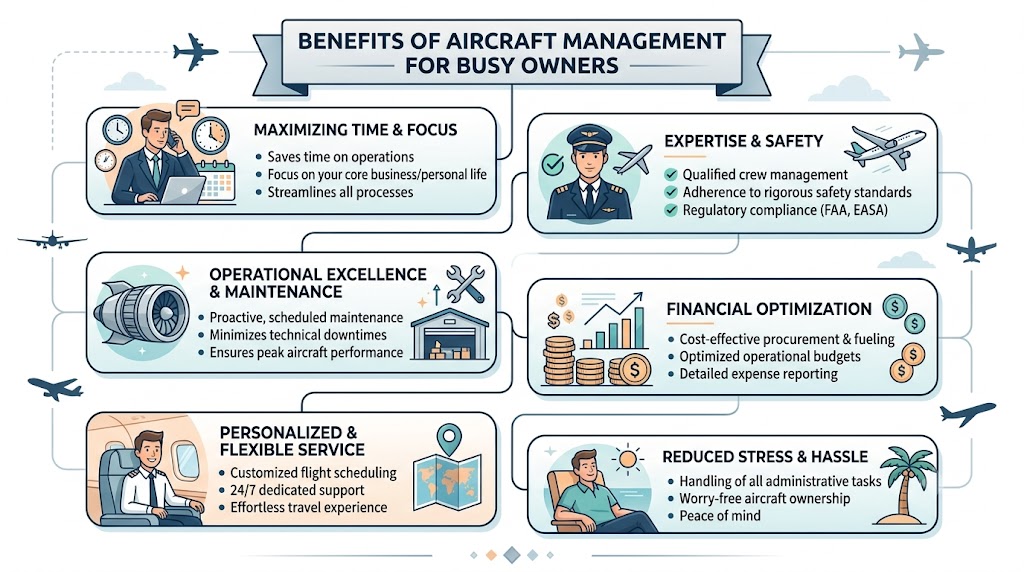
Aircraft ownership offers flexibility and convenience, but it also comes with a long list of responsibilities. An owner may enjoy the freedom of private aviation while still needing to deal with scheduling, maintenance coordination, crew administration, documentation, vendors, operating expenses, and regulatory requirements.
For an owner with a demanding business schedule, handling every responsibility personally can become difficult. This is where professional aircraft management can provide structured support.
Aircraft management companies can coordinate many of the operational and administrative activities associated with an aircraft. The exact services depend on the provider, aircraft, operating model, jurisdiction, and management agreement.
This guide explains the major benefits of aircraft management for busy owners, compares professional management with self-management, and provides practical questions to consider before selecting a management company.
What Is Aircraft Management?
Aircraft management is a professional service arrangement in which a management company coordinates selected operational, administrative, and support responsibilities for an aircraft owner.
Depending on the agreement, services may include:
- Flight scheduling
- Maintenance coordination
- Crew administration
- Operational planning
- Documentation
- Recordkeeping
- Vendor coordination
- Financial administration
- Regulatory support
- Owner reporting
The management company does not necessarily handle every aspect of aircraft ownership. The scope depends on the specific contract.
A clear management agreement should define which responsibilities belong to the management company and which remain with the owner.
Why Busy Aircraft Owners Consider Professional Management
Aircraft ownership can involve many activities that happen behind the scenes.
An owner may need to coordinate maintenance events while planning business trips, review invoices while managing other commitments, or communicate with multiple aviation vendors.
Professional management can provide a centralized structure for these responsibilities.
Busy owners may consider management support because they want to:
- Reduce routine administrative work
- Simplify aircraft scheduling
- Coordinate maintenance
- Organize aircraft records
- Support crew administration
- Improve financial visibility
- Coordinate vendors
- Receive structured aircraft reports
- Spend less personal time handling routine tasks
Professional management does not remove the owner’s need to make important decisions. Instead, it can provide a framework for handling delegated responsibilities.
Key Benefits of Aircraft Management
1. Saves Valuable Owner Time
Time is often one of the biggest considerations for a busy aircraft owner.
Aircraft ownership can require communication with several people and organizations. Managing these interactions personally can take significant time.
A management company may coordinate activities such as:
- Scheduling
- Maintenance appointments
- Vendor communication
- Documentation
- Crew administration
- Operational planning
- Financial administration
This allows the owner to remain informed without personally managing every routine task.
The goal is not to remove the owner from the process. It is to reduce the amount of routine coordination the owner needs to perform.
2. Provides Centralized Aircraft Operations
Without a structured management system, aircraft information can become spread across multiple people and service providers.
A professional management company can serve as a central coordination point.
Depending on the agreement, the management team may coordinate:
- Flight schedules
- Maintenance activities
- Crew matters
- Airport arrangements
- Vendors
- Documentation
- Operational communication
Centralized coordination can make it easier for an owner to understand the aircraft’s current status.
3. Supports Maintenance Coordination
Maintenance is an important part of aircraft ownership.
Aircraft require planned inspections, maintenance activities, records, and coordination with qualified maintenance organizations.
A management company may assist with:
- Maintenance scheduling
- Inspection planning
- Maintenance record coordination
- Communication with maintenance providers
- Vendor coordination
- Parts and service coordination
- Aircraft downtime planning
- Owner communication
This can help the owner understand what maintenance activities are coming up and how they may affect aircraft availability.
Actual maintenance work must follow applicable approved procedures and qualified maintenance requirements.
4. Helps With Crew Management
Aircraft owners who use dedicated flight crews may have additional administrative responsibilities.
Depending on the management arrangement, a company may support areas such as:
- Pilot recruitment
- Crew scheduling
- Training administration
- Qualification records
- Leave planning
- Crew communication
- Administrative coordination
The exact role varies between management companies.
Some providers may offer extensive crew-management support, while others may provide only selected administrative services.
Owners should therefore confirm the scope of crew services before signing a management agreement.
5. Simplifies Aircraft Scheduling
Busy owners often have changing schedules.
A business meeting can move. A personal trip can be added. Another journey may require a different departure time.
Aircraft scheduling can also involve:
- Aircraft availability
- Crew availability
- Maintenance
- Airport considerations
- Weather
- Operational requirements
A management team can coordinate these factors and communicate the available options to the owner.
Professional scheduling does not eliminate operational limitations, but it can reduce the amount of coordination the owner needs to handle personally.
6. Supports Regulatory and Compliance Administration
Aircraft operations involve documentation and compliance responsibilities.
The exact requirements depend on factors such as:
- Aircraft type
- Operating model
- Jurisdiction
- Applicable aviation authority
- Type of operation
Management companies may assist with high-level areas such as:
- Aircraft documentation
- Maintenance records
- Inspection tracking
- Crew records
- Operational documentation
- Regulatory communication
- Compliance tracking
Owners should understand exactly what compliance responsibilities the management company assumes under the agreement.
Specific requirements vary by jurisdiction, aircraft, and operating model.
7. Centralizes Aircraft Records
Good recordkeeping supports organized aircraft ownership.
Important records can include:
- Maintenance documentation
- Inspection records
- Aircraft documents
- Crew records
- Operational records
- Vendor documentation
- Financial information
A management company may organize these records and make relevant information available to authorized stakeholders.
Centralized records can also make it easier for owners to understand the aircraft’s history and upcoming requirements.
8. Coordinates Vendors and Service Providers
Aircraft ownership can involve a network of service providers.
These may include:
- Maintenance organizations
- Avionics specialists
- Parts suppliers
- Fuel providers
- Hangar providers
- Ground service companies
- Cleaning and detailing providers
- Training organizations
- Other aviation vendors
Managing these relationships independently can take considerable time.
A management company can act as a central point of coordination.
However, owners should not assume that professional management automatically means every service will cost less. The value often comes from coordination, oversight, expertise, and administrative support as well as financial considerations.
9. Improves Financial Visibility
Aircraft operating costs can come from many categories.
A management company may provide administrative support for tracking areas such as:
- Maintenance
- Crew
- Fuel
- Hangar
- Training
- Insurance-related expenses
- Vendor invoices
- Other operating expenses
Depending on the agreement, owners may receive financial reports that organize aircraft-related spending.
This can help owners understand where money is being spent and identify upcoming financial commitments.
Actual reporting formats vary between providers.
10. Supports Maintenance and Operational Planning
Aircraft management involves more than reacting to immediate needs.
Forward planning can help owners understand upcoming activities such as:
- Scheduled maintenance
- Inspections
- Crew training
- Aircraft downtime
- Vendor appointments
- Budget requirements
- Planned travel
For example, if maintenance is expected to take the aircraft out of service during a planned period, the management team can communicate the timing and help coordinate the owner’s travel plans.
This kind of planning can make aircraft ownership more predictable.
11. Provides Owner Reporting
Busy owners often want information without having to collect it from several sources.
Management companies may provide reports covering areas such as:
- Aircraft status
- Maintenance activity
- Upcoming events
- Flight activity
- Operating expenses
- Budget information
- Crew matters
- Outstanding issues
Reporting frequency and format depend on the management agreement.
Before selecting a provider, owners should ask what information they will receive and how frequently it will be delivered.
12. Helps Coordinate Unexpected Changes
Aircraft operations do not always follow the original plan.
Unexpected maintenance, schedule changes, airport issues, or other operational developments can require coordination.
A management company may help organize communication between the owner and relevant aviation service providers.
Examples may include:
- Maintenance-related scheduling changes
- Aircraft availability issues
- Vendor coordination
- Trip changes
- Administrative follow-up
The exact role of the management team depends on the operating arrangement.
13. Reduces the Administrative Burden
Administrative work can occupy a surprising amount of an aircraft owner’s time.
A management company may coordinate:
- Documents
- Invoices
- Scheduling
- Maintenance communication
- Crew records
- Vendor correspondence
- Reports
- Operational information
For a busy owner, reducing this routine workload can be one of the main reasons to consider professional management.
The owner can remain involved in important decisions while delegating appropriate administrative tasks.
14. Creates a More Structured Ownership Process
Professional management can establish defined processes around aircraft ownership.
These may cover:
- Who handles scheduling
- Who coordinates maintenance
- Who communicates with vendors
- Who manages crew administration
- Who prepares reports
- Which decisions require owner approval
Clear responsibilities can reduce confusion, especially when multiple people or organizations are involved.
A strong management arrangement should make those responsibilities clear from the beginning.
Aircraft Management vs Self-Management
Aircraft owners can use different management models.
Some prefer to handle many responsibilities directly, while others delegate selected or most operational tasks to a professional management company.
| Area | Professional Aircraft Management | Self-Management |
|---|---|---|
| Scheduling | Management team may coordinate aircraft availability and trips | Owner or internal team handles scheduling |
| Maintenance coordination | Management team may coordinate maintenance providers | Owner or internal team coordinates providers |
| Crew administration | May include recruitment, scheduling, and records support | Owner or internal team manages these activities |
| Recordkeeping | Centralized through management structure | Owner or internal staff maintains records |
| Vendor coordination | Management company may serve as central contact | Owner or internal team handles providers |
| Compliance support | May provide tracking and administrative assistance | Owner or internal team handles requirements |
| Financial administration | May provide expense tracking and reporting | Owner or internal team manages finances |
| Owner involvement | Owner oversees important decisions | Owner may handle more day-to-day matters |
| Administrative workload | Potentially lower for the owner | Potentially higher for the owner |
| Direct control | Depends on the management agreement | Owner retains direct control over delegated tasks |
Neither approach is automatically suitable for every aircraft owner.
The right structure depends on the owner’s time, knowledge, internal resources, aircraft usage, operating complexity, and preferred level of involvement.
Potential Trade-Offs of Aircraft Management
Professional management can provide substantial administrative support, but owners should also understand the trade-offs.
Management Fees
Professional services come with costs. Owners should understand the management fee structure and any additional charges.
Reduced Direct Control Over Routine Tasks
Delegating responsibilities means the management team may handle activities that the owner previously managed personally.
Owners should establish clear approval procedures for important decisions.
Contract Terms
Management agreements can define service scope, responsibilities, fees, reporting, termination conditions, and other important provisions.
Owners should review these terms carefully.
Communication Expectations
A management relationship works best when both sides understand how and when information will be communicated.
Service Scope
Not every management company offers the same services.
A provider may specialize in certain aircraft categories, regions, operating models, or service areas.
What to Look for in an Aircraft Management Company
Selecting a management company requires more than reviewing a service list.
Relevant Experience
Consider whether the provider has experience with aircraft similar to yours and understands your operating environment.
Clear Service Scope
Ask exactly which responsibilities the company will manage.
Avoid relying on vague descriptions.
Strong Communication
The management team should explain aircraft status, maintenance matters, expenses, and operational issues clearly.
Maintenance Coordination
Understand how maintenance planning, records, vendors, and upcoming inspections are handled.
Crew Support
If crew management matters to you, clarify whether recruitment, scheduling, training administration, and records support are included.
Owner Reporting
Ask what reports you will receive and how often.
Financial Transparency
Understand:
- Management fees
- Additional charges
- Vendor expenses
- Administrative costs
- Reporting structure
Contract Clarity
Review:
- Service responsibilities
- Owner responsibilities
- Payment terms
- Reporting
- Approval procedures
- Contract duration
- Termination provisions
Questions Busy Aircraft Owners Should Ask
Before selecting an aircraft management company, ask:
- What services are included in the management agreement?
- Which responsibilities remain with me as the owner?
- How are maintenance activities coordinated?
- How is aircraft scheduling handled?
- How are crew matters managed?
- What documentation and compliance support is provided?
- What financial reports will I receive?
- How are vendors selected and coordinated?
- How are unexpected maintenance events communicated?
- How are additional charges presented?
- How often will I receive aircraft reports?
- Who will be my primary point of contact?
- Which decisions require my approval?
- How are major expenses authorized?
- What are the contract termination provisions?
These questions can help owners understand what they are actually purchasing rather than relying on a general description of “aircraft management.”
Aircraft Management Checklist for Busy Owners
Operational Support
- Flight scheduling
- Trip coordination
- Airport coordination
- Operational communication
Maintenance Support
- Maintenance planning
- Inspection tracking
- Maintenance records
- Vendor coordination
Crew Support
- Crew scheduling
- Training administration
- Qualification records
- Crew communication
Administrative Support
- Documentation
- Invoice management
- Financial reporting
- Vendor management
- Owner reporting
Owner Oversight
- Clear responsibilities
- Defined approval process
- Regular reporting
- Transparent costs
- Clear communication channels
Aircraft Management for Different Types of Owners
Business Owners
Business owners may place greater importance on:
- Time efficiency
- Travel scheduling
- Operational coordination
- Financial visibility
- Reliable communication
The management structure should support business travel without creating unnecessary administrative work for the owner.
Frequent Private Travelers
Frequent travelers may benefit from organized:
- Trip planning
- Aircraft scheduling
- Maintenance coordination
- Crew administration
- Airport arrangements
Their main priority may be reducing the amount of routine coordination required between trips.
First-Time Aircraft Owners
First-time owners may have less experience with:
- Maintenance planning
- Aviation vendors
- Aircraft records
- Crew administration
- Operating requirements
Professional management can provide a structured point of support while the owner becomes more familiar with aircraft ownership.
Family Offices and Businesses
Organizations managing aircraft for executives or family members may prioritize:
- Financial reporting
- Administrative structure
- Multiple stakeholder communication
- Clear approval processes
- Cost oversight
A clearly defined management structure can help establish accountability between the owner, management company, and other stakeholders.
How to Decide Whether Aircraft Management Fits Your Needs
There is no single management model that works for every owner.
Consider these factors before making a decision.
Aircraft Type
Different aircraft can create different management requirements.
Flight Frequency
Frequent aircraft use may create more scheduling, maintenance, and administrative activity.
Owner Availability
Consider how much time you can realistically dedicate to aircraft management.
Operating Complexity
More complex operations may require greater coordination.
Crew Requirements
Owners using dedicated crews may have additional administrative responsibilities.
Geographic Location
Aircraft based or operated across different regions may require additional coordination.
Internal Resources
Some owners have experienced aviation professionals within their organization. Others prefer to rely on an external management structure.
Budget
Consider the cost of professional management alongside the value of time, expertise, reporting, and coordination.
Desired Owner Involvement
Some owners want to remain closely involved in daily decisions. Others prefer to delegate routine responsibilities.
These factors can help determine whether professional management aligns with your ownership model.
Common Aircraft Management Misconceptions
Myth 1: Aircraft Management Means the Owner No Longer Needs to Be Involved
Fact: Owners generally remain responsible for important decisions even when they delegate operational and administrative responsibilities.
The management agreement should define the owner’s role clearly.
Myth 2: Aircraft Management Always Reduces Costs
Fact: Professional management involves fees and does not automatically guarantee lower operating costs.
The potential value can also come from coordination, expertise, oversight, and reduced administrative workload.
Myth 3: Every Aircraft Management Company Provides the Same Services
Fact: Service scope varies considerably between providers and contracts.
Myth 4: Aircraft Management Eliminates All Operational Problems
Fact: Management can improve coordination, but aircraft operations remain subject to maintenance, weather, airport, crew, and other operational factors.
Myth 5: The Management Company Makes Every Decision
Fact: The owner’s level of involvement depends on the management agreement and established approval processes.
Myth 6: Self-Management Is Always Cheaper
Fact: Self-management may reduce external management fees, but it can require significant owner or internal staff time and expertise.
Myth 7: A Management Agreement Covers Every Aircraft Expense
Fact: Owners should carefully review which expenses are included, which are billed separately, and how vendor costs are handled.
Comparison of Key Aircraft Management Areas
| Management Area | Typical Purpose | Owner Consideration |
|---|---|---|
| Operations | Coordinate aircraft use and trips | Understand who approves major operational decisions |
| Maintenance | Organize maintenance activities | Confirm how maintenance vendors and records are handled |
| Crew | Support crew administration | Clarify recruitment, scheduling, and training responsibilities |
| Scheduling | Coordinate aircraft availability | Understand how owner trips receive priority |
| Compliance | Support tracking of applicable requirements | Confirm which responsibilities remain with the owner |
| Records | Maintain organized documentation | Ask how records can be accessed |
| Vendors | Coordinate service providers | Understand vendor selection and expense procedures |
| Finance | Track aircraft-related spending | Review reporting and fee structures |
| Reporting | Keep the owner informed | Confirm report frequency and format |
Services and responsibilities vary by aircraft, operator, management agreement, and applicable regulations.
Frequently Asked Questions
Q1. What is aircraft management?
Aircraft management is a professional service arrangement in which a company coordinates selected operational, administrative, maintenance, crew, financial, or support responsibilities for an aircraft owner.
Q2. Why do busy aircraft owners use management services?
Busy owners may use management services to reduce routine administrative work and obtain coordinated support for scheduling, maintenance, crew, records, vendors, and reporting.
Q3. What does an aircraft management company typically handle?
Depending on the agreement, a management company may coordinate operations, maintenance, crew administration, scheduling, records, vendors, financial reporting, and other support activities.
Q4. Can aircraft management save owners time?
Yes, reducing the amount of routine coordination handled directly by the owner is one potential benefit of professional management.
Q5. Does aircraft management reduce ownership costs?
Not necessarily. Professional management involves fees, and cost outcomes depend on the aircraft, operation, management structure, and expenses. Owners should evaluate the overall value rather than assume automatic savings.
Q6. Does aircraft management include maintenance?
Management companies may coordinate maintenance planning, records, inspections, vendors, and scheduling. Actual maintenance work must be performed by appropriately qualified personnel under applicable requirements.
Q7. Can an aircraft management company manage the crew?
Some management companies provide crew-related services such as scheduling, recruitment support, training administration, or records management. The exact scope varies by provider.
Q8. How does aircraft management help with scheduling?
A management team can coordinate owner trips with aircraft availability, crew schedules, maintenance events, airports, and other operational considerations.
Q9. Does aircraft management handle regulatory compliance?
A management company may provide compliance-related administrative support, but responsibilities depend on the operating model, jurisdiction, aircraft, and contract.
Q10. What financial information should an aircraft owner receive?
Depending on the agreement, owners may receive information about operating expenses, maintenance costs, invoices, budgets, and other aircraft-related financial activity.
Q11. Is professional aircraft management better than self-management?
Neither model is universally better. The appropriate choice depends on the owner’s time, resources, aircraft, operating complexity, expertise, budget, and desired level of involvement.
Q12. What are the potential disadvantages of aircraft management?
Potential considerations include management fees, reduced direct control over routine activities, contract requirements, communication expectations, and differences in service scope.
Q13. How should an owner evaluate an aircraft management company?
Review its relevant experience, service scope, communication practices, maintenance coordination, reporting, financial transparency, contract terms, and approach to owner oversight.
Q14. What should an aircraft management contract include?
It should clearly define the services provided, owner responsibilities, management fees, additional expenses, reporting, approval procedures, communication, and termination provisions.
Q15. Is aircraft management suitable for every aircraft owner?
No. Some owners may prefer self-management or a hybrid structure, while others may benefit from extensive professional support. The right model depends on individual circumstances.
Conclusion
Aircraft ownership involves far more than operating an aircraft for personal or business travel.
Professional aircraft management can help busy owners coordinate scheduling, maintenance, crews, records, vendors, finances, and administrative responsibilities.
The main value may come from combining aviation expertise with structured coordination and owner reporting.
However, management services involve costs and do not eliminate the owner’s need for oversight and decision-making.
Owners should compare service scope, transparency, communication, and contract terms before choosing a management structure.
The right approach ultimately depends on the aircraft, operation, available resources, and the owner’s preferred level of involvement.
