
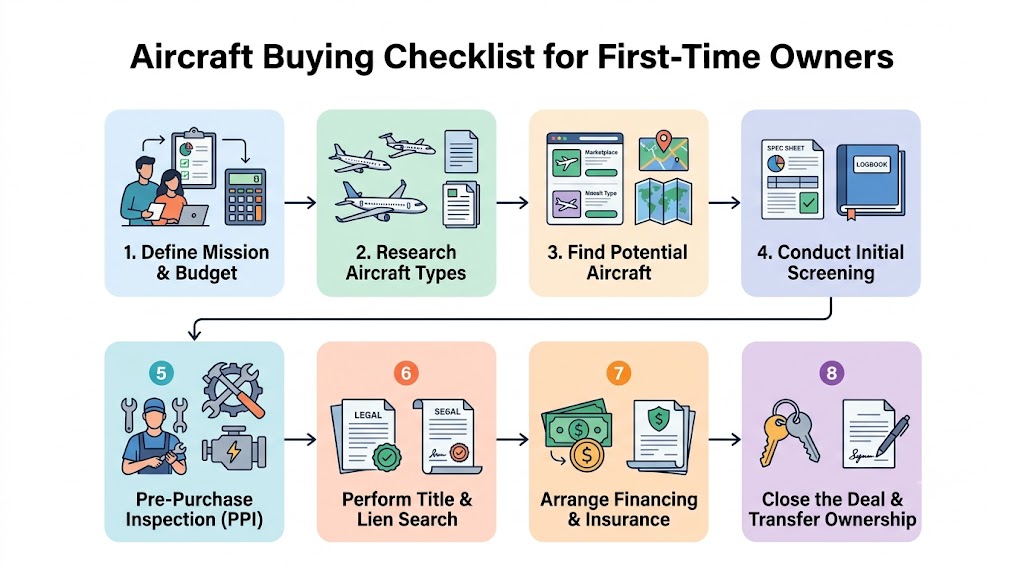
Introduction
Buying an aircraft is an important financial and operational decision. First-time buyers often begin by comparing aircraft models, cabin layouts, and asking prices. However, the purchase price tells only part of the story.
Every aircraft has different operating needs, maintenance requirements, and performance limits. The right choice depends on how you plan to use it, where you intend to fly, and how much you can afford to spend over time.
You must also review the aircraft’s records, legal status, maintenance history, and current condition. These checks can reveal issues that a sales listing may not explain.
A structured aircraft buying checklist helps you evaluate these factors before making a commitment. This guide covers each major step, from defining your travel needs to preparing for ownership after the purchase.
1. Define Your Aircraft Ownership Goals
Start by identifying why you want to own an aircraft. Your intended use should guide every decision that follows.
For example, an aircraft for short recreational trips may have different requirements from one used for regular business travel. A buyer who often carries several passengers may need more cabin space and useful load.
Ask Yourself These Questions
- Will you use the aircraft for personal, recreational, or business travel?
- How many passengers will you usually carry?
- What distances do you expect to travel?
- How much baggage will you need to carry?
- Which airports will you use most often?
- How many hours do you expect to fly each year?
- Will you operate the aircraft yourself or use qualified pilots?
- Will you manage the aircraft or hire a management company?
Your answers help establish a realistic set of requirements.
Also, separate your essential needs from optional features. You may prefer a larger cabin or advanced avionics, but these features can increase purchase and ownership costs.
A clear mission profile prevents you from choosing an aircraft that looks attractive but does not suit your actual travel needs.
2. Understand the Main Types of Aircraft
Aircraft differ in passenger capacity, range, speed, operating complexity, and maintenance needs. Understanding the main categories helps you narrow your options.
| Aircraft category | Potential uses | Important considerations |
|---|---|---|
| Single-engine piston | Recreational flying and shorter trips | Payload, weather suitability, operating limits, and pilot requirements |
| Multi-engine piston | Some longer trips and specialized missions | Greater system complexity, maintenance, and operating costs |
| Turboprop | Regional travel and certain business missions | Purchase price, fuel, maintenance, and runway requirements |
| Light business jet | Business travel for smaller groups | Range, baggage capacity, operating expenses, and airport access |
| Midsize or larger business jet | Longer trips or larger passenger groups | Higher acquisition and operating costs, crew needs, and airport limitations |
These categories provide a starting point, not a complete comparison. Aircraft within the same category can differ significantly.
Check More Than Passenger Capacity
A published seat count does not tell you how much weight or baggage the aircraft can carry on a particular flight. Fuel requirements, passenger weights, baggage, and operating conditions all matter.
Ask a qualified aviation professional to assess the aircraft against your intended routes and typical passenger load.
If possible, arrange an appropriate demonstration or supervised familiarization experience before making your decision. This can help you understand whether the aircraft suits your needs.
3. Set a Realistic Purchase and Ownership Budget
One of the most common mistakes is focusing only on the aircraft’s asking price. Aircraft ownership also involves recurring expenses and occasional major costs.
Your budget should cover both the purchase and the resources needed to operate the aircraft responsibly.
Initial Purchase Expenses
Plan for costs such as:
- Aircraft purchase price
- Independent pre-purchase inspection
- Legal and transaction services
- Financing charges, where applicable
- Applicable taxes and duties
- Registration and administrative expenses
- Import-related expenses, if relevant
- Initial maintenance or repairs identified before delivery
The exact expenses depend on the aircraft, seller, location, transaction structure, and applicable rules.
Recurring Ownership Expenses
You may also need to budget for:
- Fuel and lubricants
- Scheduled maintenance
- Unscheduled repairs
- Hangar or parking charges
- Insurance
- Engine and component maintenance reserves
- Pilot or crew costs, where applicable
- Training and proficiency requirements
- Aircraft management services
- Navigation data, subscriptions, and equipment updates
Some costs depend on flight hours, while others continue even when the aircraft rarely flies.
Ask for a realistic annual operating budget based on your expected use. Request estimates from qualified maintenance providers, insurers, and aircraft management professionals where appropriate.
Do not assume that a low purchase price means low ownership costs. An older aircraft may need substantial maintenance, while a more expensive aircraft may have different operating and support requirements.
4. Decide Between a New and Pre-Owned Aircraft
Both new and pre-owned aircraft can suit first-time buyers. The better option depends on your budget, availability needs, equipment preferences, and willingness to manage maintenance risks.
Buying a New Aircraft
A new aircraft may offer current equipment, a known delivery configuration, and applicable manufacturer warranty coverage.
However, buyers should still review the contract, delivery specifications, training arrangements, maintenance support, and warranty exclusions. Delivery schedules and final costs may also depend on the agreement.
Buying a Pre-Owned Aircraft
A pre-owned aircraft may offer more choices within a given budget. It may also have equipment or modifications that suit your needs.
However, its condition depends on its maintenance, operating, storage, and repair history. A detailed review is essential before committing.
Compare both options using the same criteria:
- Total purchase and delivery costs
- Expected maintenance requirements
- Available equipment and configuration
- Warranty or support arrangements
- Availability of parts and qualified maintenance
- Expected annual operating costs
- Resale considerations
Do not choose solely because an aircraft is new or inexpensive. Evaluate the specific aircraft and its suitability for your mission.
5. Compare Aircraft Models Carefully
After setting your budget and choosing a general category, compare individual models.
Start with the aircraft’s published specifications. Then ask a qualified professional to assess how those figures relate to your actual operating needs.
Key Features to Evaluate
Range: Can the aircraft support your typical trips with suitable reserves and operational flexibility?
Useful load: How much weight can the aircraft carry after accounting for its basic operating weight?
Baggage capacity: Will the available compartments accommodate your usual luggage?
Runway requirements: Can the aircraft use the airports you intend to visit under the relevant operating conditions?
Fuel consumption: What fuel use should you expect for your typical missions?
Avionics: Are the installed navigation, communication, and other systems suitable for your intended operations?
Maintenance support: Are qualified technicians, approved facilities, and necessary parts available?
Cabin layout: Does the seating and cabin arrangement fit your passenger needs?
Review the Aircraft’s Configuration
Two aircraft of the same model may have different equipment, interior layouts, modifications, and maintenance histories.
Confirm that the installed equipment matches the seller’s description. Ask whether modifications have the required approvals and supporting records.
A qualified aviation professional can help compare the aircraft’s configuration with its approved documentation and your intended use.
6. Review Aircraft History and Maintenance Records
An aircraft’s records help explain its history and maintenance status. They can also identify items that need further investigation before purchase.
Do not rely only on the seller’s verbal statements or a brief summary of maintenance work.
Documents to Review
Ask qualified professionals to help review the available documents, including:
- Registration and ownership-related records
- Airworthiness documentation
- Airframe maintenance logs
- Engine and propeller records, where applicable
- Inspection and repair records
- Records of major components
- Modification and installed-equipment documentation
- Relevant airworthiness directive compliance records
- Accident or damage history, where available
- Manuals and operating documentation
The exact documents required depend on the aircraft, its history, and the jurisdiction.
Look for missing entries, unexplained gaps, overdue work, and inconsistencies between the aircraft and its records. Ask the seller to explain any discrepancies and obtain supporting evidence where possible.
The Aircraft Owners and Pilots Association identifies maintenance records, airworthiness documents, and title checks as important parts of evaluating a used aircraft. <Cite refs={[“turn408063search2″,”turn408063search5”]}/>
Verify Legal Ownership Separately
Technical registration and legal ownership are not necessarily the same thing.
For aircraft registered in India, the Directorate General of Civil Aviation (DGCA) handles civil aircraft registration and airworthiness responsibilities. Official DGCA guidance also explains that registration does not, by itself, establish legal ownership. <Cite refs={[“turn408063search1″,”turn408063search24”]}/>
Use suitable legal and aviation professionals to verify ownership, any relevant liens or security interests, and the seller’s authority to complete the transaction.
7. Arrange an Independent Pre-Purchase Inspection
A pre-purchase inspection helps you understand the aircraft’s physical condition and identify maintenance issues before completing the transaction.
This is one of the most important steps when buying a pre-owned aircraft. The inspection should be performed by a qualified professional with suitable experience on the aircraft type.
Where practical, choose an independent inspector who is not influenced by the seller’s interests.
What Should the Inspection Cover?
The agreed inspection scope may include:
- Airframe condition
- Engine condition and available records
- Propeller or other relevant components
- Landing gear and braking systems
- Flight controls
- Avionics and installed equipment
- Evidence of corrosion or damage
- Previous repairs and modifications
- Maintenance status and upcoming work
- Items that may affect airworthiness or operating costs
The precise scope depends on the aircraft, its condition, and the agreed inspection arrangement.
Ask for a written report that identifies findings, recommended follow-up work, and items requiring further investigation.
What Happens If the Inspector Finds Problems?
Not every finding means you must abandon the purchase. Some issues may be minor, while others can involve substantial cost or operational concerns.
Ask the inspector to explain the significance of each finding. Obtain appropriate estimates for repairs and determine whether the issues affect airworthiness, the purchase price, or your intended use.
Make sure the purchase agreement explains how inspection findings will be handled. If significant issues remain unresolved, consider renegotiating the terms or withdrawing under the agreement’s applicable conditions.
A pre-purchase inspection reduces uncertainty, but it cannot guarantee that the aircraft will never develop a fault. <Cite refs={[“turn408063search8″,”turn408063search25”]}/>
8. Understand Maintenance and Future Repairs
Aircraft require ongoing maintenance to remain suitable for operation. The amount and timing of that work depend on the model, condition, usage, and applicable maintenance requirements.
Before buying, review the maintenance schedule and identify work that may become due soon after delivery.
Ask These Questions
- When are the next scheduled inspections due?
- Are any major components approaching required maintenance?
- Are there unresolved discrepancies?
- Is there a history of recurring technical problems?
- Are suitable maintenance facilities available nearby?
- How easily can necessary parts be obtained?
- What additional costs might arise from the aircraft’s current condition?
Request estimates from qualified maintenance providers when significant work is expected.
You should also consider how the aircraft will be managed. Some owners coordinate maintenance directly, while others use suitable management services.
A clear maintenance plan helps you prepare for recurring work and reduces the chance of unexpected expenses disrupting your ownership plans.
9. Review Insurance and Liability
Aircraft insurance is another important part of ownership planning. Available coverage and policy conditions depend on the aircraft, operator, intended use, pilot qualifications, and jurisdiction.
Before completing a purchase, speak with a qualified aviation insurance professional.
Review the available terms for:
- Aircraft damage and hull coverage
- Third-party liability
- Passenger liability, where applicable
- Pilot qualification requirements
- Permitted uses and operating conditions
- Deductibles and policy exclusions
- Coverage limits and territorial restrictions
Do not assume a policy automatically covers every pilot or every type of flight. Confirm the actual terms in writing.
Insurance requirements can also differ between personal use and commercial operations. If you intend to lease the aircraft or use it for business activities beyond ordinary private travel, obtain advice about the relevant operational and insurance implications.
10. Check Registration and Regulatory Requirements
Aircraft ownership involves legal and regulatory responsibilities. These vary by country, aircraft category, intended operation, and ownership structure.
If you are buying an aircraft in India, the DGCA is a key authority for civil aircraft registration and airworthiness matters. Its responsibilities include registration, airworthiness standards, and regulation of relevant aviation activities. <Cite refs={[“turn408063search1″,”turn408063search3”]}/>
Before purchasing, confirm the requirements that apply to your specific aircraft and transaction.
Important Areas to Verify
- Aircraft registration and transfer requirements
- Applicable airworthiness documentation
- Required inspections or reviews
- Import and customs requirements, where relevant
- Approved equipment and modifications
- Operating and pilot qualification requirements
- Insurance and other applicable obligations
For an imported aircraft, do not assume that documentation from another country automatically satisfies all local requirements.
Ask the relevant authority and qualified aviation professionals to confirm the process before you commit to the purchase. Requirements can change, so check current official guidance rather than relying on general online summaries.
11. Plan for Storage, Operations, and Support
Buying an aircraft is only the beginning. You must also determine where it will be stored and how it will be maintained and operated.
Consider Your Home Airport
Check the availability and cost of hangar space or suitable parking. Review access to fuel, maintenance facilities, ground handling, and other services you may need.
Also consider airport operating hours, runway suitability, and access to your usual destinations.
Decide Who Will Manage the Aircraft
You may be responsible for coordinating maintenance, records, insurance, scheduling, and other ownership tasks. Alternatively, a suitable aircraft management company may provide some of these services.
Before hiring a provider, review its scope of work, fees, reporting process, and responsibilities. Confirm which decisions remain yours as the owner.
Your plan should reflect your available time, experience, and intended level of involvement.
12. Understand Financing and Purchase Agreements
Aircraft purchases can involve substantial payments and detailed contractual arrangements. Buyers should understand the transaction before transferring funds or signing binding documents.
Review the Financial Arrangements
If you need financing, compare the lender’s terms, interest costs, deposit requirements, repayment schedule, and other conditions.
Ask whether the lender requires an independent inspection, particular insurance arrangements, or additional documentation.
Review the Purchase Agreement
The agreement should clearly address relevant matters such as:
- Aircraft identity and configuration
- Purchase price and payment schedule
- Deposit conditions
- Inspection arrangements
- How inspection findings will be handled
- Required documents and delivery conditions
- Responsibilities for taxes and transaction costs
- Cancellation and dispute provisions
Use a lawyer with appropriate aviation transaction experience when needed. Also confirm how ownership, any existing security interests, and registration-related steps will be handled at closing.
Do not treat a registration certificate as a substitute for verifying the legal transfer of ownership.
13. Prepare for Ownership After the Purchase
Your responsibilities continue after the aircraft is delivered. A first-time owner needs a plan for safe, compliant, and financially sustainable operation.
Build an Ownership Management Plan
Your plan should cover:
- Maintenance scheduling and records
- Insurance renewals
- Hangar or parking arrangements
- Operating budgets and reserves
- Pilot qualifications and training
- Regulatory compliance
- Flight planning and operational support
- Emergency contacts and service providers
If you will not operate the aircraft yourself, establish clear responsibilities with qualified pilots or an appropriate management provider.
Also review your annual budget regularly. Fuel prices, maintenance needs, utilization, and other expenses may change over time.
Good planning helps you manage the aircraft as an ongoing responsibility rather than a one-time purchase.
14. Common Aircraft Buying Mistakes to Avoid
Choosing Only by Purchase Price
A low asking price may hide expensive maintenance needs or a poor fit for your intended use.
Better approach: Compare total ownership costs and inspect the aircraft before making a final decision.
Skipping an Independent Inspection
A seller’s assurances cannot replace an objective technical assessment.
Better approach: Arrange a suitable inspection by a qualified, independent professional.
Ignoring Incomplete Records
Missing or inconsistent records can create uncertainty about maintenance, repairs, or compliance.
Better approach: Investigate gaps and obtain professional advice before proceeding.
Buying More Aircraft Than You Need
A larger or more capable aircraft may increase acquisition and operating expenses without providing enough practical value.
Better approach: Match the aircraft to your normal trips, passenger needs, and budget.
Underestimating Maintenance Costs
Unexpected repairs can place pressure on an unprepared budget.
Better approach: Review upcoming maintenance and maintain appropriate financial reserves.
Overlooking Legal Ownership Checks
Registration alone may not establish legal ownership or reveal every relevant financial interest.
Better approach: Arrange suitable title and transaction checks before closing.
Rushing the Purchase
Pressure to complete a deal can lead buyers to overlook important questions.
Better approach: Set clear conditions for inspection, documentation, financing, and delivery. Be prepared to pause if important concerns remain unresolved.
15. Aircraft Buying Checklist for First-Time Owners
Use this checklist to organize your purchase process.
Mission and Budget
- Define the aircraft’s main purpose.
- Estimate passenger, baggage, and route requirements.
- Set a realistic purchase budget.
- Estimate recurring and unexpected ownership costs.
- Compare suitable aircraft categories and models.
Aircraft Condition and Records
- Review maintenance and repair history.
- Check airworthiness documentation.
- Review engine and component records.
- Verify installed equipment and modifications.
- Arrange an independent pre-purchase inspection.
- Obtain estimates for significant findings.
Legal and Financial Checks
- Verify legal ownership and relevant title issues.
- Review registration and transfer requirements.
- Confirm applicable insurance arrangements.
- Review financing terms, if applicable.
- Have the purchase agreement reviewed as needed.
- Confirm taxes, fees, and delivery conditions.
Ownership Preparation
- Identify suitable storage and airport facilities.
- Arrange maintenance support.
- Confirm pilot and training requirements.
- Plan annual operating expenses.
- Decide whether management services are needed.
- Establish a process for records and regulatory compliance.
Final checkpoint: Do not complete the purchase until important inspection findings, ownership questions, documentation gaps, and contractual conditions have been addressed to your satisfaction.
Frequently Asked Questions
Q1. What should first-time aircraft buyers check before purchasing?
Start with your intended use, budget, and aircraft suitability. Then review maintenance records, verify legal ownership, arrange an independent inspection, and confirm insurance and regulatory requirements.
Q2. Is a new aircraft better than a used aircraft?
Neither option is automatically better. A new aircraft may offer different warranty and equipment benefits, while a pre-owned aircraft may offer more choices within a budget. Compare the specific aircraft and its total ownership costs.
Q3. How much does it cost to own an aircraft?
Costs depend on aircraft type, condition, annual flight hours, storage, fuel, maintenance, insurance, and staffing needs. Request estimates based on your intended use rather than relying on a universal figure.
Q4. Why is a pre-purchase inspection important?
It helps identify technical issues, maintenance concerns, and possible future expenses before the transaction closes. It should be conducted by a qualified professional with relevant aircraft experience.
Q5. What aircraft documents should a buyer review?
Relevant documents may include registration, airworthiness records, maintenance logs, engine and component records, repair history, and approved modification documentation. The exact requirements depend on the aircraft and jurisdiction.
Q6. How can buyers choose the right aircraft?
Define your typical routes, passenger numbers, baggage needs, and annual usage. Compare aircraft performance, payload, operating costs, maintenance support, and airport suitability.
Q7. What ongoing costs should aircraft owners expect?
Common costs include fuel, maintenance, insurance, storage, inspections, and possible pilot or management services. Some costs vary with usage, while others continue throughout the year.
Q8. Can first-time buyers use aircraft management services?
Yes, where suitable services are available. A management provider may help coordinate selected tasks, but buyers should review the contract, fees, responsibilities, and reporting arrangements carefully.
Q9. What regulatory checks are required before buying an aircraft in India?
The requirements depend on the aircraft, transaction, and intended operation. Buyers should verify applicable registration, airworthiness, import, and operating requirements with the DGCA and other relevant authorities.
Q10. Should a buyer hire an aviation professional before purchasing?
Yes. Qualified maintenance, legal, insurance, and financial professionals can help assess different parts of the transaction. Their advice is especially useful when the buyer has limited aircraft ownership experience.
Conclusion
Buying your first aircraft requires careful preparation, realistic budgeting, and independent verification. Choose an aircraft that fits your actual travel needs rather than focusing only on its appearance or asking price. Review maintenance records, arrange a qualified pre-purchase inspection, and verify legal ownership before completing the transaction. Plan for insurance, storage, regulatory responsibilities, and ongoing operating expenses. With the right professional support and a structured checklist, you can make a more informed decision and prepare for the responsibilities of aircraft ownership.
