
Introduction
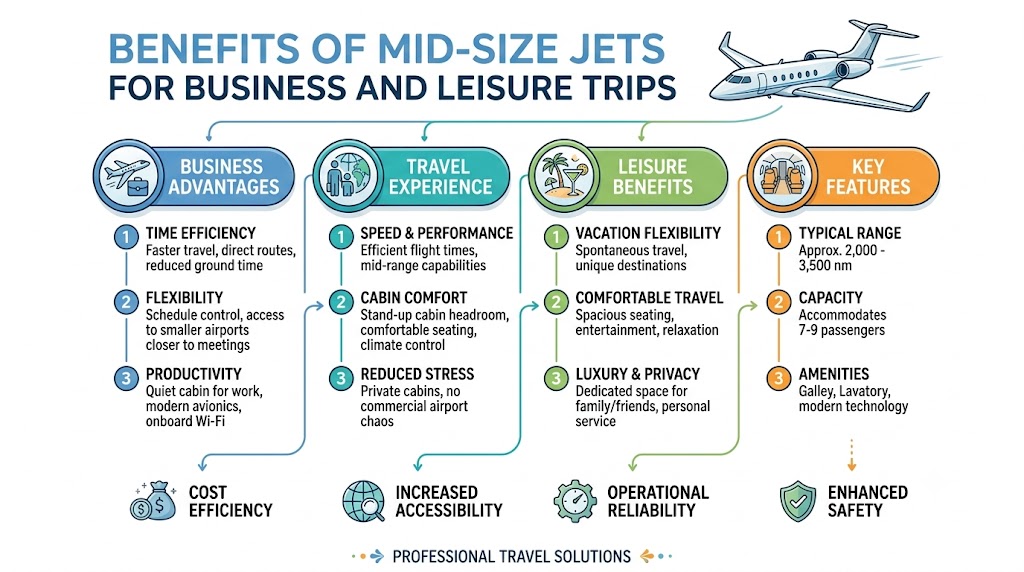
Mid-size jets occupy a practical position between light jets and larger long-range aircraft. They offer more cabin space, greater baggage capacity, longer range, and stronger passenger comfort while generally avoiding the additional size and operating complexity associated with heavy jets.
For business travelers, this combination can support productive travel with fewer compromises. For leisure travelers, it can provide a more comfortable experience for families, small groups, and longer journeys.
The real advantage of a mid-size jet is not simply its size. It is the balance it creates between range, comfort, flexibility, operating economics, and passenger capacity.
What Is a Mid-Size Jet?
A mid-size jet is a business aircraft designed to carry more passengers and travel farther than most light jets while remaining smaller and generally more economical than heavy or large-cabin aircraft.
Typical characteristics include:
- A larger cabin than light jets
- Greater baggage capacity
- Increased range
- More comfortable seating arrangements
- Improved onboard amenities
- Better suitability for longer nonstop flights
- Access to a broader selection of airports than larger aircraft
- Capacity commonly suited to small groups and corporate travel
Exact specifications vary considerably between aircraft models. Range, passenger capacity, baggage limits, cabin dimensions, and performance should always be confirmed for the specific aircraft being chartered.
Why Mid-Size Jets Are Useful for Business Travel
Business aviation is often about controlling time and reducing unnecessary travel friction. A mid-size jet can support that objective by combining a capable aircraft with a relatively flexible operating profile.
1. More Productive Travel Time
A larger cabin can make it easier for passengers to work during the flight.
Depending on the aircraft configuration, travelers may have access to:
- Work tables
- Power outlets
- Connectivity
- Comfortable individual seating
- Space for laptops and documents
- Conference-style seating arrangements
This does not mean every mid-size jet provides a full office environment. Connectivity and onboard equipment vary by aircraft and operator.
For executives and teams traveling between meetings, however, the ability to work comfortably in transit can make the journey more useful.
2. Better Suitability for Longer Business Trips
Light jets can be highly effective for shorter routes, but longer journeys may place greater emphasis on cabin comfort, baggage capacity, and endurance.
Mid-size aircraft generally provide a better balance for trips where travelers want to avoid unnecessary fuel stops or excessive cabin limitations.
The appropriate aircraft still depends on:
- Route distance
- Weather
- Passenger load
- Required fuel reserves
- Airport conditions
- Baggage requirements
- Aircraft performance
- Operational restrictions
A published maximum range should therefore never be treated as a guaranteed nonstop capability for a particular trip.
3. More Space for Small Business Teams
A mid-size jet can be particularly useful when several colleagues need to travel together.
Instead of coordinating multiple commercial itineraries, a company may charter one aircraft for the group.
Potential advantages include:
- Shared travel schedule
- Private conversations
- Flexible departure planning
- Common arrival time
- Easier coordination of meetings
- Reduced separation between team members
The value becomes more apparent when the itinerary involves several people traveling to the same destination or multiple destinations.
Why Mid-Size Jets Work Well for Leisure Travel
The same characteristics that make these aircraft useful for business can also improve leisure travel.
1. Greater Cabin Comfort
Leisure travelers often place more emphasis on comfort than pure transportation efficiency.
A mid-size jet can provide additional room for:
- Relaxing
- Reading
- Conversation
- Eating
- Working remotely
- Moving around the cabin
Cabin configuration varies substantially, so travelers should review the actual aircraft rather than relying solely on the category name.
2. More Baggage Flexibility
Leisure trips can involve significantly more luggage than short business journeys.
Passengers may need space for:
- Multiple suitcases
- Sporting equipment
- Outdoor equipment
- Family luggage
- Personal items
However, baggage capacity is aircraft-specific. Operators should confirm both the available baggage volume and any weight restrictions before booking.
3. Better for Families and Small Groups
For a family or small group, a mid-size jet can provide a useful middle ground.
The aircraft may offer:
- More personal space
- Greater seating flexibility
- Private travel
- More convenient scheduling
- Better luggage accommodation
- A quieter environment than many commercial travel alternatives
The practical benefit depends on the group’s size and itinerary. A larger aircraft is not automatically more efficient if the group does not need its additional capacity.
Key Benefits at a Glance
| Benefit | Business Travel | Leisure Travel |
|---|---|---|
| Larger cabin | Useful for working | Useful for relaxing |
| Longer-range capability | Supports longer business routes | Supports longer vacations |
| Baggage capacity | Useful for business equipment | Useful for family luggage |
| Schedule flexibility | Helps coordinate meetings | Supports customized departures |
| Privacy | Supports confidential discussions | Creates a private travel environment |
| Small-group capacity | Useful for executive teams | Useful for families and groups |
| Airport flexibility | Can support convenient routing | Can simplify destination access |
| Cabin amenities | Supports productive travel | Improves comfort |
3. Greater Airport Flexibility
One of the most practical benefits of private aviation is access to airports that may not be served by the traveler’s preferred commercial itinerary.
A mid-size aircraft may be capable of operating from airports closer to a business meeting, residence, resort, or final destination.
This can potentially reduce:
- Ground transportation time
- Airport transfers
- Connecting flights
- Waiting between flights
- Unnecessary positioning
Airport suitability must still be checked for every specific aircraft and trip. Runway length, weather, aircraft performance, airport operating hours, and local restrictions can all affect feasibility.
4. More Flexible Departure Planning
Commercial aviation operates around published schedules. Charter travel can offer greater flexibility around the passenger’s itinerary.
For example, a business traveler may need to:
- Attend a morning meeting.
- Depart later in the day.
- Fly directly to another city.
- Attend an evening event.
- Return without building the itinerary around commercial flight schedules.
A leisure traveler may similarly want to coordinate departure around:
- Hotel checkout
- Sporting events
- Family schedules
- Resort transfers
- Cruise embarkation
- Connecting ground transportation
This flexibility is one of the primary reasons private charter can be attractive.
Mid-Size Jets vs. Other Aircraft Categories
Choosing a mid-size aircraft makes more sense when its characteristics are compared with the alternatives.
| Factor | Light Jet | Mid-Size Jet | Heavy Jet |
|---|---|---|---|
| Cabin space | Limited | Moderate to spacious | Large |
| Typical passenger requirement | Small groups | Small to medium groups | Larger groups |
| Longer trips | More constrained | Strong fit for many routes | Strong fit |
| Baggage needs | Moderate | Higher capacity | High capacity |
| Operating complexity | Lower | Moderate | Higher |
| Cost profile | Generally lower | Middle range | Generally higher |
| Best use | Shorter trips | Balanced business/leisure travel | Larger groups and long-range travel |
These are broad category-level observations rather than guarantees. Aircraft specifications differ significantly within each class.
When a Mid-Size Jet Makes the Most Sense
A mid-size aircraft can be particularly appropriate when several requirements overlap.
Consider one when you need:
- More cabin space than a light jet
- Longer-range capability
- Additional baggage capacity
- Comfortable travel for a small group
- Greater schedule flexibility
- Privacy for business discussions
- A balance between comfort and operating cost
- Access to suitable regional airports
The strongest use case is often the traveler who needs more capability than a light jet but does not require the capacity of a heavy aircraft.
Business Scenario: Executive Multi-City Travel
Consider a hypothetical executive team traveling between three cities over two days.
A commercial itinerary might require:
- Multiple flight schedules
- Connections
- Overnight accommodation
- Additional airport transfers
- Fixed departure times
A chartered mid-size jet could potentially allow the group to structure the itinerary around its meetings instead.
The important point is not simply that the aircraft is faster. The overall travel schedule may become more efficient because the aircraft, departure timing, and airport selection can be coordinated around the business itinerary.
Leisure Scenario: Family Vacation
Consider a family traveling with several bags to a destination where commercial flight options require a connection.
A mid-size jet may provide:
- Direct routing where operationally feasible
- More cabin space
- Greater baggage flexibility
- Customized departure timing
- A private environment
Again, the actual benefit depends on route availability, aircraft capability, weather, airport restrictions, and charter pricing.
Understanding the Cost Trade-Off
A common mistake is to compare charter pricing only against the price of commercial airline tickets.
The more useful calculation considers the total travel requirement.
Potential factors include:
- Aircraft charter cost
- Positioning requirements
- Airport fees
- Crew expenses
- Ground transportation
- Accommodation
- Travel time
- Lost working hours
- Number of passengers
- Baggage requirements
- Additional flight legs
For business travel, time can have economic value. For leisure travel, convenience and flexibility may carry greater importance.
However, convenience should not be confused with guaranteed cost savings. Private charter can be substantially more expensive than commercial travel depending on the itinerary and aircraft.
Operational Factors Travelers Should Understand
Aircraft Availability
The aircraft category requested may not always be available at the preferred departure location.
Ask the operator:
- What aircraft will actually operate the flight?
- Is the aircraft guaranteed or subject to substitution?
- Where is the aircraft positioned?
- Could repositioning affect the total price?
- What happens if the requested aircraft becomes unavailable?
Aircraft Age and Condition
Aircraft age alone does not determine whether an aircraft is appropriate.
More useful questions concern:
- Maintenance status
- Operator oversight
- Inspection requirements
- Cabin condition
- Aircraft records
- Crew qualifications
- Operational history
The operator should be able to explain relevant operational and maintenance information within appropriate privacy and commercial limits.
Crew
A capable aircraft still depends on properly qualified crew.
Travelers can ask about:
- Pilot qualifications
- Aircraft-specific experience
- Required training
- Crew duty considerations
- Operator safety procedures
The exact regulatory requirements depend on the jurisdiction and operating certificate under which the flight is conducted.
Safety Should Be Evaluated at the Operator Level
A polished cabin should not be the primary measure of charter quality.
Travelers should consider the operator’s:
- Regulatory status
- Safety management practices
- Maintenance program
- Pilot training
- Operational oversight
- Insurance
- Aircraft documentation
- Emergency procedures
It is also useful to understand who is actually operating the aircraft. A booking company, broker, and aircraft operator may be different entities.
That distinction matters because the company arranging the trip may not be the company responsible for operating the flight.
Common Mistakes When Selecting a Mid-Size Jet
1. Choosing Based Only on Cabin Photos
Marketing photographs can make aircraft appear more spacious than they are.
Instead, confirm:
- Cabin dimensions
- Seating configuration
- Actual aircraft model
- Baggage capacity
- Passenger limitations
2. Treating Published Range as Guaranteed
Maximum range figures are based on defined assumptions.
Actual performance can be affected by:
- Passenger weight
- Baggage
- Weather
- Wind
- Routing
- Fuel reserves
- Runway conditions
- Operational requirements
Ask the operator whether the intended itinerary can be completed nonstop under realistic operating conditions.
3. Ignoring Baggage Restrictions
A cabin may comfortably accommodate passengers while the baggage compartment cannot accommodate everything they plan to bring.
This is particularly important for:
- Families
- Golf groups
- Ski trips
- Photography equipment
- Sporting equipment
- Extended vacations
4. Comparing Aircraft Categories Instead of Actual Aircraft
“Mid-size jet” is a category, not a single aircraft specification.
Two aircraft in the same category can differ substantially in:
- Cabin layout
- Range
- Seating
- Baggage capacity
- Connectivity
- Lavatory configuration
- Performance
Always compare the actual aircraft being offered.
A Practical Decision Framework
Before selecting a mid-size jet, work through five questions.
1. How many people are traveling?
Passenger count establishes the basic capacity requirement.
2. How far is the journey?
Distance helps determine whether the aircraft’s realistic range is suitable.
3. How much baggage is required?
Weight and volume can both matter.
4. How important is cabin space?
A traveler primarily concerned with transportation may have different requirements from someone expecting to work or relax throughout the flight.
5. What is the value of flexibility?
If the itinerary involves multiple destinations, remote airports, tight meetings, or unusual departure times, flexibility may become a major consideration.
Questions to Ask Before Booking
A professional charter inquiry should cover more than price.
Aircraft
- What exact aircraft model is being proposed?
- How many passengers can it accommodate?
- What is the usable baggage capacity?
- What cabin amenities are available?
- Is there a lavatory?
Route
- Can the aircraft fly the requested route nonstop?
- Which airports can it use?
- Are there operational restrictions?
- What happens if weather affects the planned routing?
Crew and Operations
- Who is operating the aircraft?
- What qualifications and training standards apply to the crew?
- Is the aircraft operated directly or through another provider?
Pricing
- What is included in the quoted price?
- Are repositioning costs included?
- Are airport fees included?
- Are there additional waiting or overnight charges?
- What are the cancellation terms?
Contingency Planning
- What happens if the aircraft becomes unavailable?
- What is the substitution policy?
- How are significant schedule disruptions handled?
How to Choose the Right Mid-Size Jet
The right aircraft is determined by the mission rather than by the aircraft’s marketing description.
A useful evaluation sequence is:
Passenger count → Route → Range → Baggage → Cabin requirements → Airport suitability → Schedule → Cost → Operator → Contract terms
This order prevents travelers from choosing an aircraft based primarily on appearance or price before confirming whether it can actually perform the mission.
Benefits and Limitations
Benefits
- More cabin space than many light jets
- Greater suitability for longer trips
- Useful baggage capacity
- Flexible scheduling
- Private travel environment
- Good fit for small business teams
- Comfortable option for family travel
- Potential access to convenient airports
Limitations
- Higher charter cost than smaller aircraft in many situations
- Not every mid-size aircraft offers the same range
- Aircraft availability can be limited
- Weather can affect nonstop capability
- Baggage limitations still apply
- Larger aircraft may be unnecessary for very small groups
- Airport suitability must be confirmed for the specific aircraft
Best Practices for Business Travelers
Business travelers should focus on the mission, not simply the aircraft category.
Before booking:
- Define the complete itinerary.
- Identify the required passenger count.
- Confirm baggage requirements.
- Determine whether nonstop travel is operationally realistic.
- Verify the actual aircraft.
- Confirm airport suitability.
- Review operator information.
- Understand the complete quotation.
- Review cancellation and substitution terms.
- Build reasonable schedule flexibility into the itinerary.
Best Practices for Leisure Travelers
Leisure travelers should pay particular attention to comfort and practical logistics.
Consider:
- Actual cabin configuration
- Family seating requirements
- Baggage volume
- Sporting equipment
- Catering requirements
- Ground transportation
- Departure flexibility
- Airport proximity to the destination
- Aircraft substitution policies
A slightly smaller aircraft that fits the mission can sometimes be more practical than selecting a larger aircraft simply because it offers more space.
Mid-Size Jet Selection Checklist
Before confirming a charter, verify:
- Passenger count confirmed
- Exact aircraft identified
- Cabin configuration reviewed
- Baggage requirements confirmed
- Route feasibility checked
- Nonstop capability confirmed
- Departure and arrival airports confirmed
- Crew and operator information reviewed
- Pricing and additional charges understood
- Cancellation terms reviewed
- Aircraft substitution policy understood
- Weather contingency discussed
- Ground transportation arranged where necessary
Frequently Asked Questions
Q1. What is a mid-size jet best suited for?
Mid-size jets are generally suited to travelers who need more cabin space, baggage capacity, and range than a light jet can provide without requiring the size of a heavy aircraft.
Q2. Are mid-size jets suitable for business travel?
Yes. Their cabin space, privacy, range, and flexible scheduling can make them practical for executives and small business teams.
Q3. Are mid-size jets suitable for family vacations?
They can be. Families may benefit from additional cabin space, baggage capacity, privacy, and flexible departure scheduling.
Q4. Can a mid-size jet fly any route nonstop?
No. Nonstop capability depends on the specific aircraft, route, weather, payload, fuel requirements, airport conditions, and operational restrictions.
Q5. Do all mid-size jets have the same cabin size?
No. Aircraft within the same category can have significantly different cabin dimensions, seating layouts, amenities, and baggage capacity.
Q6. Is a mid-size jet always more economical than a heavy jet?
Not necessarily. The appropriate aircraft depends on passenger numbers, route, availability, positioning, and other operating costs.
Q7. What should I check besides the aircraft price?
Review the complete quotation, including positioning, airport charges, crew-related expenses, waiting time, overnight costs, cancellation terms, and possible aircraft substitution.
Q8. How much baggage can a mid-size jet carry?
Capacity varies by aircraft. Travelers should provide the operator with the number, size, and approximate weight of their bags rather than relying on a generic category limit.
Q9. Should I choose an aircraft based on its maximum range?
No. Maximum range is only one specification. The operator should confirm whether the aircraft can realistically complete your specific itinerary with the required passengers, baggage, fuel reserves, and operational considerations.
Q10. What is the biggest advantage of a mid-size jet?
Its main advantage is the balance between cabin comfort, range, passenger capacity, baggage capability, and operational flexibility.
Final Recommendation
Mid-size jets can be a practical choice when travelers need more capability than a light jet but do not require a heavy aircraft.
For business trips, they can combine privacy, productive cabin space, and flexible scheduling.
For leisure travel, their additional room and baggage capacity can improve comfort for families and small groups.
The best choice should be based on the actual route, passenger count, baggage, airport requirements, and operating conditions.
Travelers should compare the specific aircraft and operator rather than relying only on the mid-size category.
A well-matched aircraft provides the greatest value when its capabilities align closely with the trip’s actual requirements.
