
Introduction
Light jet charter services provide a flexible way to travel by private aircraft without the ownership responsibilities associated with purchasing and operating a jet. They are particularly useful for short- and medium-distance journeys where travelers value schedule flexibility, private cabins, direct routing, and access to airports that may be less convenient for conventional commercial travel.
However, booking a light jet is not simply a matter of selecting an aircraft and paying for a flight. The aircraft’s range, passenger capacity, baggage limitations, airport suitability, weather, operating restrictions, repositioning requirements, and charter operator all affect the practical value of a trip.
A well-planned charter begins with the mission rather than the aircraft. Travelers should first define where they need to go, when they need to arrive, how many people are traveling, how much baggage they have, and what level of onboard comfort they expect. The charter provider can then identify aircraft and routing options that genuinely fit those requirements.
What Is a Light Jet Charter?
A light jet charter is a privately arranged flight using a smaller business jet designed primarily for short- and medium-distance travel.
Compared with larger private jets, light jets generally have:
- Smaller passenger cabins
- Lower operating costs
- Lower fuel consumption
- Shorter range
- More limited baggage capacity
- Access to smaller airports
- Faster boarding and ground handling than typical commercial travel
The exact configuration varies considerably between aircraft. Some light jets are designed around efficiency and short trips, while others provide more cabin space, improved baggage capacity, or enhanced avionics.
A charter flight may be arranged as a dedicated trip for one group rather than selling individual seats to unrelated passengers. This gives the travelers greater control over the itinerary and onboard environment.
Who Typically Uses Light Jet Charter Services?
Light jets can be appropriate for several types of travelers.
Business Travelers
Executives and business teams may use light jets when several meetings need to be completed across different cities within a limited period.
The ability to select suitable airports and departure times can reduce unnecessary ground transfers.
Families and Private Groups
Families may value the privacy of traveling together without navigating a crowded terminal or coordinating around commercial schedules.
Leisure Travelers
A light jet can be useful for weekend trips, resort destinations, sporting events, private gatherings, or multi-destination itineraries.
Small Corporate Teams
A company may charter a light jet when a small team needs to travel together and the schedule is more important than purchasing separate commercial tickets.
Travelers Visiting Smaller Destinations
One of the practical advantages of private aviation is airport flexibility. Some destinations are better served by smaller regional airports than by major commercial hubs.
When Does a Light Jet Make Sense?
The decision should be based on the complete travel requirement rather than the aircraft category alone.
A light jet can be particularly useful when:
- The group is relatively small.
- The journey is within the aircraft’s practical range.
- Travelers need schedule flexibility.
- The destination is conveniently served by a smaller airport.
- Multiple commercial connections would otherwise be required.
- Privacy is important.
- The group needs to travel together.
- Time spent on ground transportation is significant.
- The itinerary involves multiple stops.
A light jet may be less appropriate when the passenger group is large, the route is exceptionally long, substantial baggage is required, or the destination requires an aircraft with capabilities beyond the light-jet category.
Light Jet vs. Other Private Aircraft Categories
Aircraft categories overlap, so travelers should avoid choosing based purely on labels.
| Factor | Light Jet | Midsize Jet | Heavy Jet |
|---|---|---|---|
| Typical passenger capacity | Small group | Medium group | Larger group |
| Cabin size | Compact | More spacious | Significantly larger |
| Range | Short to medium | Medium to longer | Long |
| Operating cost | Generally lower | Higher | Highest |
| Airport flexibility | Often strong | Varies | More restrictive at some airports |
| Baggage capacity | Limited to moderate | Moderate to high | High |
| Best suited for | Shorter private trips | Longer trips and larger groups | Long-distance and larger-group travel |
These are broad categories rather than universal specifications. Individual aircraft models can differ substantially.
How Light Jet Charter Booking Works
The booking process normally begins with a trip request.
The provider may ask for:
- Departure airport or preferred region
- Destination
- Travel date
- Departure time
- Number of passengers
- Baggage requirements
- Return details, if applicable
- Special requirements
- Preferred airport options
- Any pets or mobility considerations
The provider then evaluates aircraft availability, routing, operating limitations, crew requirements, airport suitability, and other operational factors.
The quote may include an aircraft option, itinerary, estimated departure and arrival times, pricing, and applicable terms.
Before accepting the proposal, travelers should examine what is actually included rather than comparing only the headline price.
Choosing the Right Aircraft
Aircraft selection should start with the mission.
Passenger Count
Do not assume that the published maximum seating capacity represents the most comfortable configuration for your group.
Consider:
- Number of travelers
- Cabin layout
- Seating configuration
- Personal space requirements
- Crew requirements
- Baggage volume
If everyone is traveling with substantial luggage, an aircraft that technically accommodates the passengers may still be impractical.
Range
Published aircraft range should not be treated as an absolute promise for every route.
Actual operational range can be affected by:
- Passenger weight
- Baggage
- Weather
- Winds
- Fuel requirements
- Alternate-airport requirements
- Routing
- Airport restrictions
- Regulatory requirements
Ask the charter provider whether the proposed aircraft can operate the planned route under realistic conditions without an unnecessary fuel stop.
Airport Compatibility
Airport selection can have a major impact on the value of a charter.
A smaller airport may be closer to the final destination, but the aircraft still needs to be authorized and operationally suitable for that airport.
Relevant considerations include:
- Runway characteristics
- Aircraft performance
- Airport operating hours
- Weather conditions
- Navigation facilities
- Customs and immigration requirements
- Ground handling
- Parking availability
- Noise or operational restrictions
Understanding Light Jet Charter Pricing
Charter pricing is rarely based on distance alone.
The total cost may reflect:
- Aircraft type
- Flight time
- Aircraft availability
- Positioning or repositioning
- Crew costs
- Fuel
- Airport charges
- Handling fees
- Landing fees
- Overnight expenses
- Catering
- De-icing where applicable
- International requirements
- Taxes and applicable charges
- Special passenger requests
Empty-Leg Opportunities
An empty leg occurs when an aircraft needs to reposition without passengers on part of its itinerary.
If the timing and route happen to match your plans, an empty-leg opportunity may provide a lower-cost option.
However, flexibility is essential. Empty-leg schedules can be less suitable for travelers who require a fixed itinerary.
One-Way vs. Round Trip
A round trip is not necessarily priced as exactly twice the one-way fare.
Aircraft positioning, crew requirements, overnight stays, and scheduling can influence the total.
Always request the complete price for the actual itinerary rather than calculating it independently.
What a Charter Quote Should Tell You
A professional quotation should provide enough information for the traveler to understand what is being purchased.
Look for details such as:
- Aircraft type
- Passenger capacity
- Proposed itinerary
- Departure and arrival airports
- Estimated flight times
- Total price
- Included services
- Additional charges
- Cancellation terms
- Payment requirements
- Aircraft substitution provisions
- Catering arrangements
- Baggage limitations
If important costs are described only as “additional” without explanation, ask for clarification before confirming the trip.
Safety and Operator Selection
Safety should be evaluated at the operator level as well as the aircraft level.
Travelers should understand:
- Who operates the aircraft
- Whether the flight is being operated directly or arranged through another provider
- The operator’s certification status where applicable
- Crew qualifications
- Aircraft maintenance responsibilities
- Operational oversight
- Safety-management practices
- Insurance arrangements
A broker and an aircraft operator are not necessarily the same company.
This distinction matters because the company arranging your trip may not be the company actually operating the aircraft.
Ask explicitly:
Who will be the operating carrier for my flight?
That single question can clarify several important parts of the booking.
Why Aircraft Age Alone Is Not a Useful Safety Shortcut
Aircraft age should not be treated as a standalone measure of safety or quality.
A well-maintained aircraft with appropriate inspections, maintenance programs, qualified crews, and strong operational oversight can be very different from another aircraft of similar age operated under different standards.
More useful questions focus on:
- Maintenance status
- Required inspections
- Operator oversight
- Crew qualifications
- Operational history
- Aircraft suitability
- Maintenance organization
- Safety procedures
Travelers generally benefit from evaluating the operator and specific aircraft together.
Understanding the Crew
The flight crew plays an important role in the operation of a charter.
Depending on the aircraft and operation, travelers should understand:
- Number of pilots
- Pilot qualifications
- Experience relevant to the aircraft
- Crew duty limitations
- Rest requirements
- Backup arrangements
Operational decisions may occasionally require changes to routing, timing, or airport selection. A professional operator should prioritize safe operation rather than treating the original itinerary as an absolute requirement.
What to Expect at the Airport
Private aviation does not eliminate airport procedures, but the experience can differ significantly from commercial travel.
The exact process varies by airport and operation.
Travelers may use:
- Private terminals
- Fixed-base operators
- Dedicated passenger facilities
- Separate security procedures
- Private lounges
- Direct vehicle access to aircraft in some locations
For international travel, immigration and customs requirements still apply.
Travelers should confirm the required arrival time with the charter provider rather than assuming they can arrive immediately before departure.
Baggage Planning
Baggage is one of the most commonly overlooked aspects of light jet travel.
A cabin may have enough seats for the passengers while the aircraft has insufficient baggage capacity for everyone’s luggage.
Consider:
- Number of bags
- Bag dimensions
- Weight
- Hard-shell luggage
- Sporting equipment
- Golf equipment
- Musical instruments
- Oversized items
- Strollers
- Special equipment
Tell the provider about unusual baggage before the aircraft is finalized.
Do not wait until departure day to discover that an important item cannot be accommodated.
Pets and Special Requirements
If you are traveling with a pet, wheelchair, medical equipment, sporting equipment, or another special item, disclose it during the booking process.
The provider may need to verify:
- Aircraft compatibility
- Cabin or baggage-space requirements
- Airport procedures
- Documentation
- Handling arrangements
- Local regulations
Special requests can affect aircraft selection and should therefore be addressed before the final quote is accepted.
Catering and Onboard Services
Light jets vary widely in their onboard facilities.
Depending on the aircraft, travelers may have access to:
- Snacks
- Beverages
- Hot or cold meals
- Wi-Fi
- Entertainment systems
- Power outlets
- Work tables
- Lavatory facilities
Do not assume that every light jet provides the same amenities.
If a specific service matters to your trip, request confirmation before booking.
For example, travelers who need to work during the flight may want to confirm the availability and practical reliability of connectivity rather than simply asking whether Wi-Fi is “available.”
Scheduling and Flexibility
One of the main reasons people choose charter aviation is schedule flexibility.
However, flexibility has practical limits.
The aircraft, crew, airport, air traffic environment, weather, and regulatory requirements all influence the actual operation.
A professional charter plan should account for potential changes rather than assuming every departure and arrival time is guaranteed under every circumstance.
For important business meetings or connecting travel, build reasonable time buffers into the itinerary.
Weather and Operational Disruptions
Weather can affect private aviation just as it affects commercial aviation.
Potential consequences include:
- Departure delays
- Route changes
- Diversions
- Airport changes
- Additional fuel requirements
- Cancellation or rescheduling
A smaller aircraft may also have different performance limitations from a larger aircraft.
The correct response to challenging weather is not to pressure the crew into maintaining the original schedule. Operational decisions should remain with qualified flight crews and the operator’s procedures.
Common Light Jet Charter Mistakes
1. Choosing the Cheapest Quote
The lowest headline price may not represent the lowest total cost.
A cheaper aircraft could require additional positioning, a less convenient airport, or other charges.
2. Focusing Only on Passenger Capacity
Seats are only one part of aircraft suitability.
Cabin configuration and baggage capacity matter too.
3. Ignoring Airport Location
Saving flight time is less useful if the selected airport creates a long ground transfer.
4. Not Asking Who Operates the Flight
The booking company may be different from the actual aircraft operator.
5. Assuming Every Service Is Included
Catering, ground transportation, special handling, and other services may be charged separately.
6. Providing Incomplete Baggage Information
Unexpected baggage can create operational complications.
7. Ignoring Cancellation Terms
Charter contracts can contain specific cancellation and change provisions.
Review them before payment.
8. Treating an Empty Leg Like a Guaranteed Commercial Flight
Empty-leg availability can depend heavily on the aircraft’s positioning requirements.
9. Assuming Aircraft Substitution Is Impossible
Operational circumstances can result in an aircraft change.
Review the contract to understand the provider’s substitution policy.
10. Leaving Everything Until Departure Day
Important details should be resolved before the travel date, particularly international documentation, special baggage, pets, and airport arrangements.
A Practical Charter Decision Framework
Before selecting a light jet, evaluate the trip across five areas.
| Decision Area | Questions to Ask |
|---|---|
| Mission | What cities and airports need to be served? |
| Passengers | How many people are traveling? |
| Baggage | How much luggage and special equipment is involved? |
| Schedule | How important are departure and arrival times? |
| Budget | What is the complete trip cost, including additional services? |
Then evaluate the available aircraft against the actual mission.
The right aircraft is the one that meets the operational requirements without introducing unnecessary cost or complexity.
Questions to Ask a Light Jet Charter Provider
Before booking, ask:
- What aircraft will operate the flight?
- Who is the actual operating carrier?
- How many passengers can the aircraft comfortably accommodate?
- What is the available baggage capacity?
- Can the aircraft operate the proposed route nonstop under expected conditions?
- Which airports are being proposed and why?
- What is included in the quoted price?
- Which charges could be added later?
- What are the cancellation and modification terms?
- Can the aircraft be substituted?
- What happens if weather affects the itinerary?
- Are catering and ground transportation included?
- What documentation is required?
- Are there restrictions on pets or special equipment?
- What is the expected airport arrival process?
- What happens if the aircraft becomes unavailable?
- How are international customs and immigration arrangements handled?
- Are there minimum flight-time or repositioning charges?
Clear answers to these questions make it easier to compare charter proposals objectively.
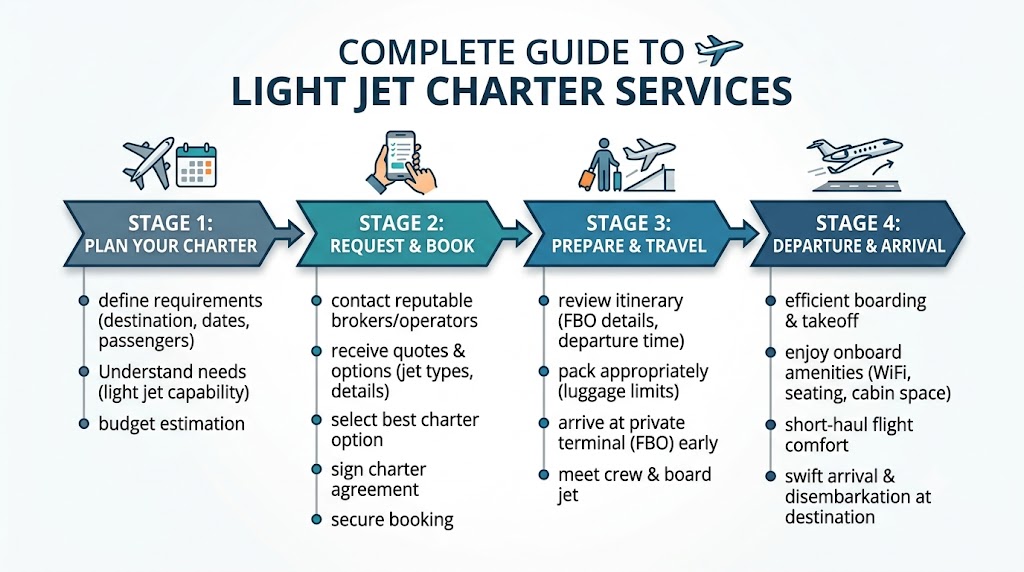
Booking Workflow
A disciplined booking process can look like this:
Step 1: Define the Mission
Establish passengers, destinations, dates, times, baggage, and special requirements.
Step 2: Identify Suitable Airports
Consider both airport accessibility and aircraft capability.
Step 3: Request Multiple Options
Ask the provider to explain meaningful differences between aircraft options.
Step 4: Review the Operator
Understand who is actually operating the flight.
Step 5: Compare Complete Costs
Look beyond the headline charter price.
Step 6: Review Contract Terms
Pay particular attention to cancellation, changes, substitutions, and additional charges.
Step 7: Confirm Passenger Information
Verify names, documentation, baggage, pets, and special requirements.
Step 8: Confirm the Final Itinerary
Check airports, departure times, ground arrangements, catering, and other services.
Step 9: Reconfirm Before Departure
Operational details can change, so confirm the latest itinerary and airport instructions.
Operational Considerations for Business Travelers
Business travelers should think beyond the flight itself.
The value of a charter may depend on the complete door-to-door journey.
For example, a slightly more expensive flight from a conveniently located airport could potentially reduce substantial ground-transfer time.
For business travel, consider:
- Meeting schedules
- Ground transportation
- Airport proximity
- Return-flight flexibility
- Connectivity
- Workspace
- Confidentiality
- Baggage
- Backup plans
A charter should be evaluated as a travel operation, not merely as an airborne product.
Privacy and Confidentiality
Private aviation can provide a more controlled travel environment, but travelers should still consider how passenger information is handled.
When confidentiality matters, ask about:
- Passenger information handling
- Manifest procedures
- Ground-service arrangements
- Communication channels
- Third-party vendors
- Transportation providers
- Catering providers
Avoid sharing sensitive information through unsecured or unnecessary channels.
For corporate travel, organizations should also establish who is authorized to book charter services and approve expenses.
Cost-Control Strategies
Charter does not have to mean choosing the most expensive aircraft available.
Practical cost-management strategies include:
Choose Aircraft Based on Mission
Do not pay for capacity or range that the trip does not require.
Consider Alternative Airports
A nearby regional airport may provide better operational or pricing flexibility.
Evaluate Empty Legs Carefully
They can be attractive when your schedule is flexible.
Compare Complete Itineraries
A lower hourly rate does not automatically produce a lower trip cost.
Avoid Unnecessary Customization
Additional services can increase cost quickly.
Plan Early When Possible
Earlier planning can provide more aircraft and routing options.
What Happens When Plans Change?
Travel plans sometimes change after booking.
Potential changes include:
- Different departure time
- Additional passengers
- Destination change
- Airport change
- Extended stay
- Earlier return
- Baggage changes
Contact the provider as soon as the requirement changes.
The effect may range from a simple administrative adjustment to a completely different aircraft or itinerary.
The earlier a change is communicated, the more options the provider may have.
Light Jet Charter Checklist
Before Requesting a Quote
- Confirm passenger count
- Confirm destinations
- Confirm preferred airports
- Confirm departure and return dates
- Confirm approximate times
- Estimate baggage
- Identify special equipment
- Identify pet requirements
- Identify international travel requirements
Before Booking
- Confirm aircraft type
- Confirm operating carrier
- Review operator information
- Verify passenger capacity
- Verify baggage capacity
- Confirm airport suitability
- Review complete pricing
- Check additional charges
- Review cancellation terms
- Review aircraft substitution terms
- Confirm catering requirements
Before Departure
- Confirm passenger information
- Confirm documentation
- Confirm baggage
- Confirm airport and terminal instructions
- Confirm departure time
- Confirm ground transportation
- Confirm catering
- Check for itinerary changes
How to Compare Two Charter Proposals
Suppose two providers offer different light-jet options.
Do not compare only the quoted prices.
Use a structured comparison:
| Factor | Proposal A | Proposal B |
|---|---|---|
| Aircraft | Verify model | Verify model |
| Passenger capacity | Compare configuration | Compare configuration |
| Baggage capacity | Verify | Verify |
| Departure airport | Evaluate convenience | Evaluate convenience |
| Arrival airport | Evaluate convenience | Evaluate convenience |
| Nonstop capability | Confirm operationally | Confirm operationally |
| Total quoted cost | Review inclusions | Review inclusions |
| Additional charges | Identify | Identify |
| Operator | Verify | Verify |
| Cancellation terms | Review | Review |
| Aircraft substitution | Review | Review |
| Special requirements | Confirm | Confirm |
This approach reduces the chance of choosing an option based on one attractive number while overlooking a significant operational difference.
What Makes a Charter Experience Successful?
A successful light jet charter is usually the result of good planning rather than simply an expensive aircraft.
The important elements are:
Appropriate aircraft: The aircraft fits the passengers, route, baggage, and operational requirements.
Suitable airports: Airports are selected based on both aircraft capability and destination convenience.
Transparent pricing: The traveler understands what is included and what may cost extra.
Qualified operation: The flight is conducted by an appropriate operator with suitable crews and procedures.
Clear communication: Passenger requirements and itinerary changes are communicated early.
Contingency planning: Weather, aircraft availability, and airport changes are considered realistically.
Final Recommendation
Light jet charter services can be a practical solution when flexibility, privacy, airport access, and time efficiency matter more than following a fixed commercial schedule. The strongest booking decisions begin with the travel mission rather than a particular aircraft model. Travelers should evaluate the operator, aircraft capability, baggage, airport suitability, complete pricing, and contract terms together. Safety and operational suitability should take priority over convenience when conditions change. A carefully planned charter is less about selecting the most impressive aircraft and more about matching the right aircraft and operator to the actual journey.
FAQs
Q1. What is a light jet charter?
A light jet charter is a privately arranged flight using a smaller business jet, generally suited to short- and medium-distance journeys and smaller passenger groups.
Q2. How many people can travel on a light jet?
Passenger capacity depends on the aircraft model and cabin configuration. Travelers should confirm the actual configuration rather than relying only on a category-level capacity.
Q3. How much does a light jet charter cost?
Pricing varies according to aircraft, route, flight time, positioning, airport charges, crew requirements, fuel, taxes, and additional services. A complete quotation is necessary to determine the actual trip cost.
Q4. Can a light jet fly nonstop between two cities?
It may be possible depending on the aircraft’s range, passenger and baggage load, weather, routing, fuel requirements, and airport conditions.
Q5. Can I choose the departure airport?
Often, travelers can request an airport that is convenient for their itinerary, but the aircraft and operator must be able to use that airport safely and legally.
Q6. Is baggage capacity limited on light jets?
Yes. Baggage capacity varies by aircraft and can be an important consideration when traveling with several passengers or bulky equipment.
Q7. Can I travel with a pet?
Pet policies vary by operator, aircraft, route, and destination. Inform the charter provider about the pet before the aircraft is finalized.
Q8. Does a private charter require airport procedures?
Yes. Private aviation still involves applicable security, immigration, customs, and other airport requirements. The exact process varies by airport and route.
Q9. What is an empty-leg charter?
An empty leg is a repositioning flight on which an aircraft would otherwise travel without passengers. When an itinerary matches the aircraft’s positioning requirement, it may provide a different pricing opportunity.
Q10. Should I book directly with an operator or through a broker?
Both models can be used. The important consideration is understanding who is arranging the flight, who will operate it, what is included, and what contractual responsibilities apply.
Q11. Can the aircraft change after booking?
Aircraft substitutions can occur for operational reasons. Travelers should review the applicable terms and ask what happens if the originally proposed aircraft becomes unavailable.
Q12. What should I verify before paying for a charter?
At minimum, verify the aircraft, operating carrier, itinerary, total cost, baggage capacity, airport arrangements, cancellation terms, substitution provisions, and any special requirements.
Q13. Is the newest light jet always the best option?
Not necessarily. Aircraft selection should be based on the mission, operational suitability, cabin requirements, baggage, range, airport compatibility, cost, and other relevant requirements.
Q14. How early should I plan a light jet charter?
Planning requirements vary by route and availability. Earlier planning generally provides more opportunity to evaluate aircraft, airports, schedules, and pricing options.
Q15. What is the most important thing to remember when booking a light jet?
Treat the charter as a complete travel operation. Evaluate the aircraft, operator, airports, schedule, baggage, pricing, safety considerations, and contract terms together rather than making the decision from price or aircraft appearance alone.
Conclusion
Light jet charter is most valuable when the aircraft and itinerary are matched carefully to the travel mission.
Passengers should evaluate range, baggage, airports, operator qualifications, pricing, and scheduling together.
Transparent communication is essential, particularly for special requirements and itinerary changes.
Travelers should also understand cancellation, substitution, and additional-cost provisions before booking.
The objective is not simply to charter a private aircraft, but to create a safe, practical, and well-coordinated journey.
Good planning turns the flexibility of light jet travel into a meaningful operational advantage.
