
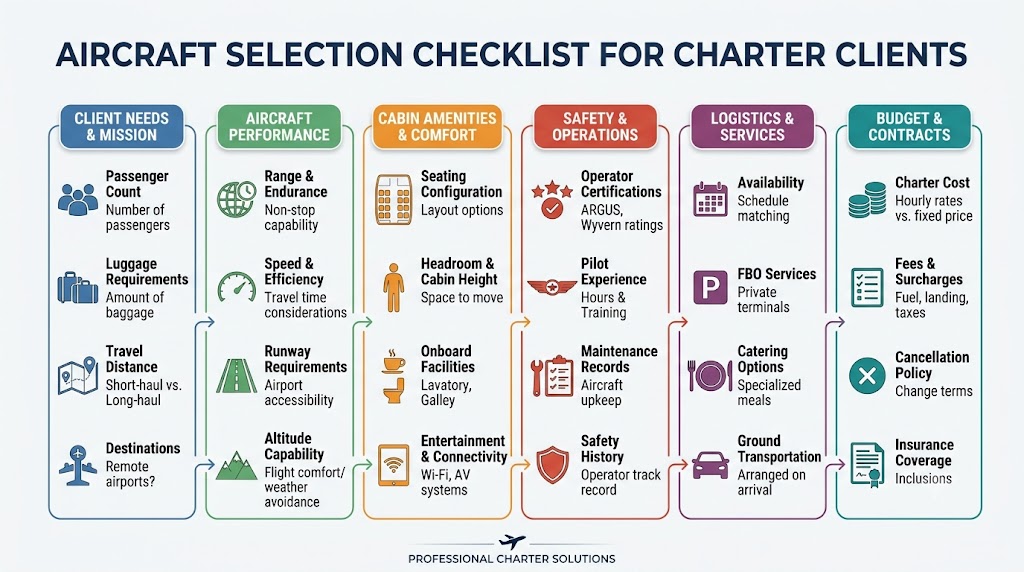
Introduction
Choosing an aircraft for a private charter is not simply a matter of selecting the largest, newest, or most luxurious jet available. The right aircraft is the one that fits the actual mission: passenger count, route, baggage, airport requirements, schedule, comfort expectations, and operational conditions.
A well-selected aircraft can reduce unnecessary cost, improve schedule reliability, provide better access to convenient airports, and make the overall journey considerably more comfortable. A poorly matched aircraft can create avoidable compromises, such as insufficient baggage capacity, an inconvenient technical stop, limited airport access, or a cabin that does not meet the passengers’ expectations.
This checklist provides a structured way for charter clients to evaluate aircraft before confirming a booking. It is useful for leisure travelers, executives, families, corporate groups, production teams, sports organizations, and other passengers arranging private air travel.
Executive Summary
Aircraft selection should begin with the mission rather than the aircraft category.
Before accepting a proposed aircraft, a charter client should evaluate:
- Number of passengers
- Passenger age and mobility requirements
- Total baggage volume and weight
- Departure and destination airports
- Required range and possible fuel stops
- Preferred departure and arrival times
- Cabin size and seating configuration
- Lavatory requirements
- Catering expectations
- Connectivity requirements
- Weather and seasonal operating conditions
- Airport runway and operating limitations
- Aircraft availability
- Operator qualifications and operational standards
- Total charter cost and potential additional charges
- Backup arrangements if the aircraft becomes unavailable
The most important principle is simple:
Select the aircraft that best satisfies the complete mission, not merely the aircraft with the most attractive specifications.
1. Start With the Charter Mission
The first step is to define exactly what the aircraft needs to accomplish.
A charter provider should understand the trip before presenting aircraft options. Clients should also avoid choosing an aircraft based only on a photograph or a headline specification.
Define the Basic Mission
Record:
| Requirement | Client Information |
|---|---|
| Number of passengers | ___ |
| Departure airport | ___ |
| Destination airport | ___ |
| Preferred departure time | ___ |
| Preferred arrival time | ___ |
| Return requirement | ___ |
| Baggage quantity | ___ |
| Baggage type | ___ |
| Pets | Yes / No |
| Special assistance | Yes / No |
| Catering requirements | ___ |
| Connectivity requirements | ___ |
| Sleeping requirement | Yes / No |
| Lavatory requirement | ___ |
| Special equipment | ___ |
This information becomes the foundation for aircraft selection.
2. Passenger Count Is More Than a Seat Number
One of the most common charter-planning mistakes is treating passenger capacity as the only seating consideration.
An aircraft may technically accommodate a certain number of passengers while offering a cabin configuration that is unsuitable for the group’s actual needs.
For example, a group may technically fit into an aircraft but still have an uncomfortable experience because:
- Seats are tightly configured.
- Passengers cannot sit together as expected.
- There is insufficient space for personal belongings.
- The cabin layout does not support meetings.
- Sleeping arrangements are inadequate.
- The aircraft has limited lavatory facilities.
- Families cannot easily accommodate children.
- Passengers with mobility limitations face access challenges.
Ask These Questions
- How many passengers are traveling?
- Do passengers need to sit together?
- Are there children in the group?
- Are any passengers elderly or mobility-limited?
- Does anyone require additional personal space?
- Is privacy important?
- Will passengers work during the flight?
- Will anyone need to sleep?
- Does the group require a particular seating arrangement?
Passenger capacity should therefore be treated as a starting point, not the final decision criterion.
3. Evaluate the Cabin Class Carefully
Private aircraft are commonly grouped into categories such as:
- Very light jets
- Light jets
- Midsize jets
- Super-midsize jets
- Heavy jets
- Long-range jets
- Turboprops
- Business aircraft with specialized configurations
These categories provide useful orientation, but they should not replace an aircraft-specific evaluation.
Two aircraft in the same broad category can provide noticeably different experiences.
Cabin Evaluation Checklist
Consider:
- Cabin length
- Cabin width
- Cabin height
- Number of seats
- Seat configuration
- Seat pitch
- Reclining capability
- Club seating
- Divans
- Sleeping arrangements
- Lavatory configuration
- Galley facilities
- Storage areas
- Noise characteristics
- Lighting
- Temperature control
- Accessibility
If comfort is important, ask for the actual aircraft model and configuration, rather than accepting only a generic category description.
4. Match Aircraft Range to the Actual Route
Range is one of the most important technical considerations in charter planning.
A published maximum range does not necessarily mean an aircraft can fly every possible route at that distance under every condition.
Actual mission capability can be influenced by:
- Passenger load
- Baggage
- Fuel reserves
- Weather
- Headwinds
- Temperature
- Runway conditions
- Aircraft configuration
- Operational restrictions
- Routing
- Airport limitations
- Regulatory requirements
Therefore, clients should ask the charter provider to confirm whether the proposed aircraft can complete the intended mission without an unnecessary fuel stop.
Useful Question
“Can this aircraft complete our requested route with our expected passenger and baggage load while maintaining the required operational fuel reserves?”
That question is much more useful than asking only for the aircraft’s advertised range.
5. Confirm Whether a Fuel Stop Is Required
A fuel stop can materially change a charter experience.
It may affect:
- Total travel time
- Arrival time
- Catering
- Passenger comfort
- Airport fees
- Crew scheduling
- Ground transportation
- Connection planning
- Overall charter cost
A fuel stop is not automatically a problem. In some cases, it may be the most practical or economical solution.
However, it should be identified before the charter is confirmed.
Fuel-Stop Checklist
Ask:
- Is a nonstop flight operationally feasible?
- If not, where would the stop occur?
- How long is the expected stop?
- Do passengers remain onboard?
- Can passengers leave the aircraft?
- Is the stop dependent on weather or airport conditions?
- Does the stop create additional fees?
- Does it affect the requested schedule?
6. Consider Airport Compatibility
Aircraft selection and airport selection are closely connected.
A particular aircraft may be capable of flying the route but unsuitable for a specific airport because of:
- Runway length
- Runway surface
- Aircraft performance
- Elevation
- Temperature
- Weight limitations
- Noise restrictions
- Operating hours
- Customs or immigration availability
- Airport-specific restrictions
- Weather conditions
This is especially important when clients want to use smaller regional or private-use airports to minimize ground travel.
The Real Question
Do not ask only:
“Can this aircraft fly there?”
Ask:
“Can this aircraft legally and operationally serve this airport for this specific mission?”
That distinction can prevent major last-minute changes.
7. Evaluate Airport Access as Part of the Aircraft Decision
The airport closest to the destination is not always the most suitable airport for the selected aircraft.
A smaller aircraft may have access to an airport that is significantly closer to the passenger’s final destination.
A larger aircraft may require a different airport with more suitable runway, handling, customs, or operational facilities.
Therefore, aircraft selection should be evaluated together with door-to-door travel time.
Compare:
Option A
Aircraft A → convenient airport → short ground transfer
Option B
Aircraft B → larger airport → longer ground transfer
Even if Aircraft B has a lower hourly charter rate, Option A may provide the better overall travel experience.
8. Check Baggage Capacity Before Booking
Baggage is frequently underestimated during charter planning.
A group traveling for several days may carry significantly more baggage than expected, particularly when passengers bring:
- Golf equipment
- Skis or sporting equipment
- Musical instruments
- Camera equipment
- Business materials
- Medical equipment
- Child equipment
- Large suitcases
- Specialized cases
The important question is not simply whether the aircraft has a stated baggage compartment.
You need to know whether the actual baggage can be accommodated on the specific aircraft.
Baggage Checklist
Provide the operator with:
- Number of bags
- Approximate weight
- Bag dimensions
- Oversized items
- Sporting equipment
- Fragile equipment
- Special handling requirements
Do not assume that published baggage volume automatically translates into usable baggage space.
9. Consider Passenger Comfort for the Flight Duration
Comfort expectations should increase with flight duration.
For a short flight, passengers may accept a relatively compact cabin.
For a longer journey, factors such as:
- Cabin height
- Seat width
- Legroom
- Lavatory
- Galley
- Cabin noise
- Seating flexibility
- Sleeping capability
- Connectivity
become much more important.
A Practical Rule
For short sectors, prioritize airport convenience and mission efficiency.
For longer sectors, place greater weight on cabin comfort, space, amenities, and passenger fatigue.
10. Review Seating Configuration
The number of seats does not tell the whole story.
Look at how those seats are arranged.
Common considerations include:
- Club seating
- Forward-facing seats
- Divans
- Individual seats
- Conference-style arrangements
- Adjustable seats
- Sleeping positions
- Privacy partitions
For corporate travel, passengers may prefer a configuration that supports conversation and work.
For family travel, passengers may value proximity.
For overnight or long-duration travel, sleeping capability may become more important than the number of available seats.
11. Determine Whether a Lavatory Is Required
Lavatory arrangements vary considerably across aircraft.
For some clients, a lavatory is simply desirable. For others, it is a non-negotiable requirement.
This can include:
- Elderly passengers
- Families with children
- Longer flights
- Overnight flights
- Medical considerations
- Executive travel
- Passenger privacy requirements
Always confirm the actual aircraft configuration rather than relying solely on the aircraft category.
12. Evaluate Connectivity and Productivity
For business travelers, connectivity can be a significant aircraft-selection factor.
Ask whether the specific aircraft provides:
- Wi-Fi
- Cellular connectivity where applicable
- Power outlets
- USB charging
- Device compatibility
- Cabin communication systems
- Worktable space
- Conference-style seating
Connectivity availability can vary by aircraft and configuration.
Therefore, “Wi-Fi available” should not automatically be interpreted as equivalent to a reliable office-like internet connection.
Ask More Precisely
- Is Wi-Fi installed on the actual aircraft?
- Is it available throughout the flight?
- Is there a usage limitation?
- What type of connectivity system is installed?
- Are power outlets available at the required seats?
- Can passengers reliably conduct business communications?
13. Consider Catering Requirements
Catering requirements should be communicated early.
A small aircraft may have limited galley facilities compared with a larger jet.
Consider:
- Number of passengers
- Flight duration
- Hot meal requirements
- Dietary restrictions
- Allergies
- Beverage preferences
- Children’s meals
- Special occasions
- Food storage requirements
A charter provider should know about significant dietary or catering requirements before the aircraft is finalized.
14. Account for Weather and Seasonal Conditions
Aircraft selection should not be made in isolation from operating conditions.
Weather can influence:
- Aircraft performance
- Departure airport suitability
- Destination airport suitability
- Route planning
- Fuel requirements
- Arrival alternatives
- Schedule reliability
For example, a particular aircraft may be suitable under normal conditions but face greater operational constraints under challenging temperature, wind, runway, or airport conditions.
The operator’s flight-planning team should evaluate the mission using the actual expected operating conditions, not merely brochure specifications.
15. Understand Payload and Performance Limitations
An aircraft’s useful payload includes more than passengers.
It may include:
- Passengers
- Checked baggage
- Cabin baggage
- Catering
- Equipment
- Other required items
As payload increases, available range or performance margins may change.
This is why the following combination matters:
Passengers + baggage + route + weather + airport + fuel requirements
rather than any one specification by itself.
16. Compare Aircraft Based on the Whole Mission
A useful aircraft comparison should look something like this:
| Selection Factor | Aircraft A | Aircraft B | Aircraft C |
|---|---|---|---|
| Passenger capacity | Suitable | Suitable | Suitable |
| Cabin comfort | Good | Excellent | Moderate |
| Nonstop capability | Confirm | Confirm | Fuel stop likely |
| Baggage capacity | Moderate | High | High |
| Airport access | Excellent | Moderate | Good |
| Lavatory | Confirm | Confirm | Confirm |
| Connectivity | Confirm | Confirm | Limited/Confirm |
| Schedule fit | Good | Excellent | Good |
| Operating cost | Lower | Higher | Moderate |
| Ground-transfer advantage | High | Moderate | Low |
| Overall mission fit | High | High | Moderate |
The purpose of the table is not to find the aircraft with the highest specification in every category.
It is to identify the aircraft with the best overall mission fit.
17. Aircraft Selection Decision Matrix
For clients who want a more disciplined process, assign importance to each factor.
| Criterion | Weight | Aircraft A | Aircraft B | Aircraft C |
|---|---|---|---|---|
| Route suitability | 20% | 9 | 10 | 8 |
| Airport access | 15% | 10 | 7 | 8 |
| Cabin comfort | 15% | 8 | 10 | 7 |
| Baggage capacity | 10% | 7 | 10 | 8 |
| Schedule fit | 15% | 9 | 10 | 8 |
| Connectivity | 5% | 8 | 10 | 6 |
| Cost efficiency | 10% | 9 | 6 | 8 |
| Operational flexibility | 10% | 9 | 9 | 7 |
The weighting should reflect the client’s priorities.
For example:
- A family vacation may prioritize comfort, baggage, and airport access.
- A corporate trip may prioritize schedule, connectivity, and airport convenience.
- A large group may prioritize cabin capacity and nonstop performance.
- A short regional trip may prioritize airport access and cost efficiency.
18. Do Not Choose Based on Aircraft Size Alone
Larger is not always better.
A larger aircraft may provide:
- More cabin space
- Greater baggage capacity
- More amenities
- Greater range
But it can also involve:
- Higher charter cost
- Greater operating requirements
- Fewer compatible airports
- Higher handling expenses
- Less flexibility for certain missions
Likewise, a smaller aircraft may offer:
- Lower cost
- Access to smaller airports
- Efficient operation for short sectors
- Easier scheduling in some circumstances
The correct choice depends on the mission.
19. Do Not Choose Based on Price Alone
A low quoted charter price can be attractive, but clients should understand what is included.
Ask whether the quotation accounts for:
- Aircraft
- Crew
- Fuel
- Landing charges
- Handling
- Catering
- Ground transportation
- De-icing where applicable
- Parking
- Overnight crew requirements
- International handling
- Taxes and other applicable charges
The exact structure varies by operator and trip.
A useful comparison is therefore:
Total expected trip cost and total travel experience
rather than simply the headline aircraft price.
20. Ask About the Actual Aircraft
One of the most important questions is:
“Is this the actual aircraft being proposed, or is this an aircraft category?”
Aircraft descriptions can sometimes refer to a family or category rather than a specific tail or configuration.
Clients should confirm:
- Aircraft make and model
- Actual seating configuration
- Cabin configuration
- Baggage arrangement
- Lavatory configuration
- Connectivity equipment
- Aircraft availability
- Operating entity
- Any expected aircraft substitution
This avoids a mismatch between expectations and the aircraft eventually operated.
21. Understand Aircraft Substitution Policies
Aircraft substitutions can occur for legitimate operational reasons.
Potential causes include:
- Maintenance
- Crew scheduling
- Operational restrictions
- Weather
- Aircraft availability
- Unexpected technical issues
A substitution is not necessarily a service failure.
However, the replacement aircraft should still satisfy the agreed mission requirements.
Ask:
- Can the operator substitute the aircraft?
- Under what circumstances?
- Must the replacement meet minimum specifications?
- What happens if the replacement has fewer seats?
- What happens if baggage capacity changes?
- What happens if nonstop capability changes?
- What happens if the aircraft category changes?
This is particularly important for clients with strict cabin or seating requirements.
22. Review Operational Reliability
A technically suitable aircraft is not enough.
The operator’s ability to manage the mission matters as well.
Consider:
- Aircraft availability
- Crew availability
- Maintenance support
- Operational planning
- Dispatch capability
- Backup aircraft options
- Airport handling arrangements
- Weather planning
- Communication procedures
Clients generally cannot evaluate every internal operational process themselves, but they can ask sensible questions about how disruptions are handled.
23. Verify the Charter Operator
Aircraft selection should always be considered alongside operator selection.
Important questions include:
- Who is actually operating the aircraft?
- Is the operator appropriately authorized for the proposed service?
- What safety and operational standards does the operator follow?
- How is maintenance managed?
- How are crews assigned?
- What happens if the aircraft becomes unavailable?
- Who is responsible for passenger communication?
The charter broker, booking company, aircraft owner, and actual operating carrier may not always be the same entity.
Understanding these roles is useful when evaluating a charter arrangement.
24. Separate Broker Services From Aircraft Operations
A charter broker may coordinate aircraft options and logistics without actually operating the aircraft.
That distinction matters.
A client should understand:
Who sells the charter?
Who operates the aircraft?
Who provides the crew?
Who is responsible for operational decisions?
Who handles disruptions?
This creates a clearer chain of responsibility.
25. Consider International and Cross-Border Requirements
International charter flights can introduce additional operational complexity.
Depending on the route, requirements may involve:
- Customs
- Immigration
- Airport operating permissions
- Handling arrangements
- Passenger documentation
- Crew documentation
- Overflight permissions
- Landing permissions
- Local operating restrictions
Requirements vary by jurisdiction and route.
For international missions, aircraft selection should therefore be made only after confirming that the selected aircraft and operator can support the complete itinerary.
26. Evaluate Special Passenger Requirements
Some passengers have needs that should influence aircraft selection from the beginning.
Examples include:
- Mobility limitations
- Young children
- Elderly passengers
- Service animals or pets
- Medical equipment
- Sporting equipment
- Musical instruments
- Specialized professional equipment
Do not leave these details until the day of departure.
The earlier they are disclosed, the more effectively the operator can determine whether the aircraft is suitable.
27. Pets Require Advance Planning
Pet travel can introduce aircraft-specific and airport-specific considerations.
Clients should communicate:
- Number of pets
- Animal size
- Carrier dimensions
- Destination requirements
- Handling preferences
- Required documentation
Policies vary by operator and jurisdiction.
Never assume that because an aircraft is privately chartered, every pet-related requirement automatically disappears.
28. Think About Ground Transportation
Aircraft selection can affect the ground portion of the trip.
A slightly smaller aircraft may allow the group to land closer to its final destination.
That can reduce:
- Driving time
- Ground transportation cost
- Traffic exposure
- Fatigue
- Schedule uncertainty
For many charter clients, the real journey is:
Home → airport → aircraft → destination airport → final destination
not simply airport-to-airport.
Aircraft selection should support the entire journey.
29. Assess Privacy Requirements
Privacy can mean different things to different clients.
Consider whether the passengers need:
- A private cabin
- Separate seating areas
- Confidential business discussions
- Minimal passenger interaction
- Private transportation
- Discreet airport handling
For business or sensitive travel, cabin configuration and airport choice can be just as important as aircraft size.
30. Evaluate Schedule Flexibility
One advantage of charter travel is schedule flexibility, but aircraft availability and airport constraints still matter.
Ask:
- Can the aircraft depart at the desired time?
- Is the aircraft positioned nearby?
- Is there another flight before the requested departure?
- Are crew duty considerations relevant?
- Are airport operating hours restrictive?
- Is the return schedule practical?
- What happens if the schedule changes?
A charter plan should account for the complete itinerary rather than only the first departure.
31. Consider Empty-Leg Opportunities Carefully
An empty leg can sometimes offer attractive charter economics, but it may have less scheduling flexibility than a conventional charter arrangement.
Potential advantages include:
- Lower price in some circumstances
- Access to an aircraft already positioned for another mission
Potential limitations include:
- Fixed route
- Fixed or narrow departure timing
- Limited availability
- Greater possibility of schedule changes
- Less flexibility for itinerary modifications
Empty-leg travel can be useful when the client’s schedule is flexible enough to accommodate the available aircraft.
32. Understand the Difference Between Specifications and Mission Performance
Aircraft brochures are useful for initial comparisons, but they do not replace operational planning.
A specification such as:
- Maximum range
- Maximum passengers
- Maximum baggage volume
- Maximum cruise speed
should be treated as a reference point.
The charter decision should instead focus on:
What can this aircraft realistically accomplish for our exact trip?
That is the question an experienced charter planner should answer.
33. Common Aircraft Selection Mistakes
Mistake 1: Choosing the Largest Aircraft
The largest aircraft may be unnecessary for a small group and may limit airport choices.
Better approach
Select the smallest aircraft that comfortably satisfies the complete mission.
Mistake 2: Ignoring Baggage
A passenger count that fits perfectly may still result in insufficient baggage capacity.
Better approach
Provide baggage details before the aircraft is finalized.
Mistake 3: Assuming Published Range Equals Route Capability
Maximum range is not the same as guaranteed mission range.
Better approach
Request route-specific operational confirmation.
Mistake 4: Comparing Only Hourly Rates
A cheaper aircraft may require additional costs or a fuel stop.
Better approach
Compare the expected total trip cost and itinerary.
Mistake 5: Ignoring Airport Restrictions
The preferred airport may not be suitable for every aircraft.
Better approach
Confirm aircraft-airport compatibility before booking.
Mistake 6: Assuming Aircraft Categories Are Identical
Aircraft within the same category can differ considerably in cabin layout and capability.
Better approach
Request the specific aircraft model and configuration.
Mistake 7: Forgetting the Return Leg
An aircraft may be suitable for the outbound journey but create operational complications on the return.
Better approach
Evaluate the complete round-trip mission.
Mistake 8: Leaving Special Requirements Until the Last Minute
Pets, sporting equipment, mobility needs, and special catering can affect aircraft suitability.
Better approach
Disclose all special requirements during the quotation process.
34. A Practical Aircraft Selection Workflow
Use this sequence when evaluating charter options.
Step 1: Define the Mission
Record:
- Passenger count
- Route
- Dates
- Schedule
- Baggage
- Special requirements
Step 2: Identify Suitable Aircraft Categories
Determine the smallest category capable of meeting the mission comfortably.
Step 3: Check Airport Compatibility
Confirm that the aircraft can serve the preferred airports under the expected operating conditions.
Step 4: Validate Route Capability
Confirm nonstop capability or identify required fuel stops.
Step 5: Review the Cabin
Evaluate actual seating, cabin space, lavatory, baggage, and amenities.
Step 6: Review Operator and Aircraft Details
Confirm who operates the aircraft and whether the proposed aircraft is actually available.
Step 7: Compare Total Cost
Review the complete quotation and applicable additional charges.
Step 8: Review Substitution Terms
Understand what happens if the aircraft changes.
Step 9: Confirm the Final Itinerary
Verify airports, times, passengers, baggage, catering, and ground arrangements.
Step 10: Reconfirm Before Departure
Operational conditions can change. Confirm final arrangements with the charter provider before travel.
35. Client Aircraft Selection Checklist
Use this checklist before confirming a charter.
Mission
- Passenger count confirmed
- Departure airport confirmed
- Destination airport confirmed
- Departure time confirmed
- Return schedule confirmed
- One-way or round-trip requirement confirmed
Aircraft
- Aircraft category confirmed
- Aircraft make and model confirmed
- Actual configuration confirmed
- Seating arrangement reviewed
- Cabin dimensions reviewed
- Lavatory confirmed
- Baggage capacity confirmed
- Connectivity requirements confirmed
Route
- Nonstop capability confirmed
- Fuel stop requirements understood
- Expected routing reviewed
- Alternate airport requirements understood
Airport
- Departure airport compatible
- Destination airport compatible
- Operating hours checked
- Customs/immigration requirements checked where applicable
- Ground transportation arranged
Passengers
- Special assistance communicated
- Children accounted for
- Pets communicated
- Medical or mobility requirements communicated
- Special equipment communicated
Baggage
- Number of bags confirmed
- Approximate weight confirmed
- Oversized baggage identified
- Sporting equipment identified
- Special equipment identified
Cost
- Charter price reviewed
- Additional charges understood
- Catering charges understood
- Ground transportation costs understood
- Airport/handling costs understood where applicable
- Payment and cancellation terms reviewed
Operations
- Operating entity identified
- Aircraft availability confirmed
- Substitution policy reviewed
- Disruption procedures understood
- Contact information confirmed
36. Questions to Ask the Charter Provider
Before making the final decision, ask:
- Which specific aircraft is being proposed?
- Is the quoted aircraft guaranteed, subject to substitution, or still being sourced?
- Can it complete the requested route nonstop with our passenger and baggage load?
- Can it use our preferred airports?
- What is the actual cabin configuration?
- How much usable baggage space is available?
- Does the aircraft have a lavatory?
- Is Wi-Fi available on the actual aircraft?
- Are there power outlets?
- What catering can be arranged?
- Are there any special airport or route restrictions?
- Who is the actual operating entity?
- What happens if the aircraft becomes unavailable?
- What replacement aircraft would be considered acceptable?
- What charges are included in the quotation?
- What additional charges could arise?
- What are the cancellation and change conditions?
- How are weather-related changes handled?
- Who should the client contact during an operational disruption?
- What should the client provide before departure?
37. Choosing Aircraft by Mission Type
Different missions naturally favor different aircraft characteristics.
| Mission | Primary Priorities |
|---|---|
| Short regional trip | Airport access, cost, schedule |
| Family vacation | Comfort, baggage, airport convenience |
| Executive trip | Connectivity, privacy, schedule |
| Large group | Seating, cabin space, baggage |
| Long-distance trip | Range, comfort, lavatory, connectivity |
| Sports travel | Baggage, seating flexibility, logistics |
| Medical-related travel | Accessibility, cabin configuration, operator capability |
| Multi-city itinerary | Range, airport access, scheduling flexibility |
| International trip | Range, permissions, airport services, operator capability |
The aircraft category should follow the mission requirements rather than dictate them.
38. A Simple Decision Rule
If you need a straightforward framework, evaluate aircraft in this order:
1. Can it legally and operationally perform the mission?
If no, eliminate it.
2. Can it serve the preferred airports?
If no, determine whether the ground-transfer compromise is acceptable.
3. Can it carry the passengers and baggage comfortably?
If no, eliminate it.
4. Can it meet the schedule?
If no, eliminate it.
5. Does the cabin meet passenger expectations?
If no, consider alternatives.
6. Is the total cost justified?
If yes, continue.
7. Does the operator provide acceptable operational support?
If yes, the aircraft becomes a credible candidate.
This approach prevents price or luxury features from dominating the decision too early.
39. What “Best Aircraft” Really Means
There is rarely one universally best aircraft for every charter client.
The best aircraft is the one that provides the strongest balance between:
Mission capability
Passenger comfort
Airport access
Schedule
Baggage capacity
Operational reliability
Total cost
Special requirements
For one client, a smaller aircraft may be the best answer because it can land closer to the destination.
For another, a larger aircraft may be justified because the passengers require greater cabin space and nonstop capability.
For another, a midsize aircraft may provide the best balance between cost and comfort.
40. Final Recommendation
Treat aircraft selection as a mission-matching exercise, not a luxury-shopping exercise. Start with the route, passengers, baggage, airports, schedule, and special requirements, then identify aircraft capable of meeting those requirements. Confirm the actual aircraft configuration, operational capability, airport compatibility, and total cost before committing. Pay particular attention to substitutions, fuel stops, baggage limitations, and the identity of the actual operating provider. The strongest charter decision is the one that delivers the required journey with the fewest unnecessary compromises.
FAQs
Q1. How do I choose the right aircraft for a private charter?
Start with passenger count, route, baggage, airport requirements, schedule, cabin preferences, and special needs. Then compare aircraft based on their ability to satisfy the complete mission.
Q2. Is a larger private jet always better?
No. A larger aircraft can provide additional comfort and range but may cost more and have fewer airport options. The right size depends on the mission.
Q3. Should I prioritize aircraft range?
Range is important, but maximum published range should not be treated as guaranteed route capability. Ask the operator to confirm the aircraft’s suitability for your specific passenger load, baggage, route, and operating conditions.
Q4. How important is baggage capacity?
Very important. Passenger capacity and baggage capacity are separate considerations. Large suitcases, sports equipment, and specialized items can significantly affect aircraft selection.
Q5. Can every private jet use a small regional airport?
No. Airport suitability depends on aircraft performance, runway characteristics, airport restrictions, operating conditions, and other operational factors.
Q6. Should I ask for the exact aircraft model?
Yes. Aircraft models and configurations can differ significantly even within the same general aircraft category.
Q7. What if the charter company changes the aircraft?
Aircraft substitutions can occur for operational reasons. Review the substitution terms before booking and confirm that any replacement aircraft will meet your essential requirements.
Q8. Is the cheapest charter quotation the best option?
Not necessarily. Compare the total expected trip cost, fuel stops, airport access, baggage capacity, cabin suitability, schedule, and other applicable charges.
Q9. What information should I give the charter provider?
Provide passenger numbers, airports, dates, preferred times, baggage details, pets, special equipment, mobility requirements, catering preferences, connectivity needs, and any other unusual requirements.
Q10. Should airport choice influence aircraft selection?
Absolutely. An aircraft that can access a convenient airport may provide a better overall journey than a larger aircraft requiring a longer ground transfer.
Q11. How should I compare two similar aircraft?
Compare them using mission-specific criteria such as nonstop capability, airport access, cabin layout, baggage capacity, comfort, schedule, connectivity, operational flexibility, and total cost.
Q12. What is the biggest aircraft-selection mistake charter clients make?
One of the most common mistakes is choosing an aircraft based on category, appearance, or advertised specifications without confirming whether the actual aircraft configuration satisfies the complete travel mission.
Conclusion
Aircraft selection is fundamentally about fit, not size or prestige.
The right aircraft should satisfy the route, schedule, passenger, baggage, airport, and comfort requirements together.
Clients should verify actual aircraft details rather than relying only on generic categories or published specifications.
Operational capability, substitution policies, total cost, and airport access deserve the same attention as cabin luxury.
A structured checklist helps prevent expensive surprises and makes charter decisions easier to compare.
When the aircraft is matched correctly to the mission, the entire private charter experience becomes more predictable, efficient, and comfortable.
