
Introduction
Modern IT operations have become increasingly complex due to cloud-native architectures, microservices, distributed systems, and dynamic workloads. In such environments, traditional monitoring tools are no longer sufficient to understand system behavior or quickly identify the root cause of failures. Teams often struggle with alert fatigue, fragmented visibility, and delayed incident resolution.
This is where AI Observability for Modern IT Operations becomes a game-changer. It combines artificial intelligence with observability practices to provide deeper insights into system behavior, automate anomaly detection, and accelerate root cause analysis across large-scale environments.
As organizations move toward automation-first operations, platforms like AiOpsSchool are helping professionals build practical expertise in AI-driven observability, AIOps, and modern IT operations engineering.
What Is AI Observability?
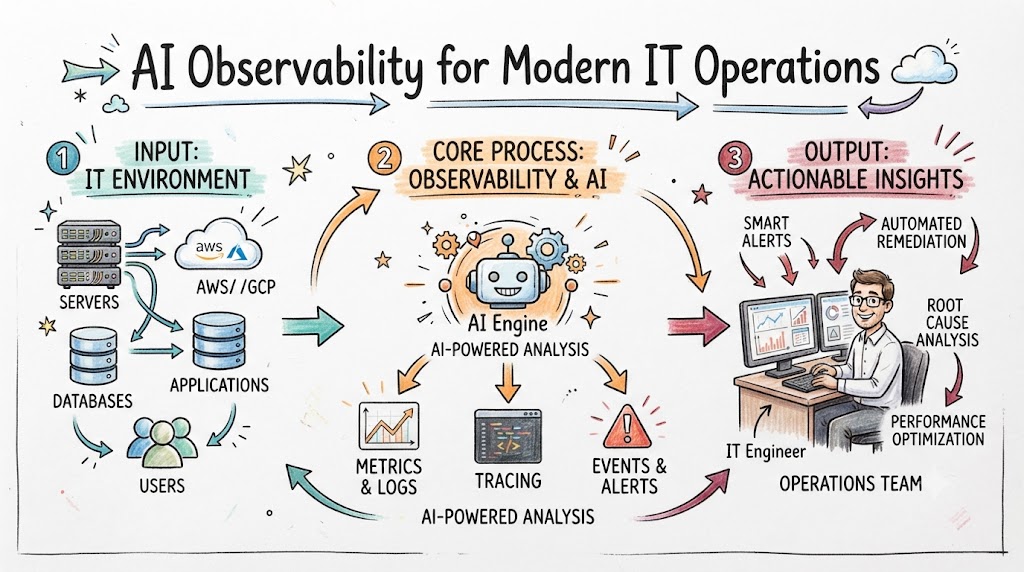
AI Observability refers to the use of artificial intelligence and machine learning techniques to enhance traditional observability systems. While observability focuses on logs, metrics, and traces to understand system health, AI observability goes a step further by analyzing patterns, detecting anomalies, and predicting failures automatically.
Instead of manually interpreting dashboards, engineers receive intelligent insights that highlight what is wrong, why it is happening, and what actions should be taken.
In modern IT operations, AI observability acts as the bridge between raw telemetry data and actionable intelligence.
Why AI Observability Matters in Modern IT Operations
The scale of modern infrastructure has made manual monitoring nearly impossible. Applications generate millions of events per minute, and critical signals are often hidden within noisy data.
AI observability helps solve this challenge by:
- Reducing alert noise through intelligent filtering
- Detecting anomalies in real time
- Correlating events across systems automatically
- Improving incident response speed
- Enabling proactive system monitoring
By integrating intelligence into observability pipelines, organizations can significantly improve system reliability and operational efficiency.
Core Building Blocks of AI Observability
AI observability in modern IT operations is built on several foundational components:
Logs, Metrics, and Traces
These are the three pillars of observability. Logs provide event-level details, metrics show system performance, and traces map request flows across services.
Machine Learning Models
ML models analyze historical data to detect anomalies, predict failures, and identify hidden patterns in system behavior.
Event Correlation Engines
These systems group related alerts into a single incident, helping engineers focus on root causes rather than symptoms.
Real-Time Analytics
Streaming data pipelines process telemetry data in real time to enable instant detection of issues.
Automation Layer
Automated workflows trigger remediation actions such as restarting services, scaling infrastructure, or rerouting traffic.
AI Observability vs Traditional Observability
| Aspect | Traditional Observability | AI Observability |
|---|---|---|
| Data Handling | Manual analysis | Automated intelligence |
| Alerting | Rule-based thresholds | Anomaly detection models |
| Root Cause Analysis | Manual investigation | AI-assisted RCA |
| Scalability | Limited in large systems | Designed for distributed systems |
| Response Time | Slower | Real-time insights |
Traditional observability shows what is happening, while AI observability explains why it is happening and what to do next.
Key Benefits of AI Observability
AI observability provides significant advantages for modern IT operations teams:
- Faster incident detection and resolution
- Reduced mean time to resolution (MTTR)
- Improved system uptime and reliability
- Reduced operational noise and alert fatigue
- Better forecasting of system performance
- Enhanced collaboration between DevOps and SRE teams
These benefits directly contribute to more stable and efficient IT environments.
AI Observability in Modern IT Operations
In modern IT operations, systems are no longer monolithic. They are distributed across cloud environments, containers, APIs, and third-party services. This complexity makes visibility extremely challenging.
AI observability helps unify these distributed signals into a single intelligent layer. It enables teams to:
- Monitor hybrid cloud environments
- Track microservices performance end-to-end
- Detect cascading failures across dependencies
- Optimize resource utilization dynamically
By integrating intelligence into observability pipelines, organizations gain full visibility and control over their IT ecosystems.
Real-World Example of AI Observability in Action
A global e-commerce platform experienced intermittent checkout failures during high-traffic events.
Initially, engineers received thousands of alerts from different services, making it difficult to identify the real issue. Traditional monitoring systems failed to pinpoint the root cause quickly.
With AI observability in place:
- The system detected unusual latency patterns in payment APIs
- It correlated database performance degradation with API timeouts
- Machine learning models identified a connection pool saturation issue
- Automated remediation scaled database connections and stabilized the system
As a result, the incident was resolved in minutes instead of hours, significantly reducing revenue loss and improving customer experience.
AI Observability Tools and Technologies
Modern AI observability relies on a combination of tools and platforms:
- Observability platforms: Datadog, New Relic, Dynatrace
- Open-source tools: Prometheus, Grafana, OpenTelemetry
- Log analytics systems: ELK Stack, Splunk
- Cloud-native monitoring: AWS CloudWatch, Azure Monitor, Google Operations Suite
- AI-powered AIOps platforms for correlation and automation
These tools work together to provide end-to-end visibility and intelligence across IT systems.
Challenges in Implementing AI Observability
Despite its benefits, implementing AI observability comes with challenges:
Data Quality Issues
Poor-quality or incomplete telemetry data can reduce model accuracy and insights.
Integration Complexity
Combining multiple monitoring tools and data sources requires careful architecture design.
Skill Gap
Teams need expertise in AI, observability, and cloud operations to fully leverage the system.
Over-Reliance on Automation
Excessive automation without validation can lead to incorrect remediation actions.
Addressing these challenges requires structured learning and proper AIOps Training programs.
AI Observability for SRE and DevOps Teams
AI observability plays a critical role in improving collaboration between SRE and DevOps teams.
For SRE teams, it helps improve reliability metrics such as MTTD and MTTR by providing faster insights into system failures. For DevOps teams, it enables better deployment monitoring and performance optimization.
Together, these teams can build more resilient systems with fewer operational disruptions.
Career Opportunities in AI Observability
The demand for professionals skilled in AI observability is rapidly increasing. Organizations are actively looking for engineers who understand:
- Observability frameworks
- AIOps systems
- Cloud monitoring tools
- Automation and incident response
Career roles include SRE Engineer, DevOps Engineer, Platform Engineer, and AIOps Specialist.
Structured learning through AIOps Training, AIOps Course, and certification programs can significantly improve job readiness in this field.
How to Learn AI Observability Effectively
To build strong expertise in AI observability, professionals should follow a structured learning path:
- Learn fundamentals of IT operations and monitoring
- Understand logs, metrics, and traces in depth
- Gain hands-on experience with observability tools
- Study AI-driven anomaly detection and event correlation
- Practice real-world incident analysis and automation
Combining theory with practical exposure is essential for mastering modern IT operations.
Why AI Observability Is the Future of IT Operations
AI observability represents the next evolution of IT operations. Instead of reacting to system failures, teams can now predict and prevent them.
As systems continue to grow in complexity, manual monitoring will become obsolete. Intelligent observability systems will form the foundation of autonomous operations, enabling organizations to achieve higher reliability, faster innovation, and reduced operational costs.
Final Thoughts
AI observability is transforming how modern IT operations teams manage complexity, detect failures, and ensure system reliability. By combining artificial intelligence with observability practices, organizations can move from reactive firefighting to proactive system optimization.
As demand for skilled professionals continues to grow, investing in structured learning through AIOps Training and certification programs can open strong career opportunities in DevOps, SRE, and cloud engineering domains.
Exploring platforms like AiOpsSchool.com can be a powerful step toward mastering AI observability and building future-ready IT operations expertise.
