
Introduction
Software releases have become increasingly frequent, complex, and business-critical. Enterprise organizations often manage multiple applications, distributed development teams, cloud platforms, microservices, compliance requirements, and global customer bases, making release management far more challenging than simply deploying code into production. A successful release must coordinate development, quality assurance, operations, security, infrastructure, business stakeholders, and support teams while minimizing risk and maintaining service reliability.
A Release Management Maturity Assessment helps organizations evaluate how effectively their release processes support reliable, predictable, and scalable software delivery. Rather than focusing only on deployment activities, the assessment examines planning, governance, automation, testing, change management, risk mitigation, stakeholder communication, monitoring, and continuous improvement. The outcome is a structured roadmap that enables enterprises to achieve delivery excellence through standardized, efficient, and well-governed release management practices.
What Is a Release Management Maturity Assessment?
A Release Management Maturity Assessment is a structured evaluation of an organization’s ability to plan, coordinate, validate, approve, deploy, and monitor software releases consistently across multiple teams and environments. It measures how mature release processes are from both technical and organizational perspectives.
The assessment evaluates release planning, scheduling, deployment automation, change management, governance, testing readiness, communication, rollback procedures, compliance, monitoring, and post-release improvement activities. Instead of identifying isolated process issues, it provides a comprehensive understanding of release capabilities and helps organizations prioritize improvements that increase delivery reliability while reducing operational risks.
Why Enterprise Delivery Requires Mature Release Management
Enterprise software delivery involves far more than moving code into production. Every release affects customers, business operations, infrastructure, compliance, and service availability. Poorly coordinated releases can introduce downtime, security vulnerabilities, performance issues, failed deployments, and customer dissatisfaction.
A mature release management process establishes consistency across engineering teams while improving collaboration between development, quality assurance, operations, security, product management, and business stakeholders. Organizations gain greater visibility into release readiness, deployment risks, approval workflows, and operational dependencies. A maturity assessment ensures releases become predictable business events rather than high-risk technical activities.
Common Release Management Challenges
Many enterprises experience release management difficulties as engineering organizations grow and software complexity increases.
Common challenges include:
- Manual release coordination
- Inconsistent approval workflows
- Limited deployment automation
- Poor release visibility
- Weak communication between teams
- Inadequate release documentation
- Deployment failures
- Delayed production releases
- Weak rollback strategies
- Compliance challenges
- Environment inconsistencies
- Limited post-release analysis
Without structured maturity evaluation, these issues often continue to affect delivery performance and operational stability.
Core Objectives of a Release Management Maturity Assessment
The assessment aims to strengthen release processes while supporting business agility and engineering efficiency.
Primary objectives include:
- Standardize release processes
- Improve deployment reliability
- Strengthen governance
- Increase automation
- Reduce operational risks
- Improve stakeholder collaboration
- Enhance release visibility
- Improve compliance readiness
- Accelerate delivery cycles
- Support continuous improvement
- Increase customer confidence
These objectives enable organizations to deliver software consistently while minimizing disruption to business operations.
Assessing Release Planning and Coordination
Successful releases begin with effective planning. Enterprise organizations must coordinate multiple engineering teams, infrastructure resources, testing activities, and business stakeholders before production deployment.
A maturity assessment evaluates release planning methodologies, scheduling practices, dependency management, milestone tracking, stakeholder communication, resource planning, risk identification, documentation standards, and release readiness reviews. Organizations with mature planning capabilities experience fewer deployment delays and greater operational predictability.
Evaluating Release Governance
Governance ensures software releases meet organizational quality, security, compliance, and business standards before production deployment.
Assessment areas include:
- Release approval processes
- Change governance
- Risk assessments
- Compliance validation
- Policy enforcement
- Documentation quality
- Audit readiness
- Executive reporting
- Operational accountability
- Governance consistency
Strong governance enables organizations to maintain delivery speed while reducing operational and regulatory risks.
Measuring Release Automation Maturity
Automation significantly improves release consistency by reducing manual intervention and minimizing deployment errors.
Assessment focuses include:
- Deployment automation
- Pipeline integration
- Environment provisioning
- Configuration management
- Artifact promotion
- Release scheduling
- Rollback automation
- Validation automation
- Infrastructure automation
- Release notifications
Organizations with mature automation capabilities deliver software more frequently while maintaining higher levels of reliability.
Assessing Environment Readiness
Reliable software releases depend on consistent environments throughout development, testing, staging, and production.
A maturity assessment reviews infrastructure consistency, configuration management, Infrastructure as Code, environment validation, deployment dependencies, cloud governance, scalability, security configuration, operational monitoring, and disaster recovery preparedness. Standardized environments significantly reduce deployment failures and operational inconsistencies.
Evaluating Quality Assurance Integration
Release quality depends on comprehensive testing that validates software functionality before production deployment.
Assessment criteria include:
- Test planning
- Automated testing
- Regression validation
- Performance testing
- Security testing
- User acceptance testing
- Test coverage
- Defect management
- Release quality metrics
- Production readiness validation
Organizations with mature testing practices release software with greater confidence while reducing production incidents.
Measuring Change Management Effectiveness
Enterprise releases often require coordinated changes across applications, infrastructure, databases, integrations, and operational procedures.
Assessment focuses include:
- Change planning
- Change approvals
- Impact assessments
- Risk management
- Communication planning
- Release scheduling
- Dependency coordination
- Emergency change procedures
- Documentation
- Continuous improvement
Effective change management reduces operational disruption while improving business confidence in release activities.
Evaluating Monitoring and Post-Release Operations
Release success extends beyond deployment. Organizations must continuously monitor software performance and respond rapidly to operational issues.
Assessment areas include:
- Application monitoring
- Infrastructure monitoring
- Deployment validation
- Incident response
- Rollback procedures
- Performance monitoring
- Customer feedback
- Operational dashboards
- Root cause analysis
- Post-release reviews
Continuous monitoring strengthens operational resilience while supporting long-term delivery improvement.
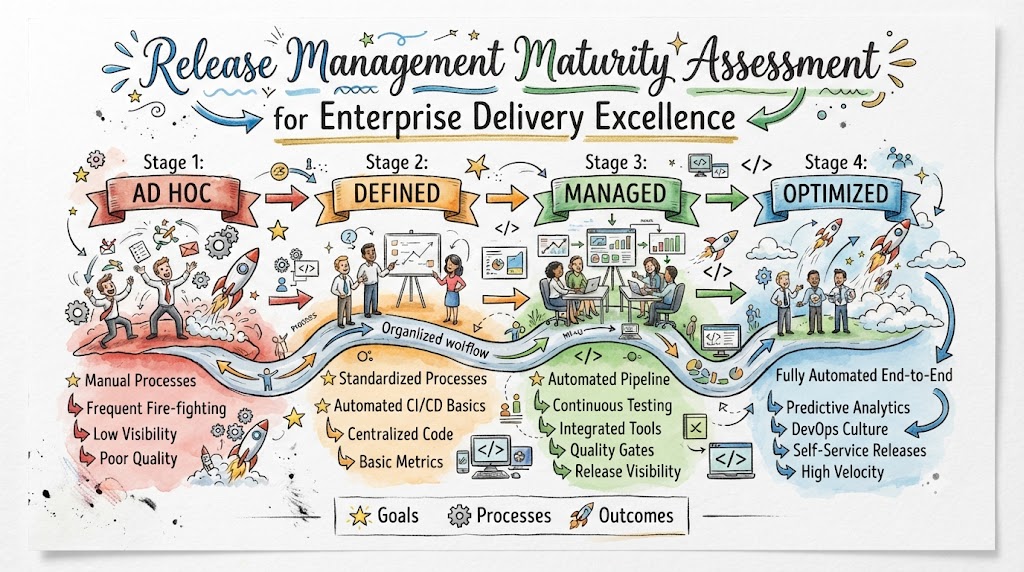
Understanding Release Management Maturity Levels
Release management maturity evolves as organizations standardize processes, strengthen governance, and expand automation.
| Maturity Level | Characteristics |
|---|---|
| Initial | Manual and inconsistent release activities |
| Managed | Basic release planning and governance established |
| Defined | Standardized release processes across teams |
| Automated | Extensive deployment and release automation |
| Optimized | Continuous improvement supported by engineering metrics |
Organizations often mature at different rates across planning, governance, automation, and operational domains, making periodic assessments essential.
Benefits of Conducting a Release Management Maturity Assessment
A structured maturity assessment provides measurable technical and business improvements.
Major benefits include:
- Improved release reliability
- Faster deployment cycles
- Better governance
- Reduced operational risks
- Increased automation
- Stronger compliance
- Improved stakeholder collaboration
- Better deployment visibility
- Reduced production incidents
- Higher customer satisfaction
- Greater operational consistency
- Continuous engineering improvement
These benefits help enterprises deliver software more confidently while supporting long-term business growth.
Who Should Participate in the Assessment?
Release management maturity assessments are most valuable when multiple organizational stakeholders contribute.
Recommended participants include:
- Chief Technology Officers
- Engineering Directors
- Release Managers
- DevOps Engineers
- Platform Engineering Teams
- Software Architects
- Development Managers
- QA Leaders
- Security Teams
- Site Reliability Engineers
- Infrastructure Engineers
- Product Managers
Cross-functional collaboration provides a complete understanding of release maturity and supports organization-wide improvement initiatives.
Best Practices for Improving Release Management Maturity
Organizations should continuously refine release processes rather than treating release management as a fixed operational function.
Recommended best practices include:
- Standardize release planning across teams.
- Automate deployment wherever practical.
- Strengthen release governance and documentation.
- Integrate quality assurance throughout release planning.
- Improve stakeholder communication.
- Monitor production releases continuously.
- Maintain tested rollback procedures.
- Use engineering metrics to improve release performance.
- Review every major release for lessons learned.
- Encourage collaboration across development, operations, security, and business teams.
Following these practices helps organizations achieve reliable software delivery while maintaining business agility.
Frequently Asked Questions About Release Management Maturity Assessment
1. What is a Release Management Maturity Assessment?
A Release Management Maturity Assessment evaluates how effectively an organization manages release planning, governance, automation, deployment, monitoring, compliance, and continuous improvement. It identifies strengths, reveals operational gaps, and provides a roadmap for improving release reliability.
2. Why is release management maturity important?
Mature release management improves deployment consistency, strengthens governance, reduces operational risks, enhances collaboration, supports compliance, and enables organizations to deliver software more predictably and efficiently.
3. Does the assessment focus only on deployment automation?
No. The assessment evaluates planning, governance, quality assurance, change management, stakeholder communication, infrastructure readiness, monitoring, compliance, operational processes, and continuous improvement in addition to automation.
4. How often should organizations perform a release management assessment?
Organizations should perform maturity assessments periodically or after significant organizational, technological, or process changes. Regular evaluations help measure improvement progress and identify emerging operational challenges.
5. What outcomes can organizations expect after completing the assessment?
Organizations typically gain improved release visibility, stronger governance, increased automation opportunities, reduced deployment risks, better collaboration, enhanced operational consistency, improved customer satisfaction, and a prioritized roadmap for continuous release management improvement.
Final Thoughts
Enterprise delivery excellence depends on far more than successful software deployments. It requires disciplined planning, standardized governance, automation, quality assurance, operational visibility, effective collaboration, and continuous learning throughout the release lifecycle. A Release Management Maturity Assessment enables organizations to evaluate these capabilities objectively while identifying practical improvements that strengthen software delivery across the enterprise.
By continuously improving release planning, expanding automation, strengthening governance, integrating quality assurance, and fostering collaboration between development, operations, security, and business teams, organizations can build mature release management capabilities that support reliable software delivery, operational resilience, and sustainable business growth.
