
Introduction
Many people begin investing in the stock market after hearing success stories from friends, social media, or financial news. However, making investment decisions based only on recommendations or market rumors can increase risk and lead to costly mistakes. Successful investing starts with understanding how to research companies, industries, and market trends before investing your hard-earned money.
Stock market research is one of the most important skills every beginner should develop. It helps investors understand how businesses operate, evaluate financial performance, identify potential risks, and make informed decisions based on facts rather than emotions.
Whether you are a student, salaried professional, first-time investor, or beginner trader, learning market research can improve your confidence and decision-making. Educational platforms like StocksMantra.com simplify stock market education by providing beginner-friendly resources on company analysis, investing principles, IPO learning, market research, and financial literacy.
What Is Stock Market Research?
Stock market research is the process of collecting, studying, and analyzing information about companies, industries, financial performance, and market conditions before making investment decisions.
Instead of relying on speculation, research helps investors understand:
- Business performance
- Financial strength
- Industry growth
- Company management
- Market trends
- Economic conditions
- Investment risks
The purpose of research is not to predict the future with certainty but to make better-informed investment decisions.
Why Stock Market Research Is Important
Good research helps investors avoid emotional decisions and improve long-term investment discipline.
Benefits include:
- Better understanding of businesses
- Improved investment confidence
- Reduced dependence on market rumors
- Stronger risk management
- Better comparison between companies
- Long-term investment planning
- More informed financial decisions
Knowledge and preparation often play a bigger role than luck in successful investing.
Building a Strong Research Foundation
Before analyzing individual companies, beginners should understand some basic concepts.
What Is a Stock?
A stock represents partial ownership in a company. Shareholders participate in the company’s growth as well as the risks associated with its business.
What Is Investing?
Investing involves purchasing financial assets with the goal of long-term wealth creation through business growth and value appreciation.
What Is Risk?
Risk refers to the possibility that an investment may lose value because of business, market, or economic factors.
What Is Diversification?
Diversification means spreading investments across different companies or industries to reduce overall portfolio risk.
Key Areas of Stock Market Research
1. Company Research
The first step is understanding the business itself.
Questions to ask include:
- What products or services does the company offer?
- How does it generate revenue?
- Who are its customers?
- What competitive advantages does it have?
- What challenges does it face?
A strong understanding of the business model provides the foundation for better investment analysis.
2. Financial Statement Analysis
Financial statements help investors evaluate the company’s financial health.
The three primary financial statements are:
Balance Sheet
Shows:
- Assets
- Liabilities
- Shareholders’ equity
Income Statement
Explains:
- Revenue
- Expenses
- Operating profit
- Net profit
Cash Flow Statement
Shows how money moves into and out of the business through operating, investing, and financing activities.
Together, these statements provide valuable insights into business performance.
3. Fundamental Analysis
Fundamental analysis evaluates the long-term strength of a company.
It examines:
- Revenue growth
- Profitability
- Cash flow
- Debt levels
- Business model
- Management quality
- Industry outlook
- Company valuation
This approach is commonly used by long-term investors.
4. Technical Analysis
Technical analysis focuses on historical price movements and trading volume.
It helps traders study:
- Price trends
- Support levels
- Resistance levels
- Moving averages
- Candlestick patterns
- Market momentum
While technical analysis is often associated with trading, some investors also use it to identify favorable entry points.
5. Sector Research
Every company operates within a larger industry.
Important sectors include:
- Banking
- Information Technology
- Healthcare
- FMCG
- Automobile
- Infrastructure
- Renewable Energy
- Pharmaceuticals
Understanding sector performance helps investors compare businesses more effectively.
6. Economic Research
Economic conditions can influence stock market performance.
Monitor factors such as:
- Inflation
- Interest rates
- Government policies
- Employment trends
- GDP growth
- Global economic developments
These indicators provide valuable context for investment decisions.
Important Financial Ratios Beginners Should Learn
Financial ratios make it easier to compare companies.
| Financial Ratio | Purpose |
|---|---|
| Price-to-Earnings (P/E) Ratio | Measures valuation |
| Earnings Per Share (EPS) | Indicates company profitability |
| Debt-to-Equity Ratio | Evaluates financial leverage |
| Return on Equity (ROE) | Measures management efficiency |
| Current Ratio | Indicates short-term financial strength |
| Profit Margin | Measures business profitability |
Financial ratios should always be interpreted alongside the company’s industry and business model.
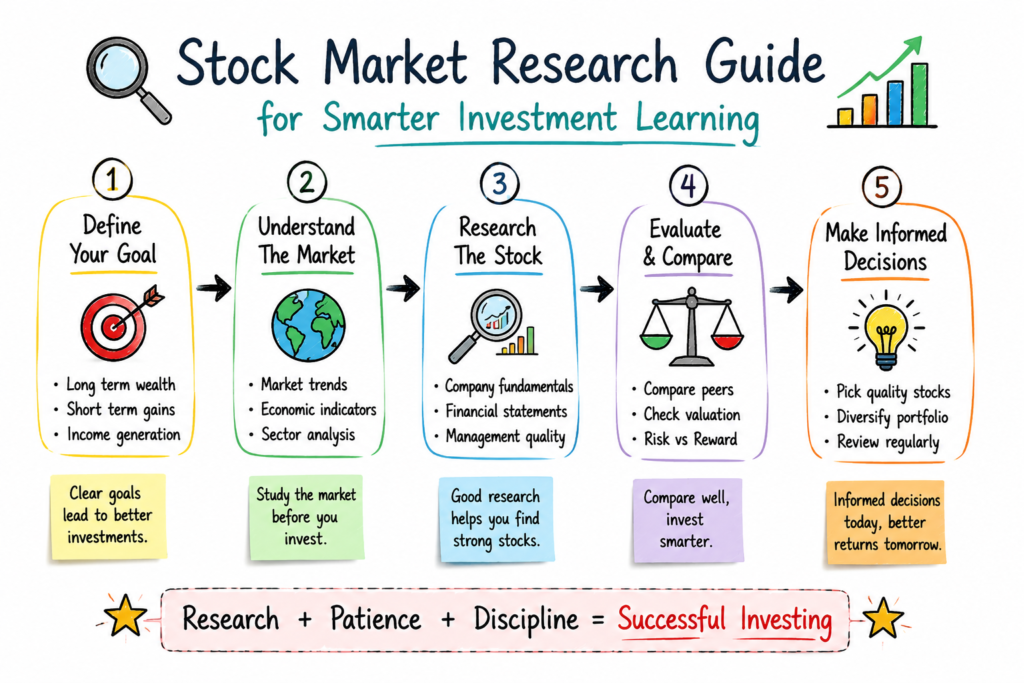
Step-by-Step Stock Market Research Process
A structured approach makes research more effective.
Step 1: Understand the Business
Learn how the company earns revenue and competes in the market.
Step 2: Review Financial Statements
Analyze revenue, profits, debt, cash flow, and overall financial health.
Step 3: Study Industry Trends
Understand market demand, competition, and future growth opportunities.
Step 4: Follow Company News
Stay informed about:
- Quarterly earnings
- Product launches
- Business expansion
- Management changes
Step 5: Evaluate Risk
Every investment has risks. Identify possible challenges before investing.
Step 6: Compare Similar Companies
Comparing businesses within the same industry provides better investment insights.
Research vs Speculation
| Research-Based Investing | Speculation |
|---|---|
| Based on financial analysis | Based on rumors |
| Focuses on long-term growth | Focuses on quick gains |
| Evaluates business quality | Relies on market excitement |
| Considers risk | Often ignores risk |
| Uses company data | Uses assumptions |
Developing research skills encourages more disciplined investing.
Common Mistakes Beginners Should Avoid
Avoid these mistakes when conducting stock market research:
- Investing without understanding the business
- Following stock tips blindly
- Ignoring financial statements
- Looking only at stock prices
- Ignoring company debt
- Overtrading
- Chasing market hype
- Investing borrowed money
- Ignoring diversification
- Failing to review investments regularly
Learning from these mistakes can improve long-term investment success.
How StocksMantra.com Supports Smarter Investment Learning
Building research skills requires continuous education. StocksMantra.com helps beginners simplify stock market learning through educational content that explains investing concepts in an easy-to-understand manner.
The platform covers:
- Stock market education
- Company research
- Fundamental analysis
- Technical analysis
- IPO learning
- Sector insights
- Market research
- Investing strategies
- Financial literacy
- Risk management
Its beginner-focused approach encourages informed decision-making and long-term financial learning rather than speculative investing.
Best Practices for Better Stock Market Research
Build these habits into your investment process:
- Research before investing.
- Read annual and quarterly reports.
- Understand company financials.
- Compare businesses within the same sector.
- Stay informed about market developments.
- Diversify investments.
- Review your portfolio periodically.
- Continue learning as markets evolve.
Frequently Asked Questions
1. What is stock market research?
Stock market research involves studying companies, industries, financial statements, and market conditions before making investment decisions.
2. Why is research important before investing?
Research helps investors understand business quality, financial performance, and potential risks before investing.
3. What should beginners research first?
Start by understanding the company’s business model, financial statements, management, and industry.
4. What is the difference between research and speculation?
Research uses financial data and business analysis, while speculation often relies on rumors or short-term market excitement.
5. Should beginners learn financial statements?
Yes. Financial statements provide valuable insights into a company’s financial health and long-term performance.
6. Is technical analysis part of market research?
Yes. Technical analysis helps traders study price trends and market behavior alongside other research methods.
7. How often should research be updated?
Review company results, annual reports, and important market developments regularly to stay informed.
8. Can research eliminate investment risk?
No. Research improves decision-making but cannot remove market risk completely.
9. How can beginners improve their research skills?
Practice reading company reports, studying industries, comparing businesses, and learning financial concepts consistently.
10. Where can beginners learn stock market research?
Educational platforms like StocksMantra.com provide beginner-friendly resources covering company analysis, investing, market research, IPOs, and financial education.
Conclusion
Stock market research is the foundation of smart investing. By understanding businesses, analyzing financial statements, studying industries, evaluating risks, and following market developments, beginners can make more informed investment decisions with greater confidence.
Rather than relying on speculation or market rumors, focus on building knowledge through continuous education and disciplined research. Resources such as StocksMantra.com make learning easier by providing practical guidance on stock market education, company analysis, investing principles, market research, and financial literacy. Remember, successful investing begins with careful research and informed decision-making.
