
Introduction
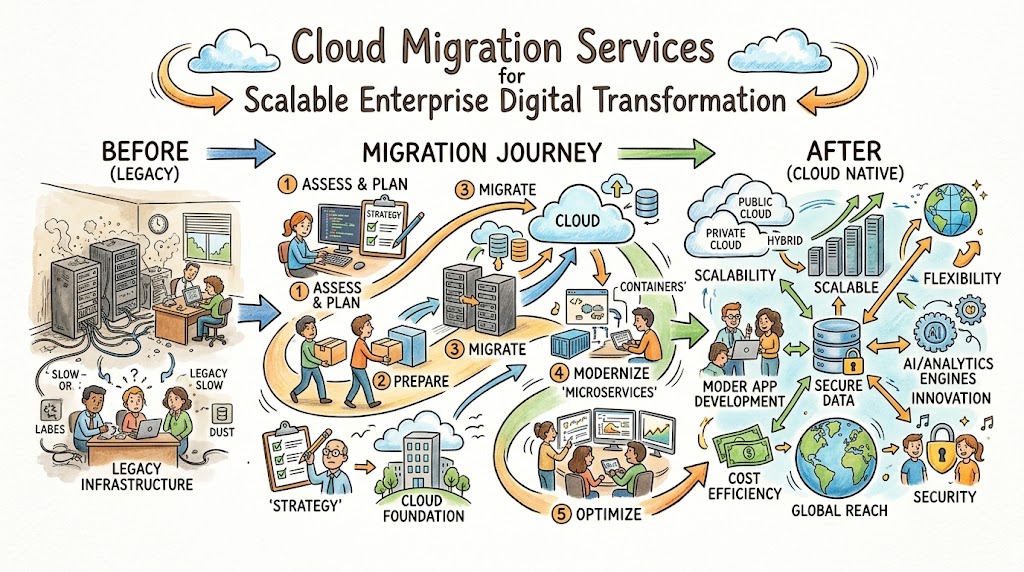
Enterprises today are rapidly moving away from legacy infrastructure as they face increasing pressure to deliver faster, scale efficiently, and innovate continuously. Traditional on-premise systems often struggle with agility, cost optimization, and modern application demands.
Cloud migration has become a foundational step in achieving enterprise digital transformation, enabling organizations to modernize infrastructure, improve resilience, and adopt cloud-native operations.
Cotocus provides structured cloud migration services that help enterprises transition from legacy environments to scalable, secure, and automated cloud ecosystems.
Reference: Cotocus Official Website
Why Enterprises Are Moving Toward Cloud Migration
Modern businesses are adopting cloud migration to overcome limitations of traditional IT systems and unlock new capabilities.
Key drivers include:
- Increasing infrastructure and maintenance costs
- Lack of scalability in legacy systems
- Slow software delivery cycles
- Need for global availability and performance
- Security and compliance challenges
- Demand for automation and faster innovation
Cloud migration is no longer just a technical upgrade—it is a strategic business transformation initiative.
What Cloud Migration Services Include
Cloud migration services involve a structured approach to moving applications, data, and infrastructure to cloud environments while ensuring stability and performance.
Core components include:
- Cloud readiness assessment and planning
- Application dependency mapping
- Migration strategy design (lift-and-shift, re-platform, refactor)
- Data migration and synchronization
- Security architecture alignment
- Post-migration optimization and monitoring
The objective is not only migration but also long-term modernization and operational efficiency.
Cotocus Approach to Cloud Migration
Cotocus follows a structured engineering-driven approach to cloud migration that minimizes risk and maximizes business value.
Assessment Phase
- Infrastructure and application analysis
- Risk identification
- Dependency mapping
Strategy Phase
- Cloud architecture design
- Migration roadmap creation
- Cost and feasibility analysis
Migration Phase
- Step-by-step workload migration
- CI/CD integration for deployment automation
- Infrastructure as Code implementation
Optimization Phase
- Performance tuning
- Security hardening
- Cost governance and monitoring
This ensures enterprises experience smooth transitions without disrupting business operations.
Cloud Consulting Services for Enterprise Modernization
Cloud migration is closely connected with broader cloud consulting capabilities that help enterprises build sustainable cloud strategies.
Key areas include:
- Cloud architecture design across AWS, Azure, and GCP
- Hybrid and multi-cloud strategy planning
- Cloud-native application development
- Infrastructure scalability planning
- Governance and compliance frameworks
- FinOps and cost optimization strategies
These services help organizations move beyond migration into continuous cloud maturity.
DevOps-Driven Cloud Migration
Modern cloud migration is incomplete without DevOps transformation.
Key DevOps integrations include:
- CI/CD pipeline automation
- Infrastructure as Code (Terraform and automation tools)
- Containerization using Docker and Kubernetes
- Automated deployment workflows
- Environment standardization
This ensures cloud environments are repeatable, scalable, and automated rather than manually managed.
Kubernetes and Cloud-Native Adoption
For enterprises adopting microservices, Kubernetes becomes a key enabler in cloud migration.
Capabilities include:
- Containerizing legacy applications
- Kubernetes cluster setup and management
- Workload orchestration and scaling
- High availability architecture
- Monitoring and observability integration
This allows organizations to fully leverage cloud-native architecture benefits.
Security and Compliance in Cloud Migration
Security remains a top priority during enterprise cloud adoption.
Key areas include:
- Identity and access management (IAM)
- Data encryption in transit and at rest
- Compliance with industry regulations
- Network security architecture design
- Continuous vulnerability monitoring
A secure migration ensures business continuity and regulatory compliance.
Cost Optimization and Cloud Governance
Without proper governance, cloud environments can lead to unnecessary spending.
Cloud migration services help with:
- Resource optimization and right-sizing
- Auto-scaling configuration
- Cost tracking and monitoring
- Budget alerts and controls
- Eliminating unused resources
This helps enterprises achieve financial efficiency alongside scalability.
Business Benefits of Cloud Migration
Enterprises adopting cloud migration services gain significant advantages:
- Faster application deployment cycles
- Improved scalability and performance
- Reduced infrastructure costs
- Higher system availability and reliability
- Better global access and user experience
- Increased innovation speed
These outcomes directly support long-term business growth and competitiveness.
Traditional IT vs Cloud-Native Enterprise
| Aspect | Traditional IT | Cloud-Native Enterprise |
|---|---|---|
| Infrastructure | Fixed and manual | Elastic and automated |
| Deployment Speed | Slow and rigid | Fast and continuous |
| Scalability | Limited | On-demand scaling |
| Maintenance | High effort | Managed and automated |
| Cost Model | CapEx-heavy | Pay-as-you-use |
| Innovation Speed | Slow | High |
Service Mapping: Cloud Migration to Business Value
| Service Area | Challenge | Cotocus Approach | Business Outcome |
|---|---|---|---|
| Cloud Migration | Legacy systems | Structured migration plan | Faster modernization |
| Cloud Consulting | Poor architecture | Cloud-native design | Scalable systems |
| DevOps Integration | Manual processes | CI/CD automation | Faster releases |
| Kubernetes Adoption | Container complexity | Orchestration strategy | Efficient workloads |
| Security | Compliance risk | Secure architecture | Reduced risk |
| Cost Optimization | Overspending | FinOps governance | Cost efficiency |
Why Enterprises Choose Cotocus
Organizations trust Cotocus for cloud migration because of:
- Strong expertise in DevOps and cloud-native transformation
- Structured and low-risk migration approach
- Focus on both consulting and execution
- Enterprise-grade security and governance practices
- Integration of DevOps, Kubernetes, and automation
- Real-world corporate training capabilities
- End-to-end digital transformation support
This makes Cotocus a reliable partner for enterprise modernization journeys.
FAQs
1. What are cloud migration services?
They are structured services to move applications and infrastructure from on-premise systems to cloud platforms.
2. Why is cloud migration important for enterprises?
It improves scalability, reduces costs, and enables faster innovation.
3. What are the main types of cloud migration?
Lift-and-shift, re-platforming, and refactoring.
4. How does DevOps support cloud migration?
It automates deployment, infrastructure setup, and operational workflows.
5. Is Kubernetes required for cloud migration?
Not always, but it is important for container-based modern applications.
6. What risks are involved in cloud migration?
Downtime, security gaps, and cost mismanagement if not planned properly.
7. How long does cloud migration take?
It depends on system complexity and strategy.
8. What is cloud migration assessment?
It is the evaluation of applications and infrastructure before migration.
9. How does Cotocus support cloud migration?
Through consulting, migration execution, DevOps integration, and training.
10. Which industries use cloud migration services?
Finance, healthcare, retail, SaaS, manufacturing, and enterprise IT.
Conclusion
Cloud migration is a critical step in enabling enterprise digital transformation. It allows organizations to modernize infrastructure, improve scalability, and accelerate innovation while reducing operational complexity. Cotocus delivers structured cloud migration services that combine strategy, DevOps practices, cloud consulting, and automation to ensure successful enterprise transformation. Reference: Cotocus Official Website For enterprises aiming to build scalable, secure, and future-ready systems, Cotocus provides a trusted pathway to cloud-native transformation.
