
Introduction
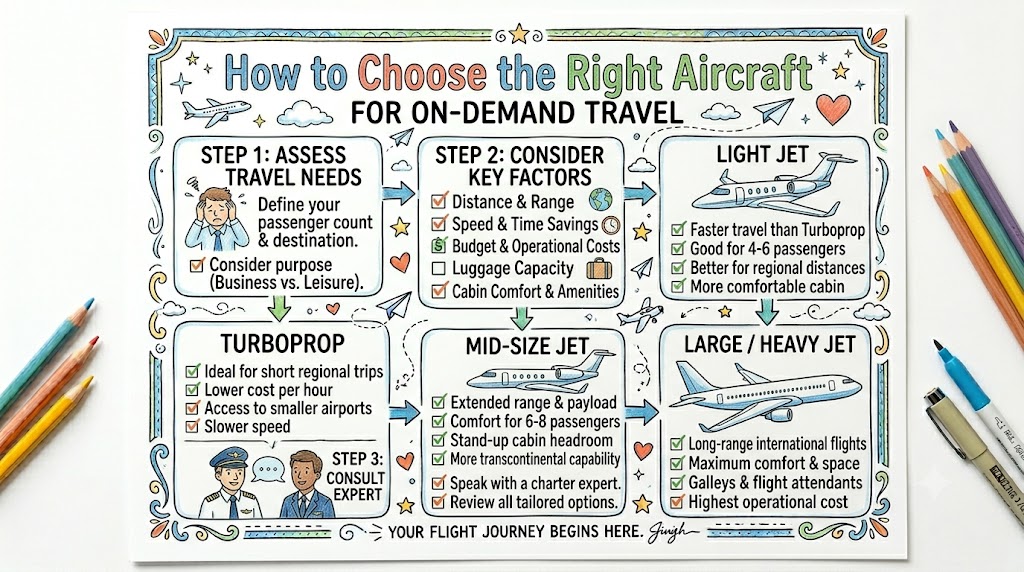
Choosing the right aircraft for on-demand travel is one of the most important decisions in private aviation. Unlike commercial flights, where aircraft selection is fixed, on-demand travel allows passengers to choose from a wide range of jets based on comfort, distance, speed, and budget. However, selecting the wrong aircraft can lead to unnecessary costs, limited comfort, or inefficient travel performance.
Every trip has different requirements. A short regional business flight may only need a light jet, while long international travel may require a heavy jet with extended range and premium amenities. Understanding these differences ensures a smoother, more cost-effective, and comfortable travel experience.
This guide explains how to choose the right aircraft for on-demand travel by breaking down key decision factors, real-world scenarios, and practical selection tips.
Real-world Use Cases
A business executive flying for a same-day meeting chooses a light jet to save time and reduce operational costs for a short regional trip.
A family planning a luxury holiday selects a midsize or heavy jet for extra comfort, luggage space, and in-flight entertainment.
A VIP traveler requiring maximum privacy opts for a heavy jet with private cabin sections and enhanced onboard services.
A corporate team traveling across multiple cities selects an aircraft with optimal seating capacity and flight range.
A medical or urgent traveler prioritizes aircraft availability and speed of deployment over luxury features.
A frequent flyer compares cost vs speed efficiency to select the most economical on-demand aircraft option.
A first-time charter passenger relies on operator guidance to understand jet categories and choose the right aircraft type.
Evaluation Criteria for Aircraft Selection in On-Demand Travel
Before selecting an aircraft, travelers should evaluate:
- Trip distance and flight duration
- Number of passengers traveling
- Budget and cost expectations
- Cabin comfort and luxury needs
- Luggage and cargo requirements
- Airport runway limitations
- Weather and route conditions
- Speed and travel time priorities
- Availability of aircraft in operator fleet
- International travel requirements
- Privacy and security expectations
- Onboard service requirements
These criteria ensure the right balance between cost, comfort, and performance.
Trip Distance and Route Planning Considerations
Distance determines the type of aircraft needed for the journey.
For example, short domestic trips may only require light jets, while intercontinental flights require heavy jets with long-range capability.
Passenger Count and Seating Configuration
The number of passengers directly impacts aircraft selection.
For example, a small group of 2–4 passengers can comfortably use a light jet, while larger groups require midsize or heavy jets.
Cabin Comfort and Luxury Requirements
Comfort level varies significantly between aircraft categories.
For example, heavy jets offer spacious cabins, sleeping areas, and luxury interiors for long flights.
Light Jet vs Midsize vs Heavy Jet Selection
Aircraft categories define performance and comfort levels.
For example, light jets are cost-efficient, while heavy jets provide premium long-distance travel capability.
Fuel Range and Refueling Requirements
Range determines whether a flight requires stops or is nonstop.
For example, long-haul travel needs aircraft with extended fuel capacity to avoid refueling stops.
Airport Runway Compatibility
Not all aircraft can operate from every airport.
For example, smaller jets can access shorter runways, while heavy jets require larger airports.
Luggage Capacity and Baggage Needs
Baggage space varies by aircraft size.
For example, heavy jets accommodate larger luggage loads and specialized equipment.
Speed vs Cost Trade-off
Faster aircraft usually come at higher operating costs.
For example, choosing a supersonic or high-speed jet increases cost but reduces travel time significantly.
Flight Time Optimization
Efficient aircraft selection reduces total travel time.
For example, choosing the right jet type avoids unnecessary stops and delays.
Weather and Performance Considerations
Aircraft performance varies based on weather conditions.
For example, larger jets handle turbulence better than smaller light jets.
Onboard Amenities and Services
Amenities differ widely across aircraft categories.
For example, heavy jets offer Wi-Fi, sleeping areas, and full catering services.
Aircraft Availability for On-demand Travel
Availability plays a key role in urgent travel planning.
For example, operators may suggest nearby aircraft based on fleet positioning.
Empty Leg Flight Opportunities
Empty leg flights provide cost savings for flexible travelers.
For example, passengers can book returning flights at reduced rates if schedules match.
Privacy and Security Preferences
Privacy needs influence aircraft choice.
For example, VIP travelers prefer aircraft with private cabins and restricted access.
International vs Domestic Travel Requirements
International travel requires larger, long-range aircraft.
For example, cross-border flights often need additional fuel capacity and compliance readiness.
Operator Fleet Availability and Positioning
Aircraft selection depends on operator availability.
For example, the nearest available jet may be chosen for urgent bookings.
Crew Experience and Aircraft Type Familiarity
Experienced crews improve safety and performance.
For example, pilots familiar with specific aircraft types ensure smoother operations.
Noise Levels and Passenger Comfort
Cabin noise impacts passenger experience.
For example, heavy jets provide quieter cabins for long-haul comfort.
Light Jet vs Midsize Jet vs Heavy Jet Comparison
| Factor | Light Jet | Midsize Jet | Heavy Jet |
|---|---|---|---|
| Range | Short | Medium | Long |
| Cost | Low | Moderate | High |
| Comfort | Basic | Good | Premium |
| Cabin Size | Small | Medium | Large |
Cost Efficiency vs Luxury Comfort
| Factor | Cost Efficiency | Luxury Comfort |
| Aircraft Type | Light Jet | Heavy Jet |
| Pricing | Lower | Higher |
| Amenities | Limited | Extensive |
| Experience | Basic | Premium |
Short-haul vs Long-haul Aircraft Suitability
| Factor | Short-haul | Long-haul |
| Jet Type | Light Jet | Heavy Jet |
| Range | Limited | Extended |
| Comfort Needs | Moderate | High |
Empty Leg vs Full Charter Selection
| Factor | Empty Leg | Full Charter |
| Cost | Lower | Higher |
| Flexibility | Limited | High |
| Availability | Fixed | On-demand |
Benefits of Choosing the Right Aircraft
Selecting the right aircraft helps travelers:
- Optimize travel costs
- Improve comfort and experience
- Reduce travel time
- Ensure flight efficiency
- Improve baggage handling
- Enhance privacy and security
- Avoid operational delays
- Increase flexibility
- Improve trip planning accuracy
- Ensure better travel outcomes
Practical Tips for Aircraft Selection
- Match aircraft type with trip distance
- Consider passenger count first
- Balance cost and comfort needs
- Check operator fleet availability
- Ask about empty leg options
- Confirm baggage capacity
- Communicate requirements clearly
Common Mistakes to Avoid
- Choosing oversized aircraft unnecessarily
- Ignoring baggage limitations
- Overlooking runway restrictions
- Focusing only on cost
- Not considering flight range
- Booking without operator consultation
FAQs
1. How do I choose the right aircraft for on-demand travel?
You should consider distance, passengers, budget, and comfort requirements before selecting an aircraft.
2. What is the difference between light and heavy jets?
Light jets are for short trips, while heavy jets are designed for long-range international travel.
3. Does aircraft type affect pricing?
Yes, larger and faster jets cost significantly more than smaller aircraft.
4. Which aircraft is best for short trips?
Light jets are ideal for short regional or domestic travel.
5. Which aircraft is best for long flights?
Heavy jets are best suited for long-haul and international travel.
6. How does passenger count affect selection?
More passengers require larger aircraft with higher seating capacity.
7. What is an empty leg flight?
It is a discounted flight when an aircraft returns empty after a trip.
8. Can aircraft be changed after booking?
Yes, but it depends on availability and operator flexibility.
9. Does baggage affect aircraft choice?
Yes, larger baggage requirements need bigger aircraft.
10. What is the best tip for first-time travelers?
Always consult the operator and match aircraft type with your travel needs.
Conclusion
Choosing the right aircraft for on-demand travel is essential for balancing cost, comfort, and performance. Every journey has unique requirements, and selecting the correct jet ensures a smooth and efficient travel experience. From light jets for short trips to heavy jets for long international travel, understanding aircraft categories helps passengers make better decisions. With proper planning and operator guidance, travelers can enjoy a seamless, comfortable, and highly efficient private aviation experience.
