
Introduction
Booking an on-demand private jet for the first time can feel exciting, but also slightly overwhelming. Unlike commercial flights, private aviation operates with different procedures, faster timelines, and more personalized services. First-time flyers often have questions about boarding, baggage, documentation, and what to expect before and during the journey.
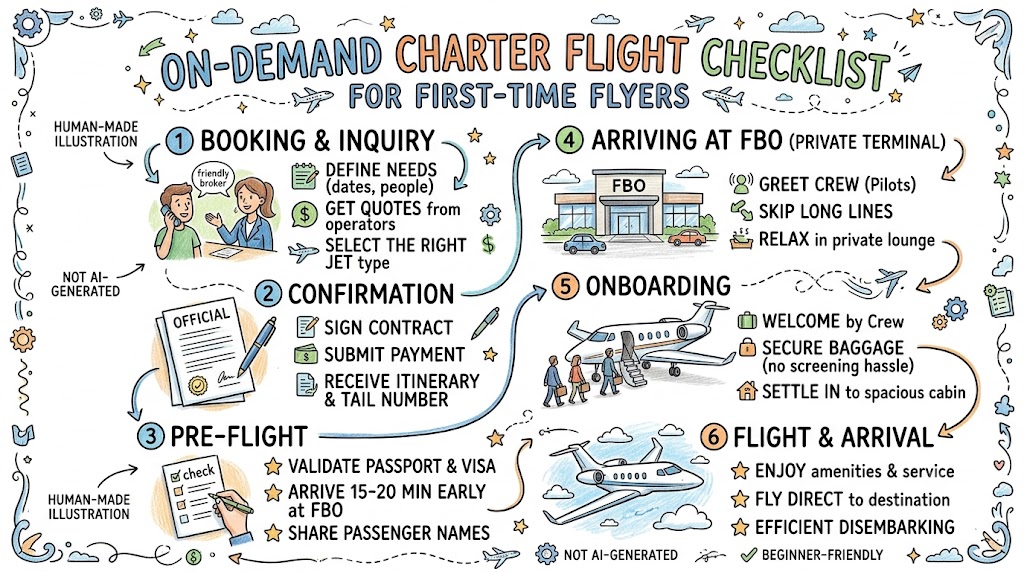
This is where a clear on-demand charter flight checklist becomes essential. It helps passengers prepare in advance, avoid confusion, and enjoy a smooth, stress-free experience from booking to landing. Whether you are traveling for business, leisure, or an emergency trip, understanding each step ensures confidence and comfort when flying private for the first time.
Real-world Use Cases
A first-time business traveler booking a private jet may need quick guidance on documentation and airport procedures before an urgent meeting.
A family traveling privately for the first time may want clarity on baggage rules, seating arrangements, and boarding process differences.
A VIP traveler transitioning from commercial flights may need reassurance about privacy, security, and onboard experience.
A corporate team using on-demand charter for urgent travel must coordinate schedules, passenger lists, and onboard requirements efficiently.
A medical emergency traveler may require fast coordination of documents, departure timing, and ground transport.
A luxury traveler planning a short-notice trip benefits from understanding pricing, aircraft selection, and boarding expectations.
A beginner unfamiliar with private terminals (FBOs) may need step-by-step clarity on arrival and check-in procedures.
Evaluation Criteria for First-Time Charter Flight Preparation
Before flying, first-time passengers should evaluate:
- Booking confirmation accuracy
- Aircraft type and suitability
- Passenger documentation readiness
- Baggage allowance details
- Airport and FBO location
- Boarding process understanding
- Payment confirmation clarity
- Weather and route awareness
- Special service requests
- Safety briefing expectations
- Operator communication clarity
- Ground transport coordination
These factors ensure a smooth and well-prepared private aviation experience.
Booking Confirmation and Flight Scheduling
The first step is confirming your booking details, including departure time, aircraft type, and route.
For example, a traveler booking a same-day flight should double-check timing and aircraft availability to avoid last-minute confusion.
Aircraft Type Selection
Choosing the right aircraft affects comfort, range, and pricing.
For example, a short regional trip may use a light jet, while a long international journey may require a heavy jet.
Passenger Identification and Documentation
Even private flights require valid identification and travel documents.
For example, international passengers must carry passports and any required visas before departure.
Baggage Allowance and Restrictions
Private jets offer more flexibility, but baggage limits still depend on aircraft size.
For example, a small jet may not accommodate oversized luggage or sports equipment.
Airport and Private Terminal (FBO) Details
Private flights operate from FBOs (Fixed Base Operators), not commercial terminals.
For example, passengers may arrive at a private terminal where boarding is quick and hassle-free.
Security and Boarding Process Differences
Security checks are simpler and faster compared to commercial flights.
For example, passengers often board within minutes instead of waiting in long queues.
Arrival Timing Recommendations
Passengers should still arrive early, even for private flights, to complete necessary checks.
For example, arriving 20–30 minutes before departure is usually sufficient.
In-flight Safety Briefing Expectations
A safety briefing is provided before departure to ensure passenger awareness.
For example, crew members explain seatbelts, emergency procedures, and cabin features.
Weather and Route Flexibility Awareness
Private flights may adjust routes based on weather conditions.
For example, pilots may choose an alternate route for smoother and safer flying.
On-demand Schedule Change Policies
On-demand flights allow more flexibility, but changes depend on aircraft availability.
For example, departure time may be adjusted if crew schedules allow.
Crew and Operator Communication
Clear communication with operators ensures smooth coordination.
For example, passengers can request catering, seating preferences, or timing updates in advance.
In-flight Catering and Special Requests
Private aviation allows customized meals and onboard services.
For example, passengers can request vegetarian meals or specific beverages before departure.
Emergency Contact and Support Procedures
Operators provide contact support in case of last-minute changes or issues.
For example, passengers can quickly reach support if travel plans change unexpectedly.
Luggage Handling and Loading Process
Luggage is handled directly by ground staff and loaded into the aircraft.
For example, passengers do not need to carry bags through terminals themselves.
Payment Confirmation and Pricing Breakdown
Before travel, passengers should understand the full cost breakdown.
For example, pricing may include aircraft time, fuel, and airport charges.
Aircraft Safety and Certification Verification
Always ensure the aircraft meets required safety and operational standards.
For example, certified operators follow strict maintenance and inspection schedules.
Ground Transportation Coordination
Private travel often includes coordination between airport and final destination.
For example, a car may be arranged to meet passengers directly at the aircraft.
Pet Travel Rules (If Applicable)
Many private flights allow pets onboard, but rules vary.
For example, small pets may travel in the cabin with proper arrangements.
International Travel Requirements
International private flights may require additional documentation and customs clearance.
For example, passengers must ensure passport validity and entry permissions.
On-Demand Charter vs Commercial Flights
| Factor | On-Demand Charter | Commercial Flights |
|---|---|---|
| Boarding | Fast and private | Long queues |
| Flexibility | High | Low |
| Privacy | Full | Limited |
| Airports | Multiple options | Major airports only |
First-Time Private Jet vs Regular Airline Travel
| Factor | Private Jet | Commercial Airline |
| Experience | Personalized | Standardized |
| Time Efficiency | High | Lower |
| Comfort | Premium | Varies |
| Security Process | Simplified | Strict and time-consuming |
Light Jet vs Heavy Jet for Beginners
| Factor | Light Jet | Heavy Jet |
| Range | Short-medium | Long-haul |
| Cabin Size | Smaller | Larger |
| Cost | Lower | Higher |
| Comfort | Good | Excellent |
FBO vs Commercial Airport Experience
| Factor | FBO Terminal | Commercial Airport |
| Waiting Time | Minimal | Long |
| Crowds | Low | High |
| Boarding | Direct | Process-heavy |
| Privacy | High | Low |
Benefits of Following a Checklist
Using a checklist helps first-time flyers:
- Reduce travel stress
- Improve preparation confidence
- Avoid booking mistakes
- Ensure smooth boarding
- Save time during travel
- Improve communication with operators
- Enhance safety awareness
- Make travel more predictable
- Reduce uncertainty
- Improve overall experience
Practical Tips for First-Time Flyers
- Confirm all booking details twice
- Prepare documents in advance
- Understand baggage limits early
- Communicate preferences clearly
- Arrive at FBO on time
- Ask questions before departure
- Choose suitable aircraft type
Common Mistakes to Avoid
- Arriving without proper documentation
- Ignoring baggage limitations
- Not confirming aircraft details
- Assuming airline procedures apply
- Forgetting to check weather conditions
- Overlooking operator communication
FAQs
1. What is an on-demand charter flight checklist?
It is a preparation guide that helps first-time flyers understand all steps before traveling on a private jet.
2. Do I need documents for private jet travel?
Yes, identification and travel documents are still required, especially for international flights.
3. How early should I arrive?
Usually 20–30 minutes before departure is sufficient for private flights.
4. Is baggage limited on private jets?
Yes, but limits are more flexible and depend on aircraft size.
5. What is an FBO?
An FBO is a private terminal used for boarding and handling private flights.
6. Can I bring pets?
Yes, most private jets allow pets, but rules vary by operator.
7. Can flight times change?
Yes, but changes depend on aircraft availability and scheduling.
8. Are private jets safer?
Private aviation follows strict safety standards and maintenance procedures.
9. What happens during boarding?
Boarding is fast and simple at private terminals with minimal procedures.
10. Is catering available?
Yes, meals and drinks can be customized based on passenger preferences.
Conclusion
An on-demand charter flight checklist is essential for first-time flyers to ensure a smooth and stress-free private aviation experience. From booking confirmation to boarding at a private terminal, every step becomes easier when travelers know what to expect. With proper preparation, passengers can enjoy faster boarding, personalized service, and a highly flexible travel experience. By following a structured checklist, first-time flyers can confidently navigate private aviation and fully enjoy the convenience and comfort of on-demand charter travel.
