
Introduction
Modern IT systems are no longer simple, predictable environments. Today’s enterprise infrastructure runs on cloud platforms, microservices, Kubernetes clusters, distributed applications, APIs, and hybrid environments. This complexity has made traditional IT operations reactive, overloaded, and slow in handling incidents.
AIOps (Artificial Intelligence for IT Operations) changes this model by applying machine learning, data analytics, and automation to IT operations workflows. It helps teams detect anomalies faster, reduce alert noise, correlate events across systems, and identify root causes automatically. The result is a shift from reactive firefighting to proactive and predictive operations.
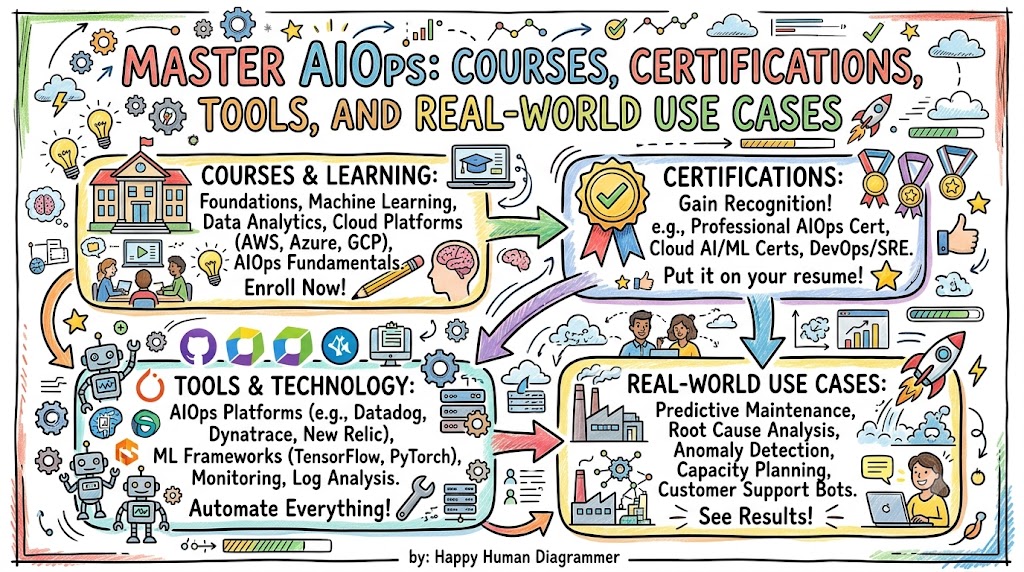
For professionals, mastering AIOps is becoming essential. Organizations now expect engineers to understand observability, automation, and intelligent incident management. This guide breaks down everything you need to master AIOps: learning paths, certifications, tools, and real-world use cases.
What is AIOps in Simple Terms
AIOps is the use of AI and machine learning to improve IT operations by:
- Collecting and analyzing logs, metrics, and traces
- Detecting abnormal system behavior
- Grouping related alerts into single incidents
- Identifying root causes automatically
- Triggering automated remediation workflows
In simple terms, AIOps helps IT teams answer three critical questions faster:
- What is broken?
- Why did it break?
- How do we fix it automatically?
Why AIOps Matters in Modern IT Operations
AIOps has become essential due to the explosion of complexity in IT systems.
Key challenges it solves:
- Thousands of alerts per minute in large systems
- Difficulty in identifying root causes across distributed services
- Manual incident triaging and slow response times
- High downtime costs in mission-critical applications
Business impact:
- Reduced Mean Time to Detect (MTTD)
- Reduced Mean Time to Resolve (MTTR)
- Improved system uptime and reliability
- Lower operational costs
- Better customer experience
AIOps is now a core capability in DevOps, SRE, and cloud engineering teams.
AIOps Learning Path: Courses and Skills You Need
To master AIOps, you need structured learning across four major areas.
1. Foundations of IT Operations
Before AIOps, you must understand:
- Linux and system administration basics
- Networking fundamentals
- Cloud computing concepts
- Application deployment models
2. Observability Fundamentals
Modern AIOps is built on observability:
- Logs (system and application logs)
- Metrics (CPU, memory, latency, throughput)
- Traces (request flow across services)
Tools like:
- Prometheus
- Grafana
- ELK Stack
3. DevOps and Automation
AIOps is deeply connected with DevOps practices:
- CI/CD pipelines
- Infrastructure as Code
- Container orchestration (Kubernetes)
- Automation scripts
4. AI and Machine Learning Basics
You don’t need to be a data scientist, but you should understand:
- Anomaly detection concepts
- Time series analysis
- Classification and clustering basics
- Predictive modeling concepts
Recommended AIOps Course Structure
A strong AIOps course typically includes:
Module 1: Introduction to AIOps
- Evolution from traditional IT ops
- Core principles of AIOps
Module 2: Data Collection & Observability
- Logs, metrics, traces
- Data pipelines in IT operations
Module 3: Machine Learning for AIOps
- Anomaly detection techniques
- Pattern recognition in system behavior
Module 4: Event Correlation & Noise Reduction
- Alert grouping techniques
- Incident prioritization
Module 5: Automation & Remediation
- Auto-healing systems
- Workflow automation
Module 6: Real-World Projects
- Monitoring distributed systems
- Building AIOps dashboards
- Incident root cause analysis
AIOps Certifications: Career Path & Value
AIOps certifications validate your ability to work with intelligent IT systems.
Why certification matters:
- Validates skills in AI-driven operations
- Improves job opportunities in DevOps and SRE roles
- Helps transition into cloud and platform engineering roles
- Builds credibility in enterprise IT environments
Common certification focus areas:
- AIOps fundamentals
- Observability and monitoring systems
- Automation workflows
- Incident management practices
- Cloud-native operations
While certification alone is not enough, it strengthens your profile when combined with hands-on experience.
Top AIOps Tools You Should Know
Mastering tools is critical for real-world AIOps expertise.
1. Splunk
- Strong log analytics and monitoring capabilities
- Advanced event correlation
- Widely used in enterprise environments
2. Datadog
- Unified observability platform
- AI-driven alerting and anomaly detection
- Excellent cloud-native integration
3. Dynatrace
- Strong AI-based root cause analysis
- Automatic dependency mapping
- Real-time performance monitoring
4. New Relic
- Full-stack observability
- Intelligent alerting and dashboards
- Application performance monitoring
5. IBM (IBM Watson AIOps)
- AI-powered incident management
- Event correlation across systems
- Enterprise-grade automation
6. Prometheus
- Open-source monitoring system
- Time-series metrics collection
- Highly flexible for cloud environments
7. Grafana
- Visualization and analytics dashboards
- Integrates with multiple data sources
- Widely used in DevOps pipelines
8. Elastic Stack (ELK)
- Log aggregation and analysis
- Powerful search capabilities
- Real-time log monitoring
9. Moogsoft
- Intelligent event correlation
- Noise reduction in alerts
- Focus on incident management
10. BigPanda
- AIOps event correlation platform
- Incident consolidation
- Automated alert grouping
Real-World Use Cases of AIOps
1. Incident Detection and Alert Management
AIOps reduces alert noise by grouping related alerts into a single incident, helping teams focus only on critical issues.
2. Root Cause Analysis
Instead of manually checking logs across systems, AIOps identifies the root cause automatically using correlation patterns.
3. Predictive Infrastructure Monitoring
AIOps predicts system failures based on historical data trends and triggers preventive actions.
4. Cloud Cost Optimization
AIOps identifies underutilized resources and helps optimize cloud spending.
5. Application Performance Monitoring
Detects slow APIs, bottlenecks, and latency issues in real time.
6. Security Event Correlation
Correlates security logs to detect suspicious activity or potential breaches.
AIOps Career Roles You Can Target
Mastering AIOps can lead to multiple career paths:
- AIOps Engineer
- DevOps Engineer
- Site Reliability Engineer (SRE)
- Cloud Operations Engineer
- Platform Engineer
- Observability Engineer
These roles are in high demand due to increasing cloud adoption.
AIOps Skill Stack Summary
To become job-ready, focus on:
- Observability tools (Prometheus, Grafana, Datadog)
- Cloud platforms (AWS, Azure, GCP)
- Automation (Terraform, Ansible)
- Containers (Docker, Kubernetes)
- Basic ML concepts for anomaly detection
- Incident management workflows
Future of AIOps
AIOps is evolving rapidly into fully autonomous IT operations.
Key trends:
- Self-healing systems
- AI-driven incident prediction
- Autonomous cloud operations
- Deep integration with DevSecOps
- Unified observability platforms
The future goal is minimal human intervention in routine IT operations.
FAQs
1. What is AIOps in simple terms?
AIOps is the use of artificial intelligence to automate and improve IT operations. It helps detect issues faster and reduce manual effort in managing complex systems.
2. Is AIOps difficult to learn?
AIOps is moderate in difficulty. You need basic IT, cloud, and DevOps knowledge, along with some understanding of AI concepts.
3. What skills are required for AIOps?
You need knowledge of cloud computing, monitoring tools, DevOps practices, and basic machine learning concepts.
4. What jobs use AIOps skills?
Roles like DevOps Engineer, SRE, Cloud Engineer, and AIOps Engineer commonly use AIOps skills.
5. Do I need coding for AIOps?
Basic scripting knowledge (Python or shell scripting) is helpful but not always mandatory.
6. What are the best AIOps tools?
Popular tools include Datadog, Dynatrace, Splunk, New Relic, and IBM Watson AIOps.
7. How does AIOps reduce downtime?
It detects anomalies early, correlates alerts, and identifies root causes faster than manual methods.
8. Is AIOps part of DevOps?
Yes, AIOps is an extension of DevOps that adds AI-driven intelligence to operations.
9. Can beginners learn AIOps?
Yes, beginners can start with basic IT operations and gradually move into observability and automation.
10. What is the future of AIOps?
The future includes autonomous IT systems that self-heal and self-optimize with minimal human intervention.
Conclusion
AIOps is transforming the way modern IT operations work by introducing intelligence, automation, and predictive capabilities into complex systems. As infrastructure continues to grow across cloud and hybrid environments, AIOps becomes essential for maintaining reliability, performance, and scalability. By mastering AIOps courses, certifications, and tools, professionals can position themselves for high-demand roles in DevOps, SRE, and cloud engineering. The combination of observability, automation, and AI-driven insights makes AIOps one of the most important skills in modern IT careers.
